 When fat people try to get clothes that fit us, there are several levels of oppression that we might face:
No Clothes For You
The first is companies and lines who simply don’t bother to make clothes to fit us. They know fat people exist, they are fully capable of making clothing in larger sizes, but they just don’t.
We’ll Take Your Money, But Keep Your Fat Ass Out Of Our Store
These are companies that make our sizes, but don’t carry them in the stores – this even happens in stores that specifically cater to larger sizes (ie: Lane Bryant sells “extended sizes” or, as I like to call them, sizes, only online. Their lingerie brand, Cacique, doesn’t fit sizes larger than a 28, but instead of expanding their sizing up, they decided to expand it down to serve the population already served by almost every other brand that exists.)
Not only is this dehumanizing, it’s expensive. Sizes aren’t consistent, even within individual brands, and it’s often hard to tell how something will look on you until you’ve tried it on (especially since many “plus size” models aren’t even big enough to fit into the clothes they are modeling.) So instead of going into a store and trying on four different pant/shirt outfits in three sizes each to find the right one, we would have to pay for all 24 items upfront, and pay for shipping.
The Fat Tax
The fat tax happens when they charge more for clothing in larger sizes. People (including some fat people – internalized oppression is real) tend to bend over backward to justify this, but it is simply wrong.
Defenses include that it’s more difficult to make larger “women’s” clothes. It’s more fabric, blah blah blah bolt size, blah blah blah whatever.
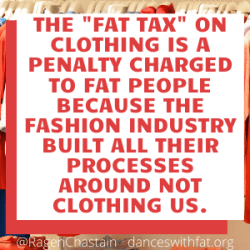
The idea that larger sizes should cost more because they are currently more difficult to make is literally charging fat people a penalty because the fashion industry built all their systems and processes around not bothering to clothe us. We’ve always existed, and we’ve always existed with less access to clothing. Fixing that is the right thing to do, charging us more to fix a history of exclusion is not.
When it comes to extra fabric, I think it’s hard to defend the idea that size 00 -size 14 are the same price, but a size 16 should cost $15 more due to the extra fabric.
But don’t just take my word for it, reader Dayna R (aka @knitwrit15) did the math:
A 12/14 is not so much different than a 2/4. Don’t believe me? I ran the numbers. Size charts from clothing companies vary vastly, so I’m using the Craft Yarn Council size chart for women.
Assuming XS is size 0-2, the L would be size 12/14. The difference between the waist sizes is 34 minus 24, so 10 inches. If waists were perfect circles and the two circles were overlaid using the same center point, the difference in radii between the larger and smaller would be 5.41 minus 3.82, which is 1.59. So there’s only a 2” difference from the edge of one waist to the edge of the other waist. That’s a total of only 4″ if a point on each circle were aligned with the other.
If I were sewing a pair of pants for these two sizes, I’d add 2.5” to the four seams of the XS to fit the waist of the L. There’s a 10-inch difference in the circumferences of 3X and L, so it’s the same as between XS and L.
It’s not that much at all.
Even if it was a lot, it’s still not right. The actual solution here is incredibly simple, and it’s easy to implement because it’s what they are already doing for so-called “straight sizes” – which is to take the cost of each size, and average it across all sizes so that everyone pays the same amount for the same piece of clothing.
Fair is fair and just like a size 00, 5, 10, and 14 should (and do!) all pay the same price, so should people who are sizes above that. It’s time for people who happen to be smaller to stop feeling (and being) entitled to more and cheaper clothing that those who happen to be larger, and it’s time for those selling clothing to stop penalizing us financially as part of their process of no longer excluding us.
David’s Bridal has already gotten rid of the fat tax, other brands, lines, and stores need to follow suit.
Was this helpful? If you appreciate the work that I do, you can support my ability to do more of it with a one-time tip or by becoming a member. (Members get special deals on fat-positive stuff, a monthly e-mail keeping them up to date on the work their membership supports, and the ability to ask me questions that I answer in a members-only monthly Q&A Video!)
Like this blog? Here’s more cool stuff:
Price: $25.00 ($10 for DancesWithFat members – register on the member page)
This e-course that includes coaching videos, a study guide, and an ebook with the tools you need to create a rock-solid relationship with your body. Our relationships with our bodies don’t happen in a vacuum, so just learning to see our beauty isn’t going to cut it. The world throws obstacles in our way – obstacles that aren’t our fault, but become our problem. Over the course of this program, Ragen Chastain, Jeanette DePatie, and six incredible guest coaches will teach you practical, realistic, proven strategies to go above, around, and through the obstacles that the world puts in front of you when it comes to living an amazing life in the body you have now.
Price: $99.00
($79.00 for DancesWithFat members – register on the member page)
Love It! 234 Inspirations And Activities to Help You Love Your Body
This is filled with thoughtful advice from the authors Jeanette DePatie, Ragen Chastain, and Pia Sciavo-Campo as well as dozens of other notable names from the body love movement, the book is lovingly illustrated with diverse drawings from size-positive artist Toni Tails.
Price: $9.99 softcover, $7.99 Kindle, ($6.95 + free shipping for DancesWithFat Members)
Non-Members click here for all the details and to register!
Book and Dance Class Sale! I’m on a journey to complete an IRON-distance triathlon, and I’m having a sale on all my books, DVDs, and digital downloads to help pay for it. You get books and dance classes, I get spandex clothes and bike parts. Everybody wins! If you want, you can check it out here! (DancesWithFat Members get an even better deal, make sure to make your purchases from the Members Page!)
Book Me! I’d love to speak to your organization. You can get more information here or just e-mail me at ragen at danceswithfat dot org!
I’m (still!) training for an Iron-distance triathlon! You can follow my journey at www.IronFat.com .
If you are uncomfortable with my offering things for sale on this site, you are invited to check out this post.
 The Vague Future Health Threat is something that I first wrote about almost a decade ago. But it’s still going on, and it came up in conversation today, so I’m writing about it again today!
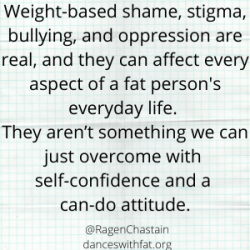 To be a fat person in this fatphobic culture is to be constantly mistreated, and then blamed for that mistreatment. If you don’t want to be the victim of institutional oppression we’re told, you should stop being fat. (As a queer person who came out in Texas in the mid-90’s this is a familiar refrain – if you don’t want to be gay-bashed, stop being gay…)
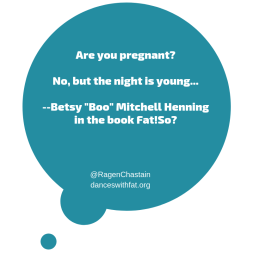 Here’s the next installment of my series of comebacks to the fatphobic nonsense we have to deal with. If you have a phrase you’d like me to create a comeback for, or if you have a comeback that you love, please leave them in the comments! (
 I recently wrote about the dangerous downsides of dieting, including eating disorders. I saw a post that clearly illustrates one of the issues from
 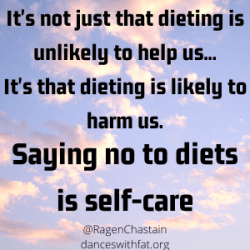 We hear a lot about how
 Reader Jen let me know about a
  Let’s say you’re a doctor who learns that in WW1, munitions workers who were exposed to 2,4-dinitrophenol (DNP) began sweating profusely, experienced stomach pain, weakness, and diarrhea, yellowed skin, weight loss, fevers at and over 104 degrees Fahrenheit, confusion, agitation, unconsciousness and then death.
 One of the reasons most commonly given for refusing to treat fat people with basic human respect, or to represent fat people in the media as happy, or successful at anything other than weight loss, is that fat people aren’t “prioritizing our health” and thus deserve to be treated poorly and denied positive media representation.
 Christian Siriano is a designer who has made a name for himself designing for, among others, plus-size clients. You may remember that him for his work with Lizzo, and as
  Dances With Fat