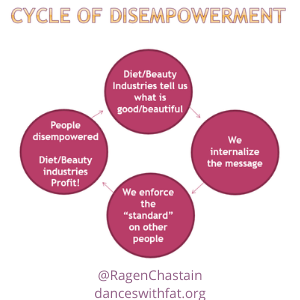
 The diet and beauty industries don’t stumble into making billions of dollars. They employ very specific strategies, one of which is their cycle of disempowerment.
The cycle goes like this:
Step 1: They Create The Message
The diet and beauty industries tell us what is good/beautiful based on the products they sell (essentially, they create “problems” out of things that are completely normal – fat bodies, grey hair, wrinkles etc. – and then sell “solutions”)
This happens through a lot of different mediums – advertisements, billboards, fashion magazines and more. We are told sold a stereotype of beauty rooted in white, thin cisgender, able-bodiedness.
Step 2: We Internalize The Message
We start to believe that the (completely made up) stereotype of beauty is reality. We start to believe that bodies, and people, are better the more closely they approximate the stereotype. We even start to believe that only people who can fit the stereotype of beauty can be talented.
Step 3: We Enforce The “Standard” On Other People
This happens in so many ways. It happens when we engage in negative body talk against other people. It happens when we care more about what an actor is wearing than the work she did that got her nominated for an award in the first place. It happens when we insist that people should dress in “flattering” ways (which is to say using clothes the create the optical illusion that we look closer to the stereotype of beauty.) In this way we become walking, talking, peer-pressuring advertisements for the diet and beauty industries.
Step 4: People Are Disempowered, The Diet And Beauty Industry Profit
This cycle is incredibly profitable for the people who sell the promise of bringing us closer to the stereotype because, as my friend Courtney Legare likes to say, they are in the business of stealing our self-esteem, cheapening it, and selling it back to us at a profit.
We can break the cycle though, and we can do it in a lot of ways. We can stop engaging in negative body talk of any kind, we can interrupt other people when they start engaging in negative body talk (or we can just walk away.) We can examine our own prejudices and privilege as they relate to people who fall outside of the stereotype of beauty. We can purposefully celebrate bodies that fall outside of the stereotype in everything from our social media feeds to the art we have in our homes. We can ask ourselves if the things that we buy, the bodies we celebrate, and the choices we make are supporting or challenging the current paradigm.
Was this helpful? If you appreciate the work that I do, you can support my ability to do more of it with a one-time tip or by becoming a member. (Members get special deals on fat-positive stuff, a monthly e-mail keeping them up to date on the work their membership supports, and the ability to ask me questions that I answer in a members-only monthly Q&A Video!)
Like this blog? Here’s more cool stuff:
Price: $25.00 ($10 for DancesWithFat members – register on the member page)
This e-course that includes coaching videos, a study guide, and an ebook with the tools you need to create a rock-solid relationship with your body. Our relationships with our bodies don’t happen in a vacuum, so just learning to see our beauty isn’t going to cut it. The world throws obstacles in our way – obstacles that aren’t our fault, but become our problem. Over the course of this program, Ragen Chastain, Jeanette DePatie, and six incredible guest coaches will teach you practical, realistic, proven strategies to go above, around, and through the obstacles that the world puts in front of you when it comes to living an amazing life in the body you have now.
Price: $99.00
($79.00 for DancesWithFat members – register on the member page)
Love It! 234 Inspirations And Activities to Help You Love Your Body
This is filled with thoughtful advice from the authors Jeanette DePatie, Ragen Chastain, and Pia Sciavo-Campo as well as dozens of other notable names from the body love movement, the book is lovingly illustrated with diverse drawings from size-positive artist Toni Tails.
Price: $9.99 softcover, $7.99 Kindle, ($6.95 + free shipping for DancesWithFat Members)
Non-Members click here for all the details and to register!
Book and Dance Class Sale! I’m on a journey to complete an IRON-distance triathlon, and I’m having a sale on all my books, DVDs, and digital downloads to help pay for it. You get books and dance classes, I get spandex clothes and bike parts. Everybody wins! If you want, you can check it out here! (DancesWithFat Members get an even better deal, make sure to make your purchases from the Members Page!)
Book Me! I’d love to speak to your organization. You can get more information here or just e-mail me at ragen at danceswithfat dot org!
I’m (still!) training for an Iron-distance triathlon! You can follow my journey at www.IronFat.com .
If you are uncomfortable with my offering things for sale on this site, you are invited to check out this post.
 Today I’m writing about the horribly misguided idea of putting exercise amounts on food labels. Before I get too far into it, I want to point out that this may be triggering to those who could develop, have, or are recovering from disordered eating and/or eating disorders.
 Imagine working your entire life with the dream of making the NBA, playing in a game that’s aired on ESPN.
 Now that I live in LA, the Oscars have a special personal meaning – that I should avoid downtown because of the traffic. But of course the Oscars mean more than that – it’s a night where artists get to see if they have won one of their industry’s top honors, which – especially for the women and femmes – will likely be completely overshadowed by people’s opinions of their dresses, hair, make-up, and bodies.
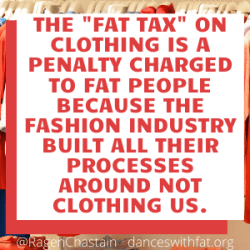 When fat people try to get clothes that fit us, there are several levels of oppression that we might face:
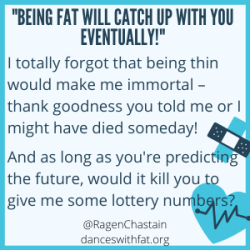 The Vague Future Health Threat is something that I first wrote about almost a decade ago. But it’s still going on, and it came up in conversation today, so I’m writing about it again today!
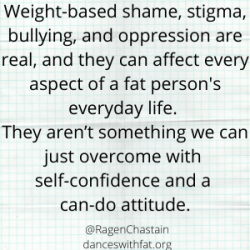 To be a fat person in this fatphobic culture is to be constantly mistreated, and then blamed for that mistreatment. If you don’t want to be the victim of institutional oppression we’re told, you should stop being fat. (As a queer person who came out in Texas in the mid-90’s this is a familiar refrain – if you don’t want to be gay-bashed, stop being gay…)
 Here’s the next installment of my series of comebacks to the fatphobic nonsense we have to deal with. If you have a phrase you’d like me to create a comeback for, or if you have a comeback that you love, please leave them in the comments! (
 I recently wrote about the dangerous downsides of dieting, including eating disorders. I saw a post that clearly illustrates one of the issues from
 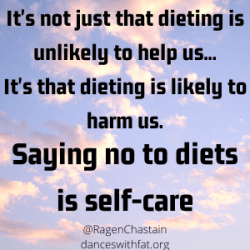 We hear a lot about how
 Dances With Fat