Taking HAES to Work

I get e-mails from readers all the time who are frustrated with things at work. Sometimes it’s things like weight loss contests or signs around the office promoting weight loss.  Sometimes it’s more sinister – like people being required to participate in Weight Watchers in order to keep their benefits or to avoid having to pay more for benefits.

Approaching this is tricky.  There can be office politics involved, or someone may fear for their job.  Even if someone is willing to go in guns a blazing that may not be the best tactic.  It’s important to remember that when you want a specific response, the way that you communicate your request is often the determining factor in whether or not your audience is receptive, and thus whether or not you get what you want.

I’m about to give you a bunch of ideas, please understand that some will be a great idea for one workplace and a horrible idea for another workplace. Know who you are dealing with.  How do they like to be communicated with?  Are they open to employee suggestions or do they get defensive?

Next, get your facts straight.  Gather research that supports your case and make sure you understand it.  There is a research bank in the documents for the Rolls Not Trolls group, and Big Liberty has a great list on her website.

You can always go the direct route.  Send the research and ask why the company is still pushing weight loss.

When you are told that you have to lose weight to get benefits or attend Weight Watchers, let them know that it’s against your Health at Every Size practice.  If you have a HAES-friendly doctor, try to get a doctor’s note.

Consider using a questioning technique.  For example, send a study or an article about the issues with BMI as a health measure attached to an e-mail that says “I found this research about BMI that seems to disagree with the way that our company uses BMI to measure health.  Can you help me make sense of it?”

or

“I found this research that shows that more than 95% of people who do Weight Watchers end up gaining their weight back and often they gain back more.  I’m sorry for my confusion, I must be missing something here.  Can you help me understand the company’s decision to go with Weight Watchers?”

Sometimes assumptive questioning works, but be careful or it can come off as bitchy:

“A friend of mine was telling me that there isn’t a single study that shows that weight loss works for more than a small fraction of people.  I told her that can’t be true since our company health program is based on weight loss.  Could you please give me the studies that our program is based on so that I can help educate her?”

“I understand that the company has created an initiative whose goal is for me to lose weight. I’d like to study up, when you have a minute can you send me the research that this program is based on?”

You can also become public about your Health at Every Size practice and talk about it like other people talk about their diets.

Finally, you can ask your HR to bring in Health at Every Size Speakers to do lunch and learns, presentations etc.  I got to speak at Google and Apple because of employees who asked for these kinds of talks.

Speaking of me, I want to tell y’all something cool.  A lot of people don’t know that I retired from a career as a business operations consultant to do this work.  One of my goals has been to combine these things to help companies make sure that they are treating their employees and their customers of size well.  We’ve been working on a more professional website for me and now it’s done:  www.SizedForSuccess.com  Woo Hoo!

Back to the subject at hand –  work can be tricky.  However you decide to approach this, my basic suggestions are:  Take office politics into account, understand the risks, get your facts straight, craft a message that’s likely to cause people to want to engage with you (and not likely to make them defensive or pissed), and be ready to help them figure out how to create the solution that you’re looking for.

Online Meet-up

By reader request, I’m going to try something new.  On Wednesday the 11th at 8:30 Central time we are having an online meet-up.  This will be an ask me anything meet-up where you can ask me questions and get and give feedback yourself.  This is free for voluntary subscribers (see below) and just $5 for everyone else.  If this works we’ll be doing them a couple times a month with different themes. Click here to sign up  Once you’re signed up I’ll get you all the details. Questions?  E-mail me at ragen at danceswithfat dot org!

This blog is supported by its readers rather than corporate ads.  If you feel that you get value out of the blog, can afford it, and want to support my work and activism, please consider a paid subscription or a one-time contribution.  The regular e-mail subscription (available at the top right hand side of this page) is still completely free.   Thanks for reading! ~Ragen

What’s With Weight Bullying?

I’ve been thinking a lot about bullying today.  I was reflecting on how Michelle Obama is simultaneously leading a National anti-bullying effort and a National war on childhood obesity, how she doesn’t see any conflict between those two things, and how that’s fucked up.

Just like it’s a problem that prescribe for fat people what we diagnose in thin people, it’s a problem that we treat (and encourage others to treat)  fat people the same way that we tell them they must not treat anyone else.

We’ve talked before about how fat people are oppressed, but people often tell me that the treatment of fat people doesn’t constitute bullying so let’s break it on down.  I went to wikipedia…

Bullying is a form of aggressive behavior manifested by the use of force or coercion to affect others, particularly when the behavior is habitual and involves an imbalance of power.

So, for example, when someone’s employer forces them to go to Weight Watchers in order to keep their benefits.  Or when the government launches a war against citizens of a specific size.  Or when a forum has a “fat hate” day and sends members to this blog to leave hundreds of comments from calling me names to threatening my life. Or when supposed “healthcare” organizations create billboards meant to shame people for their size.

Bullying ranges from simple one-on-one bullying to more complex bullying in which the bully may have one or more ‘lieutenants’ who may seem to be willing to assist the primary bully in his bullying activities.

So when the government enlists schools, parents, television networks, doctors, the diet and beauty industries  and anyone else they can get onboard, to give everyone the constant message that the goal is to eradicate people who look like me whether we want to be eradicated or not.  Or when people are encouraged to police other people’s body size, eating habits etc.

“But but but it’s for your own good” they say. “It’s not bullying if it’s for your own good, and besides you can just get thin.  It’s not bullying because we’ll stop once you do what we think you should”.

There’s been a lot of focus on LGBTQ kids and I think that’s a good thing. As a queer fat woman I’ve noticed some parallels between the bullying of queer people and the bulling of fat people.

Many people justify bullying people who are LGBTQ by arguing that being queer is morally wrong and that it’s an “unhealthy” lifestyle, and that we could just be straight or just fit our socially constructed gender role and biological sex if we wanted to.

Of course queer people assert that we are the best witnesses to our experience so if we say that this is who we are, then people should damn well take our word for it since, as they are not us, they do not know better than us about us.

As a bisexual woman I, somewhat unbelievably, often face bullying from other queer people who claim that there is no such thing as bisexuality and that I need to “pick one”.  I find it shocking that people who are fighting to be considered the best witnesses to their experience turn around and do the Exact. Same. Thing. to other people, but it happens more often than you might think.  (I once went out on a date with a woman who started in on this diatribe – you’ll have to buy me a drink to hear to whole story of the date, but I explained it to her in small words and she said “Now I’m feeling ashamed” to which I replied “that is because your behavior is shameful”.  There was not a second date.)  At any rate, I am the best witness to my experience and so if I say that this is who I am, people should damn well take my word for it since, as they are not me, they do not know better than me about me.

When it comes to fat people, the belief behind the bullying is that being fat is morally wrong, that it’s an “unhealthy” lifestyle, and that people can stop being fat if they want, and so they should.

As a fat person I assert that I am the best witness to my own experience so if I say that this is who I am, then people should damn well take my word for it, as they are not me, they do not know better about me.

Because of these arguments, the controversy incorrectly falls on whether or not people can stop being queer or fat.  Based on the research there is almost no chance for queer people to stop being queer or for fat people to stop being fat.  But that’s not why queer people and fat people (or any people) shouldn’t be bullied.

People shouldn’t be bullied because they don’t have any obligation to do what someone else thinks is morally right.  People who think it’s not right to be fat and people who think it’s not right to be queer are no more damaged by fat people and queer people living their lives than people who don’t believe that eating pork is morally right are damaged when someone else eats bacon. Which is to say – not at all. Nobody is forcing them to eat bacon, but they don’t get to eradicate bacon for everyone else because of their moral beliefs.

People don’t have an obligation to do what someone else thinks is best for their health.  People don’t have an obligation to do what THEY think is best for their health.  The health of people who exercise regularly is not effected by people who choose not to exercise. The health of people who think that a raw food diet is the healthiest choice is not affected by those who think that paleo is the way to go.  Even if fat is unhealthy, it does not affect the health of others, and anyone wishing to make a “won’t somebody think of the tax dollars” argument may mosey over here.

What is happening to fat people in this culture is bullying, period.  It does not matter if people think it’s for our own good, if they think that we could be thin, or if they think that we will be healthier if we do what they think we should.  Our bodies are uniquely ours and trying to force or coerce us into changing our bodies is bullying and it’s plain wrong. Any anti-bullying campaign that does not include bullying based on body size is making a major mistake.

This blog is supported by its readers rather than corporate ads.  If you feel that you get value out of the blog, can afford it, and want to support my work and activism, please consider a paid subscription or a one-time contribution.  The regular e-mail subscription (available at the top right hand side of this page) is still completely free.   Thanks for reading! ~Ragen

There’s Always Something You Can Do

I went to great lengths to watch the movie Big Miracle in the theater for three reasons.  First, because I love an underdog story, second because I have a massive girl crush on Drew Barrymore, but mainly because of an exchange I saw in the trailer.  The male lead is talking to Drew’s character (I can call her Drew, we’re that close…) and he says “There’s nothing you can do”.  She responds “there’s always something that you can do.”

This has a double meaning for me.

First, about activism.  Pretty much every day, some of my readers send me things that are in the news. Usually, it’s not good news.  Don’t get me wrong, it’s awesome that y’all send this stuff and I really appreciate it because I don’t always have time to keep up with current events, so please keep sending stuff.  But some mornings I wake up to 50 or 100 e-mails of depressing things, and I have a moment of feeling like progress is impossible.

Of course that’s not true, we are making tons of progress, but when I feel down about things I remember that there’s always something I can do.  I can send an e-mail, make a phone call, write a blog, post something to Facebook, start a project – you know, whatever.   Seriously, activism isn’t always judged by the effect on the intended goal or target – sometimes it’s about how it affects us. In a world where fat hatred runs rampant, just standing up for ourselves and our friends is a major deal.  I think the first step to getting civil rights is realizing that you deserve them.  The next step is demanding them again and again.  In this culture, standing up for ourselves is an act of revolution.

The other side of this is about Health at Every Size itself.  I’ve seen a lot of articles recently where people (sometimes I think purposefully) miscontstrue the concept of HAES.  One article suggested that HAES states that “everybody can be healthy at 600 pounds”.  HAES isn’t about saying at what size somebody can or can’t be healthy, it’s about separating health and size, and being clear that bodies of all sizes can engage in healthy behaviors.

So no matter what someone weighs, no matter what their circumstances are, they can still make some healthy choices – if you want to be healthier, there is always something that you can do.  And every little bit helps.  I think that one of the great travesties of the weight=health paradigm is the lie we are sold that healthy habits won’t make us healthier unless they also make us thin.  So, having been lied to by the people trying to sell us skinny and the people who believe whatever the people who try to sell us skinny say, fat people give up on healthy habits because they don’t make us thinner, when the truth is that they do make us healthier.  Nobody makes any money if the word gets out that 30 total minutes of moderate movement (walking, dancing in your livingroom etc.) mitigates most of the health issues that are correlated with excess weight.  Meanwhile the diet industry and the people who get their information from them sit by while our health suffers because of a lie, and suffers more when we buy and use their products.

But we don’t have to sit by and let this happen to us.  There is always something we can do to stick up for ourselves, and there is always something that we can do for our bodies (drink a glass of water, eat some broccoli, eat your lunch without guilt, spend a full minute thanking your body for the things it does for you, walk around the house, stretch in your chair whatever).  You are the only person who is in charge of how you feel about your body and what you do with your unique body in your unique situation.  You can listen to other people, you can accept their opinions about you and what you should do, you can be an activist or not, but at the end of the day, you are the only one in charge, you are the boss of your underpants,  and there is always something you can do.

This blog is supported by its readers rather than corporate ads.  If you feel that you get value out of the blog, can afford it, and want to support my work and activism, please consider a paid subscription or a one-time contribution.  The regular e-mail subscription (available at the top right hand side of this page) is still completely free.   Thanks for reading! ~Ragen

Physicians for (Ir)responsible Medicine

There is an organization called “Physicians Committee for Responsible Medicine”.  Using their naming style, I’m going to start a company called “Ragen Chastain Astrophysics Genius” because, based on the evidence, I know exactly as much about astrophysics as these people do about responsible medicine. Which is to say – precious little.

Interestingly, you don’t need to be a physician to be a member of the Physicians Committee for Responsible Medicine.  You could be a veterinarian, a self-declared healthcare professional, or just someone willing to donate $20.  Even better – membership doesn’t seem to require any understanding of, or commitment to, responsible medicine.  How else can you explain creating an ad [Trigger warning – this ad is a fat shaming horrible idea, if you don’t want to give them traffic I’ll explain the ad below] that promotes veganism by shaming fat people, then shames vegans, with no evidentiary basis for the long-term efficacy of any of it.

In the ad, two thin men sit in aisle seats on a plane.  A large man boards the plane and decides to take the window seat by stepping across the seated man, smashing him in the face with his stomach (I’ve been on 16 planes in the last month and I’ve NEVER seen this happen but why concern yourself with reality when you are busy shaming fatties.)  Just as the other man is about to have to deal with the sheer, unadulterated horror (sarcasm meter 10 out of 10) of sitting next to another human being on a plane who happens to be fat, the seated man explains that he paid an extra $10 to sit next to a vegan. An announcer explains this option as his vegan seatmate enters the frame.  Of course it’s not just any vegan – it’s a hot blonde vegan.  (Because, as PETA has already taught us, going vegan gives you huge boobs).  But then they throw in a negative stereotype of vegans, she starts listing off “benefits” of veganism in an annoying voice (some of which I’m pretty sure are not supported by good research) and the announcer says that for another $10 you can NOT sit next to a vegan – although one assumes that your new seat partner will be guaranteed to be thin.

First of all, I am not in any way intending to cast aspersions on vegans.  Eat whatever you choose, I totally support you.

But let’s talk about PCRM a little more:

According to their website, “The PCRM family includes physicians, healthcare professionals, veterinarians, and compassionate laypersons, all of whom support our mission to:

  • Advocate for ethical research
  • End cruelty to animals in labs and education
  • Promote life-saving nutrition policies and practices”

One of the headlines on their homepage proudly declares “Victory for Ferrets”.  I’m all for happy ferrets but how can a group want to end cruelty to animals and simultaneously create cruelty to people?

What do they have to say for themselves?

The intention behind PCRM’s most recent ad, directed toward American Airlines, was to highlight a particularly positive benefit of the vegan diet – weight management. The video was not intended to offend those who are overweight.

First, responsible medicine is based on evidence, and there is no evidence that becoming a vegan will lead to long term weight loss.  There are fat vegans (and, I have been told, they are often treated very poorly by the vegan community).

But the question that I’m dying to ask is this:  What would the ad have looked like if they HAD intended to offend overweight people? And how can a bunch of people who are willing to stick up for the rights of ferrets not understand that this ad is offensive to fat people?  It strains credulity at best.

Credulity is strained to the breaking point when one realizes that PCRM was responsible for the fat shaming billboards showing fat stomachs and thighs for which they, almost inexplicably, blamed cheese; and for which they’ve already been roundly criticized.  At this point I think it’s safe to say that either they don’t care about shaming fat people, or they’re morons.  Either way, it’s time to fix the problem. People who are actually proponents of Responsible Medicine suggest evidence-based health interventions that don’t shame anyone.

Activism Opportunity

E-mail PCRM at membership@pcrm.org.  You could suggest that they look into the research around negative implications of fat shaming, you could tell them how being shamed makes you feel and if it induces you personally to want to treat your body well, and you could ask them to please start practicing actual Responsible Medicine.  Whatever you decide to write, I would personally suggest that you not just point out the problem, but offer solutions (like maybe focusing on evidence based health interventions that don’t shame anyone?), and let them know if you’re open to further dialog on the subject.

This blog is supported by its readers rather than corporate ads.  If you feel that you get value out of the blog, can afford it, and want to support my work and activism, please consider a paid subscription or a one-time contribution.  The regular e-mail subscription (available at the top right hand side of this page) is still completely free.   Thanks for reading! ~Ragen

Shame-Free Self Care

I got an e-mail response to yesterday’s blog from a woman who asked “can you address the practical side of it? How do you deal with the sweaty, rubbing aspect of bodies, especially in the heat”

This is a big deal because we live in a society that tells us that our bodies, if they are fat, are not worthy of care.  We also get the message that the needs of a fat body are embarrassing and shameful.  We are in charge of whether or not we believe these things, and I do not.  I think my body is amazing and worthy of great care.

My first experience with this was when I decided to look for a solution to inner thigh chaffing (aka “chub rub”).  What shocked me most was that it wasn’t just fat women – there were thin women dealing with the same issues.  That’s when I realized that these aren’t just “fat people issues” it’s just that fat people are the only ones encouraged to be ashamed of them.

For me, it’s all about honoring the needs of my body without guilt or shame.  Here are some examples:

Chaffing

There are all kinds of cremes and powders to address this. There’s a thread about those here [TW – not a Health at Every Size Space].  Making sure that your clothes fit well is another part of it.  When I’m wearing skirts I often wear leggings under them (long length if I want them to show and bike short length if I don’t want them to show).  This also helps with the fact that I have a hard time remembering to sit like a lady and I have a tendency to just high kick for any old reason!  There are also cloth pads that you can buy that go under your bra or in your tunny fold to prevent chaffing.  I bought the bra ones because sometimes I dance in an underwire bra and that makes the skin under my breasts really sad.  The pads cleared the problem right up.

Showering

It’s possible that a combination of body size and/or arm length and/or inflexibility will lead to you know being able to reach your whole body when showering.  Consider using loofah or other sponges that have long handles, getting a shower head that separates.  While you’re at it, consider investing in a big, ginormous towel or two (I have found that it’s completely awesome to have a towel that matches my bodies proportions) and make sure that you dry off thoroughly.

Treats!

Your body is awesome and it can feel awesome to treat it well with special things and decorations.  It can be as simple as a scented lotion or a bubble bath, or as dramatic as a tattoo or piercing.

More of Me to Love, Ample Stuff, and My Size USA all offer products specifically to help people take care of their large bodies. (I don’t get paid by any of these sites, More of Me to Love was the major donor on the Billboard Project).

Regardless, if I let people shame me into not taking good care of my big amazing body then the shamers win and I’m the only one who suffers.

So, today is “ask me anything about self-care day”!  Leave a comment with your question, and I’ll do my best to get you an answer.

I also wrote this week for iVillage about the Vogue article involving the mother who decided to make body shame part of her 7 year old daughter’s inheritance.  Feel free to read and comment if the mood strikes you!

This blog is supported by its readers rather than corporate ads.  If you feel that you get value out of the blog, can afford it, and want to support my work and activism, please consider a paid subscription or a one-time contribution.  The regular e-mail subscription (available at the top right hand side of this page) is still completely free.   Thanks for reading! ~Ragen
When Every Body But Mine Was Beautiful

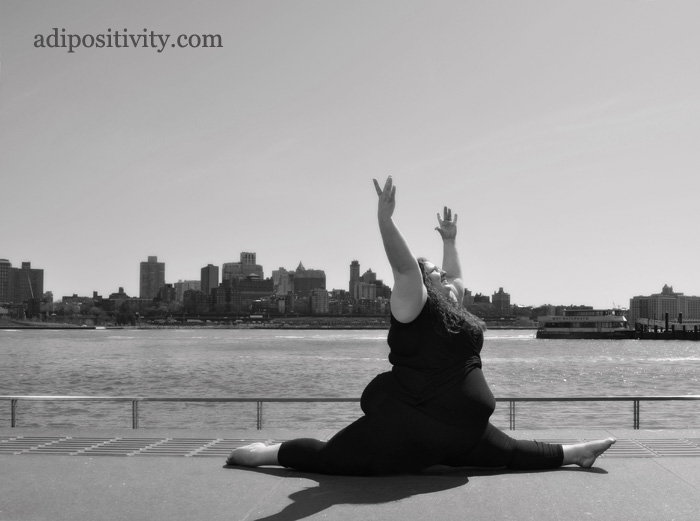
Splits on WallstreetOne of the most common e-mails that I get is from blog fans who say that, while they completely understand size acceptance for everyone else, and they find bodies of all sizes beautiful and valuable and awesome, they just can’t get there for their own bodies. I got an e-mail like that today and it really struck me because I’m preparing to be an Adiposer tomorrow. If you don’t know about the [NSFW] adipositivity project, you are absolutely missing out. It’s a project that “aims to promote size acceptance, not by listing the merits of big people, or detailing examples of excellence (these things are easily seen all around us), but rather, through a visual display of fat physicality.”  There are stunning pictures of fat people in various stages of dress and undress.  It’s amazing, I’ve loved it forever and tomorrow I get to pose for the project and meet its amazing creator, Substantia Jones, which in some ways is a culmination of all the self work I’ve done about this,  and wow am I rambling off topic right now. (Update:  The picture attached to this blog is from that amazing photoshoot and, if it’s possible, Substantia is even more amazing in person.)

For me, the thing that triggered the idea that I could ever be happy with my fat body was the realization that I didn’t feel about other fat bodies the way that I felt about my body at the time. I was trying to quit a diet program that had me eating less than I had with an eating disorder and wouldn’t allow me to exercise, and I was gaining weight.  When I told them I was quitting, they made me go into a little room with a little poster about not quitting and a woman brought in a binder with pictures of fat women, and she started flipping through it silently.  She said “You might not know it, but this is what you look like and these women will die alone eating bon bons in front of the television and is that what you want for yourself?”

What I realized in that moment was that I didn’t find anything wrong with those women’s bodies, in fact I thought that they were beautiful.  I didn’t expect that they would never find love (and I didn’t know what bon bons were but that’s another thing.) So it occurred to me in a rush: if I thought that their bodies were beautiful… and if I looked like them…then maybe it was possible to think that my body was beautiful.

Of course that was the beginning of a long process.  I started that process by focusing on what my body does instead of how it looks.  I made a massive list of all the things that I appreciate about my body – I included things like blinking and breathing, I included standing, walking, reaching,  hugging and any other action I could think of.  I included that I love my curly hair and my eyes that change color.  I wrote down anything that I could think of that I liked about my body, or that my body did.

Then I committed to really paying attention to my thoughts and every time I had a negative thought about my body I would replace it with a positive thought from the list.  Every time it crossed my mind I would thank my body for doing anything that I could think of  – hey, thanks for breathing! I appreciate you reaching for that!  Way to climb the stairs!  Whatever I could think of.

More than any work that I have done, this started to shift the way that I felt about my body.

At the same time I made a point of noticing something beautiful about every body that I saw.  When something about someone caught my eye because it was outside the stereotype of beauty, I focused on what was amazing about it.  When I had negative thoughts I reminded myself that I had been spoon-fed these ideas by industries that profit from my thinking them; and that if they didn’t serve me or didn’t feel authentic, then I was free to replace those thoughts with thoughts that I came up with on my own that did serve me and felt authentic.

I stopped engaging in body snarking altogether and I started to interrupt it when other people did it.

I actively sought out pictures of people who were outside of the stereotype of beauty.  Some places I can recommend for this are:

The Fit Fatties Forum Photo Gallery

The Adipositivity Project (NSFW)

The Flickr Athletes of Every Size group

Full Figure Entertainment Gallery

I looked for similarities between the people I thought were beautiful and pictures of my own body, and I reminded myself that other people were looking at me and seeing the same beauty that I saw in those women.

And I had a lot of compassion for myself.  Changing thoughts and patterns that are ingrained, and sometimes reinforced by the culture around us is really hard work.  It takes time, there will often be backslides and mistakes, and the best ways to NOT succeed are not having compassion for the learning process, not having patience, and trying to rush it along. I know for me I decided that I was going to get there, and then I held that thought all the way through.  Patience, persistence, and belief that I would get there were the keys to my success.

Like this blog?  Here’s more cool stuff:

Like my work?  Want to help me keep doing it? Become a Member! For ten bucks a month you can support size diversity activism, help keep the blog ad free, and get deals from size positive businesses as a thank you.  Click here for details

Buy the book:  Fat:  The Owner’s Manual  The E-Book is Name Your Own Price! Click here for details

Book Me!  I’d love to speak to your organization. You can get more information on topics, previous engagements and reviews here or just e-mail me at ragen at danceswithfat dot org!

Dance Classes:  Buy the Dance Class DVDs or download individual classes – Every Body Dance Now! Click here for details 

I’m training for an IRONMAN! You can follow my journey at www.IronFat.com

A movie about my time as a dancer is in active development (casting, finding investors etc.).  Follow the progress on Facebook!

If you are uncomfortable with my offering things for sale on this site, you are invited to check out this post.

The Billboards Are Going Up Today!

When I first had the idea to put up billboards in response to the Strong4Life campaign of shame and weight bullying, people said that it was impossible.  They were wrong:

Thousands of people helped get the word out about the campaign  (Thanks everybody!)

1010 people donated their own money to the cause (Thanks to every donor!)

A corporate donor supported us with a $5,000 matching  donation (Thanks More of Me to Love)

$21,720.20 was raised (holy cow!)

6 billboards and 10 bus shelter signs are going up all over Atlanta today. (Thanks to Allan from Adout, Inc. for negotiating on our behalf and helping us through the billboard project)

The original goals of this campaign were to:

  1. Show Atlanta kids of all sizes that they are valued and respected and try to undo some of the damage of the Strong4Life campaign
  2. Assert that we can support the development of healthy habits in kids of all sizes (including a focus on providing access to healthy food and movement options that are culturally appropriate and that kids enjoy) without shaming or stigmatizing any kids at all
  3. Educate people about why shaming kids is bad for their health and about the Health at Every Size option

I feel like we are on our way to accomplishing those goals with the billboards, bus shelter ads, and the new website.  All of the pieces link to www.SupportAllKids.com  This website, beautifully designed by Sabrina Wilson of ThoughtBoxMarketing, includes the final version of the billboard, the 10 bus shelter ads, and information intended to help start authentic dialog and support people in learning more about Health at Every Size, Size Acceptance, and Fat Civil Rights.

If you’ve ever done a project of this magnitude, then you know that they attract criticism.  Some, and possibly all, of that criticism will be absolutely valid.  One of the things that makes doing big projects with this many moving parts scary (and one of the reasons that people tell me keeps them from doing this kind of work) is that you know you are going to screw things up, you know that people will point it out, and you don’t know if they will give you the benefit of the doubt.

Any mistakes made on this project are my own and I take full responsibility and apologize.  I am already aware that, in retrospect, I absolutely could have done a better job of reaching out to communities including people of color, people with disabilities, the LGBTQ community, and anyone else who may not feel that Fat Activism is welcoming to them or addressing the issues that are specific to their community.  I deeply apologize for that, and it’s something that I will continue to work on and improve. I learned a lot from this project and part of that is that I still have a lot to learn.

I think it’s important to continuously strive to be better activists, and I also think it’s important to celebrate our victories, and this project is a victory – More than 1,000 people got together and got something done.  Something massive.  Something that people said was impossible.  Thanks so much to everyone involved.  Congratulations and here’s to bigger and better things in the future!

This blog is supported by its readers rather than corporate ads.  If you get value out of the blog, can afford it, and want to support my work and activism, please consider a paid subscription or a one-time contribution.  The regular e-mail subscription (available at the top right hand side of this page) is still completely free.   Thanks for reading! ~Ragen

As Long as We’re Healthy

I see a lot of people say some version of “I think it’s fine for people to be any size as long as they’re healthy”.  I think they usually think that they are being supportive, and are well intentioned (which we’ll deal with in a moment). First I want to explain why I find this to be faulty for a number of reasons:

First, the idea that other people should dictate to us what health means, how highly we should prioritize it, and what path we should choose to get there is deeply problematic in no small part because it quickly becomes a slippery slope.  I find that, for example, omnivores who want to police my health choices are typically much less excited to have their health choices questions by someone who believes that a vegan diet is the best for health.

Second, whether intended or not, this often has the feel of someone who sees themselves as superior and thereby empowered to dole out approval of my size and health plan.  I don’t recognize anyone else’s authority over my body and health – I have trusted advisors but I am the ultimate boss of my underpants.

Third, it makes it sound like they believe that I can be fat if I’m healthy (by whatever definition of healthy they are using) but if I start to have health problems then it’s time to get thin.  That is a trifecta of putting the ass in assumption, including:   1. fat is causing the problem 2.  becoming thin would solve the problem  3.  becoming thin is possible (It’s the third one that’s the real doozie – since there’s no proof that most fat people can maintain long-term weight loss, it doesn’t matter what becoming thin might do because we don’t know how to get it done).

So what do we do about this?  You all know that I don’t like to criticize without giving some suggestions so here are some options that I’ve personally used, just in case  it helps you.  As always it’s up to you and your mileage may vary:

This can be an opportunity to educate about Health at Every Size – “I’m not sure what path to health that person has chosen, but from my research, I see this differently.  I practice Health at Every Size which acknowledges that  health and weight are two separate things.  There are healthy and unhealthy people of every shape and size.  Since there’s not a single study that shows that weight loss works, regardless of my health I would still choose health interventions for health problems – rather than trying to change the size of my body.” or something like that.

If you’re not up to having a doing the whole education piece, maybe point out an option where people don’t make judgments about other people:  “I think that judging people based on their  size or their health is really pretty inappropriate.”

You can choose to disengage with an explanation “Actually, I’m not really comfortable with conversations that include body policing or healthism.  I’m happy to change the subject or to call it a night”

Or you can just go with short and sweet “You know, I don’t think someone else’s health or size is up for my approval or, really, any of my business”.

Of course you are not obligated to open a dialog at all and despite your best efforts people may not choose to question their actions, but I believe that we can’t be responsible for other people’s reactions, all we can ever do is point out the issue and offer compassion, support, and education in whatever combination we believe is right.

This blog is supported by its readers rather than corporate ads.  If you get value out of the blog, can afford it, and want to support my work and activism, please consider a paid subscription or a one-time contribution.  The regular e-mail subscription (available at the top right hand side of this page) is still completely free.   Thanks for reading! ~Ragen


Obesity is Not a Stunt Double

This post is not about my desire to do work as a plus-size stunt person when I move to LA (although I do and I am so if you need that kind of thing…call me 🙂

No, this post is about the way that people say “obesity” when they mean general or specific health problems.  Obesity is a poorly cast stunt double who gets called on set to stand in for diabetes, high blood pressure, high cholesterol, heart  disease, eating  disorders and whatever other thing we’re confusing correlation and causation about this week.

Yesterday’s post about Planned Parenthood is a really good example of how this happens. They were trying to list three “critical health care issues” and they listed obesity, children’s healthcare, and suicide.  Unfortunately that’s actually 2 critical health issues and one body size. It’s the same as if they said “critical health issues like tallness, children’s healthcare, and suicide.”.

Tallness, you see, is also associated with a shorter lifespan and a higher risk for health issues, but that doesn’t mean we try to make tall people shorter (and remember that we the chances of making someone thin are less than 5% better than making them shorter).

Part of this is a massive correlation vs. causation error.  Correlation means that we can observe two things happening at the same time, causation means that we know that one actually causes the other and how that happens. If all we have is correlation, even if the two things ALWAYS happen at the same time, we still can’t prove causation until we know how one causes the other.  This is the most basic pillar of research.  If all we know is correlation, then we have to leave room for the possibility that the two things are caused by a third factor, or that they are unrelated.  If we fail to do that, we are incompetent researchers.

So, even if every August has the most murders and the most ice cream eaten, we have no reason to believe that if we stop selling ice cream in August the murder rate will go down.  Nor can we accurately state that we want to work serious crime issues like home break-ins, grand theft auto, and ice cream eating.  Ice cream is not a stand in for murder no matter how much they may be correlated. But that’s exactly the mistake we make when we call obesity a “health care issue”.

Obesity is correlated with diseases, but causation isn’t proven.  It’s possible that both things are caused by a third factor (for example the stress of constant stigma has also been correlated to many of the same diseases as obesity in Peter Muennig’s work).  There are some chemicals that are in food that are correlated to both obesity and the disease that are commonly correlated with obesity.  The point is that nobody has solid research about why bodies are the size that they are (and it doesn’t matter what “everybody knows”), nobody has a shred of evidence proving that they can make fat people thin for the long term, and so calling fat bodies a health care crisis is not an evidence based claim, and focusing on things that we could “cure” if we could make people thin is like focusing on things that we could cure if we could make people fly.  Even if it would work, we don’t know how to get it done.

Not only does it create a second class of citizens who are shamed and stigmatized because of their body size and can’t get evidence-based healthcare because doctors are too busy prescribing behaviors for us that they diagnose as unhealthy in thin people.  It also harms thin people, who get all of the same diseases as fat people but often can’t get a diagnosis because their physicians believe that these diseases only happen to fat people, and are sold a dangerously false sense of security because they are told that their weight makes them healthy, regardless of their habits.

I sometimes wonder if the focus on obesity instead of disease is on purpose since obesity is seen as something that the obese person is “responsible for” and has to deal with, but diseases are seen as something that deserves healthcare (although  I notice some people, especially in the United States, are desperately trying to make disease an issue of blame and fear as well.)

Regardless of why it’s done, obesity is not the stunt double for diseases with which it is correlated. Obesity is a ratio of height and weight and we need to stop confusing the two.

This blog is supported by its readers rather than corporate ads.  If you get value out of the blog, can afford it, and want to support my work and activism, please consider a paid subscription or a one-time contribution.  The regular e-mail subscription (available at the top right hand side of this page) is still completely free.   Thanks for reading! ~Ragen

Life, Liberty, and the Pursuit of Fat People

Update!    Planned Parenthood has responded and removed “obesity” from it’s list of health concerns.  Activism works!  Send a thank you to ppaction at ppvotesnw dot org.

I am a fan of planned parenthood so I was saddened to learn that In a post about about women’s rights in Alaska, Planned Parenthood Northwest stated:

Alaska should not be the place for the next frontier on the national war on women. As a state, we need to focus on continued revenue generation, addressing critical health care issues like obesity, children’s health care, and suicide, and ensuring that all Alaskans are afforded the rights put in place by our constitution regardless of their socioeconomic status.

So let me see if I understand this:

Planned Parenthood Northwest would like to shift the focus from inappropriate attention on women’s reproductive systems to inappropriate attention to fat people’s bodies.

Planned Parenthood Northwest doesn’t want a war on women, but they’re cool with a war on obese people.

PPNW wants to makes sure that people get their constitutional rights unless they are fat, then the want to systematically eradicate us, even against our will.

[Trigger Warning – suicide talk] They list obesity and suicide as two critical health issues, ostensibly at the same level. This is not the first time I’ve seen them talked about as parallel, in addition to having people tell me that being fat is “committing slow suicide” This infuriates me for very personal reasons: I am obese, my brother committed suicide.  I live a fabulous life with amazing friends and wonderful experiences.  My brother does not live at all.  I’m not being flip about this and I hesitated to talk about it here at all, but I think it’s important to realize the distinction –  his death was a tragedy, my body is not.  His suffering and death should never be minimized by comparing them to something that wouldn’t cause me any suffering at all if it weren’t for the bigotry and stigma that I have to deal with, that is being reinforced in PP’s memo.

The Declaration of Independence says “We hold these truths to be self-evident, that all men are created equal,that they are endowed by their Creator with certain unalienable Rights that among these are Life, Liberty and the pursuit of Happiness.”  I’m ready to get me some of that.  I’m ready to be able to enjoy the world I live in with the body I live in without shame, stigma or humiliation.  I’m ready for the government to stop putting up walls and hurdles to block my pursuit of happiness.  Pursuing happiness and being the subject of a war whose goal is my eradication are competing interests at best. I’d like to live in a world where people challenge an industry that makes $60 billion selling a product for which they have zero proof of long-term efficacy, rather than giving them grants and telling me that I have to buy in or I’m not prioritizing my health. I think that my pursuit of happiness will become a lot easier at precisely the time that the pursuit of fat people as “the enemy” stops.

Activism Opportunity

Tell Planned Parenthood how you feel.  E-mail them at ppaction@ppvotesnw.org

Here’s an example from what I wrote:

I am a long-time support of Planned Parenthood.  As an obese woman who practices Health at Every Size and leads an amazing life, I ask you to reconsider your suggestion that we transfer inappropriate focus on women’s reproductive systems to inappropriate focus on fat people’s bodies. A war on obese people is no better than a war on women.   I would ask that you stop any anti-obesity language and instead support access to healthy foods, safe movement options, and affordable evidence-based medical care for people of all sizes.

This blog is supported by its readers rather than corporate ads.  If you feel that you get value out of the blog, can afford it, and want to support my work and activism, please consider a paid subscription or a one-time contribution.  The regular e-mail subscription (available at the top right hand side of this page) is still completely free.   Thanks for reading! ~Ragen