If I Can Do It, Anybody Can’t

Reality and PerceptionI have been thinking a lot about how people assume that what’s true for them must be true for other people, or that if one person can do it than everybody can do it, and how dangerous that is in terms of how we treat each other and how we view society. I see this all over the place…

Those who love running may wrongly assume that everyone will love running if they just try, or everyone’s body feels the same as their body feels.  This just isn’t true. It’s definitely not true for me – I was a soccer player in school and I ran a ton and the only “runner’s high” I get is when I stop running.  Conversely it would be a mistake to assume that just because I hate running the people who say they love it are lying.

Some people who are part of the small percentage of people who diet successfully think that everyone can be successful because they were and, that those who don’t succeed (never mind that it’s the vast, vast majority of us) must be doing it wrong even though plenty of people who do what they did have a very different result.

Then there are people who think that if everyone ate like they did, then everyone would be their size- so if they are thin and eat a lot, then fat people must be eating tons more than they do.  Of course everybody knows people who eat a ton and stays thin, it’s not surprising that others would eat a small amount and stay heavy.

It doesn’t help that we make role models out of people who are chosen for their ability to be statistical anomalies – we choose our actors, singers, dancers, and celebrities for their ability to meet a stereotype of beauty that is unachievable by almost everyone as our first priority, with their talent often a very distant second.  Then, though we are clear that not everyone can sing, act, or dance, we suggest that everyone could look like these people if they tried hard enough.

We all have things that we are naturally good at, things that we can do with a struggle, and things that aren’t possible for us.  It’s completely foolish to assume that  list is the same for every person.  The idea that “If I can do it, anybody can!” is completely false on every level, and is used to sell us all kinds of things that we want to believe are possible.  Maybe somebody did lose 80 pounds using the Ab-Doer, or 100 pounds with Weight Watchers, but that “results not typical” fine print is there for a reason.  That reason is because, typically, this is NOT the client experience.  Marketing a best case scenario that almost never happens is legal, and as consumers we need to know that.  If I marketed a skydiving school where we don’t use parachutes, with testimonials from people who survived the fall and a tiny “results not typical” note at the bottom of the screen, would people sign up?

Our experiences can be a great guide for us.  They can tell us more about ourselves and our bodies and how we react to various things.  Our experiences are a horrible lens through which to understand the experiences of others, and the more different our lives, the worse this is. “If I can do it anybody can!” is a lie, the truth is “if I can do it, I can do it under the particular circumstances that existed when I did it.”

So if we can’t tell anything about other people’s experiences based on our own, then what can we do to understand others?  We can consider them the best witness to their experience and believe them when they tell us what things are like for them. When I say that I gained a pound a week at Quick Weight Loss Center, people can take a pass on telling me that I must have done it wrong because it worked for them. I’m a grown ass woman and I can measure a quarter cup of rice – I did it fine, it didn’t work for me.

Consider not talking about your experience as if it somehow negates someone else’s.  If someone is discussing how they hated running, consider if you really want to respond with “I thought I hated running too, until I started doing interval workouts!  Now I love it!!!”  Even if that’s true and well intentioned, it can be heard as condescending and dismissive so I’m just suggesting that you consider if that’s the best time for that story.

Not using our experiences as a lens through which to view other people’s can be easier said than done, it can become reflexive to assume that the way we feel is the way that others feel as well.  Often well intentioned but completely inappropriate people say “I just know that when I’m heavy I don’t feel good about myself – there’s no way you can feel comfortable and happy at your weight.”   That’s just not so.  Maybe eating peanut butter for protein changed your life, but it would kill other people so back off.  Our experiences are for us, and us alone.

Like the blog?  Here’s more of my stuff:

Become a member: Keep this blog ad-free, support the activism work I do, and get deals from cool businesses Click here for details

The Book:  Fat:  The Owner’s Manual  The E-Book is Name Your Own Price! Click here for details

Dance Class DVDs:  Buy the Dance Class DVDs – Every Body Dance Now! Click here for details
If My Life Were a Movie

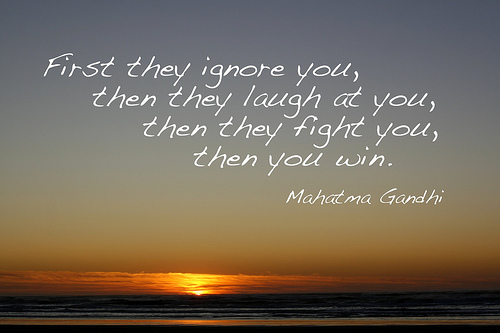
First they ignore youA little over a year ago a screenwriter named David Fried asked to write a film about my life as a dancer.  I said yes, if I’m honest I wasn’t expecting much to come of it as he interviewed me, my dance partner and my coach.  Fast forward to a couple of weeks ago when Julianne and I went back to Austin to attend a table read of the finished screenplay with my first ever dance partner – the amazing Andy.   It was a pretty interesting experience hearing people talk to “me” and have someone else answer, and hearing someone else play me.  It also reminded me of something really important.

I think one of the most overlooked forms of size acceptance activism is to just live our lives without apology for our bodies or our size. Fat stigma, stereotyping and oppression are all around us – they try to silence us, tell us that we’re nothing until we’re thin – that we shouldn’t be seen or heard.  By simply refusing to bow to this pressure, we can fight back, and help others find inspiration to do the same.
In a world where just getting out of bed and not hating ourselves is a revolutionary act, leaving the house and doing things without hating or apologizing for ourselves is serious activism.  Just going out to eat with our friends, going salsa dancing at a bar, going to see our favorite band perform and taking up just the right amount of space (which is however much space we take up), is an act of revolution.  As unwilling combatants in the “War on Obesity” being FIP (Fat in Public) is a way that we can fight back.
And we never know who will see us and be inspired. We can’t choose who we are an example to or when, but we can choose what we are an example of.  Dancing is what got me into size acceptance activism (hence the title of the blog.)  I didn’t originally intend to be a fat activist, I wanted to be a fat dancer, but it turned out I had to be a fat activist to get it done.  I wasn’t trying to do anything movie worthy, I just wanted to live the life I dreamed of in the body that I had.  A big part of my activism was, and continues to be, just showing up, being fat, and doing stuff.
So now there’s this movie written about me, and I haven’t really talked about it on the blog because it’s weird to talk about because, well, it’s a movie about me.  But after the table read the actors were asked for their feedback and they were so excited about it, I started to think about it differently.  If it wasn’t about me, I would totally go watch it – I would absolutely love to go to the movies and see a fat main character with an inspirational story that doesn’t involve weight loss, and so now I think that talking about it (even if it’s weird for me) is a good thing to do.
We are working different methods to get the movie produced (finding a producer who is interested, screenwriting contests, pitch competitions, finding a star who is excited to play me – wow that is weird to think about).  No matter what happens, it’s really been a great reminder about the power of showing up and living life without apology.
Now I’m off to see if Rebel Wilson will take my call!

Like the blog?  Here’s more of my stuff:

Become a member: Keep this blog ad-free, support the activism work I do, and get deals from cool businesses Click here for details

The Book:  Fat:  The Owner’s Manual  The E-Book is Name Your Own Price! Click here for details

Dance Class DVDs:  Buy the Dance Class DVDs – Every Body Dance Now! Click here for details

Weight of the Nation for Kids – Oh No

news liesHBO is upping the ante (and, I imagine the profitability) of their “Weight of the Nation” series with Weight of the Nation – Kids.  Just when you thought that HBO couldn’t conflate body size with health any more, now they’re adding kids to the mix.

The problem with this is that it could be amazing if they didn’t couch it as a war on fat people – and now on fat kids.  There’s a story about a girl who fights to get a salad bar in her school, and a group of teen activists who fight to have healthy, tasty (and local) food in their cafeteria. Their promo stuff goes on about nutritious food options and physical activity.

These aren’t bad things, per se.  But to the extent that they are good ideas, they are good because they are good for all kids, not because they might change the body size of kids. Focusing on weight is shown over and over again to lead to size-based bullying and increased eating disorders but not thinner or healthier people – and let’s remember that those are two different things.

But what does the research say?

Researchers studied the effects of “school based healthy-living programs.”  Turns out that these programs are being instituted in lots of schools, despite the fact that, per the researchers, there is little research on the effectiveness of these programs or any inadvertent harmful effects on children’s mental health.  This study found that these programs are actually triggering eating disorders in kids.  Dr. Leora Pinhas said “The programs present this idea that weight loss is good, that only thin is healthy…We live in a culture that stigmatizes fat people, and we’ve turned it into this kind of moralistic health thing.”

Research from the University of Minnesota found that “none of the behaviors being used by adolescents for weight-control purposes predicted weight loss…Of greater concern were the negative outcomes associated with dieting and the use of unhealthful weight-control behaviors, including significant weight gain”.

A Canadian study found that eating disorders were more prevalent than type 2 diabetes in kids.

The American Academy of Pediatrics reported that hospitalizations of children younger than 12 years for eating disorders rose by 119% from 1999 to 2006. (Children UNDER 12) There was a 15% increase in hospitalizations for eating disorders in all ages across the same time period.

The Journal of Pediatrics has identified bullying of overweight/obese children as the #1 type of bullying that takes place.

So HBO is not exactly jumping on the success train here.  These studies aren’t difficult to find, it seems to me that if they were really interested in the health of kids and not, for example, capitalizing on a moment in time of massive prejudice toward a group for the way they look to gain profit and political points, they would have found this and changed their focus.

We can have a complete conversation about public health for people of all ages without once mentioning weight.  It’s easy, actually, since there aren’t separate healthy habits for thin people and fat people at any age.  When we talk about foods that are chemically designed to be nutritionally void, make us crave them, and interfere with our sense of fullness, then there are plenty of health arguments to be made, so we don’t need to create a fat panic.  When we talk about the benefits of movement, those benefits apply to people of all sizes.

Kids come in lots of different sizes for lots of different reasons and the truth is we don’t know why, we don’t know how to change the sizes of kids, nor do we know if changing their size would change their health outcomes.  Medical experiments on kids without permission is what HBO is promoting, and it’s wrong.  Public health should be about providing information and access to people of all ages when it comes to food, movement, and healthcare.  Public health should not be about making fat people’s bodies the public’s business or trying to whip people up into a stereotyping, stigmatizing, prejudiced frenzy against part of the population for how they look.   HBO should know better and can do better.

Like the blog?  Here’s more of my stuff:

Become a member: Keep this blog ad-free, support the activism work I do, and get deals from cool businesses Click here for details

The Book:  Fat:  The Owner’s Manual  The E-Book is Name Your Own Price! Click here for details

Dance Class DVDs:  Buy the Dance Class DVDs – Every Body Dance Now! Click here for details

Why Do Dieters Regain Weight?

Ask QuestionsPredictably, after my blog yesterday called out Weight Watchers for having a failure rate hovering right around 100%, people rushed to blame almost 100% of dieters for “just doing it wrong.”  The myth goes that almost everyone fails at weight loss because almost everyone quits their diet and goes back to their old habits/doesn’t have the willpower to keep dieting/doesn’t do it “right”. That’s not exactly what the research says but before we talk about this let’s look at this from a basic perspective.

First, let’s talk about what “dieting” means (so that we can avoid the “It’s not a diet, it’s a lifestyle change!” discussion.)  Dieting occurs when someone gives their body less food than it needs to survive in the hope that it will eat itself, thereby becoming smaller.  Call it a diet, call it a lifestyle change, if you are starving your body hoping that it will eat itself resulting in intentional weight loss, congratulations you are on a diet.  (You are completely and totally allowed to diet, I’m just saying let’s call it what it is.)

So why are diets so very unsuccessful long term?  Let’s look at it from your body’s perspective.  Your body isn’t aware that there is social value in meeting an arbitrary stereotype of beauty. Your body can’t actually imagine that there is enough food available, but you won’t feed it because you are hoping that it eats itself and becomes smaller, so it assumes that you live in a circumstance where sometimes you have to deal with starvation. If you add a bunch of exercise to that then your body assumes that there are times when you are starving and have to run long distances.  Your body is very interested in helping you live, and so it reacts to this situation by putting measures into place for the express purpose of gaining and maintaining weight so that you can deal with your life of starvation and running.  And it keeps that up long after your initial weight loss ends.

An Australian research team studied people who had lost weight in an effort to understand some of these changes. A year after their initial weight loss:

  • A hormone that suppresses hunger and increases metabolism – Leptin – was still lower than normal
  • Ghrelin, nicknamed the “hunger hormone,” was about 20 percent higher
  • Peptide YY, a hormone associated with hunger suppression was abnormally low
  • Participants reported being much more hungry and preoccupied with food then they had prior to losing weight

A year after losing weight these people’s bodies were still biologically different than they had been prior to the weight loss attempt, desperately working to regain the weight – and participants had already regained about 30% of the weight they had lost.  One of the study’s authors characterized it as “A coordinated defense mechanism with multiple components all directed toward making us put on weight.”

The evidence that exists shows that almost everyone fails at long term weight loss (yes Virginia, even the National Weight Control Registry.  In fact, especially the NWCR!)   I will never cease to be amazed at people who insist that it’s just that almost everyone does it wrong.  That’s like saying that, since some people survive jumping out of planes when their parachutes don’t open, almost everyone who dies in such a circumstance is just falling wrong.

I’ve said it before, and I’ll say it again:  the truth is the almost everyone can lose weight short term on almost any program, and almost everyone gains their weight back long-term even if they are able to maintain their diet behaviors, with many people gaining back more than they lost. What WW and other diet companies have managed to do is take credit for the first half of a natural biological response (the weight loss), and convince their clients to blame themselves for the second half of that response (the rebound weight gain.)  Sure it’s disingenuous, but at least it’s highly profitable!  They’ve also managed to spread this myth far and wide, successfully making people into PR machines.  They’ve done such a great job of turning people into myth-spreading marketing machines, that diet companies don’t even have to speak up in their defense because other people will be so very happy to do their dirty work for them.

Like the blog?  Here’s more of my stuff:

Become a member: Keep this blog ad-free, support the activism work I do, and get deals from cool businesses Click here for details

The Book:  Fat:  The Owner’s Manual  The E-Book is Name Your Own Price! Click here for details

Dance Class DVDs:  Buy the Dance Class DVDs – Every Body Dance Now! Click here for details
Screw You Weight Watchers

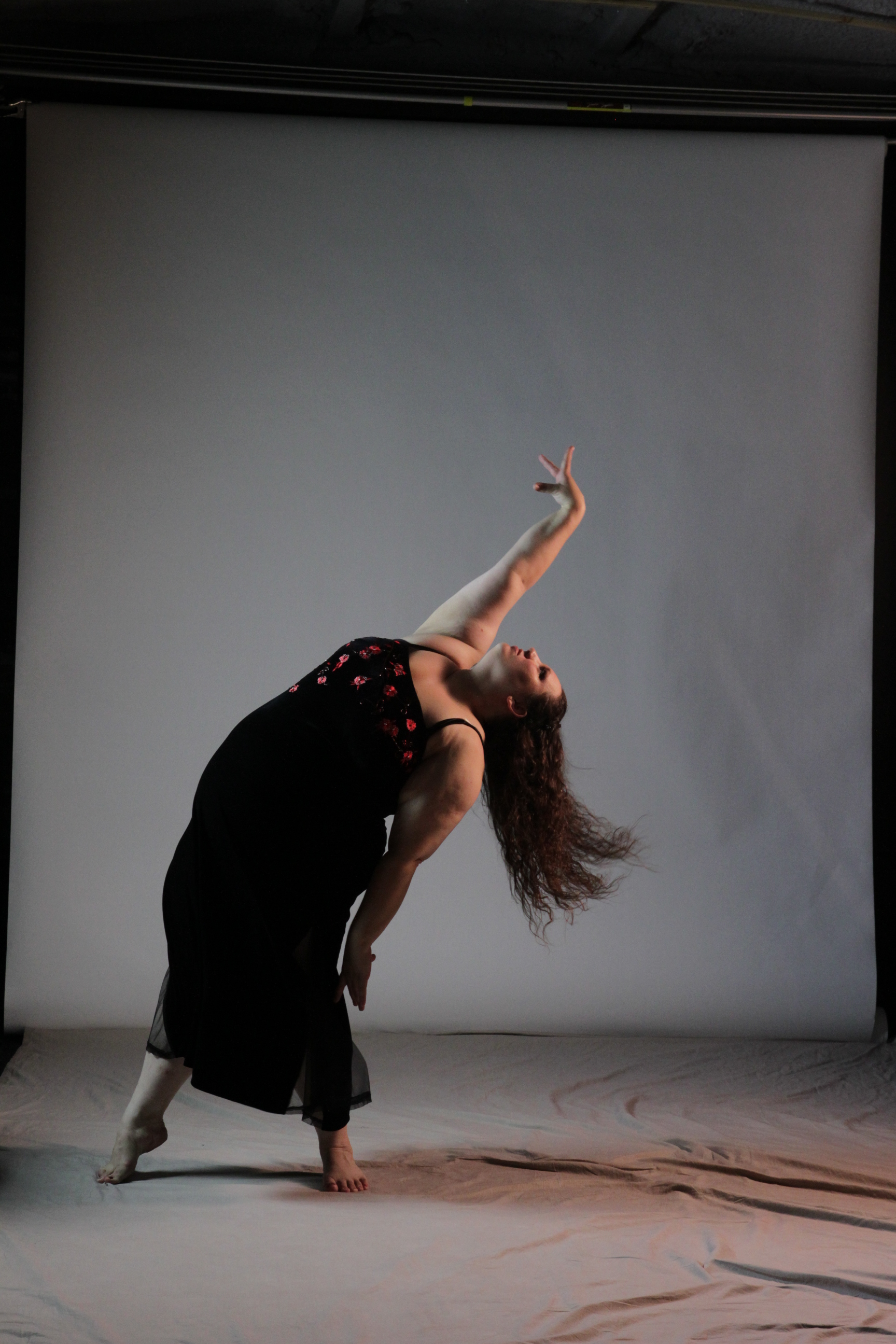
The only thing you need to wear a sleeveless shirt is shoulders - and we can get around that if necessary!
Sleeveless clothes are for anybody who wants to wear them!

Unfortunately this week I had the misfortune of seeing an ad for Weight Watchers. Now, I understand that they are in trouble financially and so all I can hope is that the expense of these ad campaigns drive them to bankruptcy.

We know that, based on their own numbers, Weight Watchers does a horrible job of helping people lose weight long term – with participants maintaining only a 5 pound loss after 2 years (and paying about $254 per pound in meeting fees alone for the privilege – not counting WW branded food, cookbooks, diet scales etc.).   We also know that they have to disclaim their products’ success every time that they claim it works because they’ve lost deceptive trade practice lawsuits brought against them by the Federal Trade Commission.

The thing that they seem to have going for them is an uncanny ability to convince their clients to credit WW with short term weight loss and blame themselves for the weight regain that almost everyone experiences, and convincing people to keep coming back for multiple rounds of the same  (me included – I’m a 6 time WW veteran.)  When I speak out about Weight Watchers I always get fat people who say “You shouldn’t say it doesn’t work, their program worked for me six times!”  These people have a different definition of “worked” than I do.

The truth is that almost everyone can lose weight short term on almost any program, and almost everyone gains their weight back long-term even if they are able to maintain their diet behaviors, with many people gaining back more than they lost. What WW has managed to do is take credit for the first half of a natural biological response, and convince their clients to blame themselves for the second half of that response.  Sure it’s disingenuous, but at least it’s highly profitable!

This new ad  has actress Ana Gasteyer singing about how she can finally go sleeveless.  So they’ve doubled down on the body shame by getting specific – not only is my fat body generally something I should hate, but I better check out my arms – if they jiggle when I clap then I need to keep them covered – for everyone’s sake.

Screw you Weight Watchers, with your marketing that’s designed to (as CJ Legare says) steal my self-esteem, cheapen it, and sell it back to me at a profit , and your commercials that try to convince me that instead of appreciating my amazing body and everything it does I should hate it for not meeting some arbitrary standard of beauty.  All so you can sell me a product that you know good and well doesn’t work.  So the plan is that I pay you a ton of money to be left the same size as when I started and hating my body more than ever.  Seriously, I can’t say this enough – screw you.  I hope I get to watch you go bankrupt and out of business.  And when that day comes I will dance while my fat arms jiggle in a sleeveless shirt in your honor.

If you’re feeling a little activist today, why not post a picture of you wearing something sleeveless – to the comments below, your Facebook, Twitter, Instagram etc.  Or on WW’s Facebook page.   Tell WW that we will not give up the right to bare arms!

Like the blog?  Here’s more of my stuff:

Become a member: Keep this blog ad-free, support the activism work I do, and get deals from cool businesses Click here for details

The Book:  Fat:  The Owner’s Manual  The E-Book is Name Your Own Price! Click here for details

Dance Class DVDs:  Buy the Dance Class DVDs – Every Body Dance Now! Click here for details

Our Health in Our Hands

Bad DoctorReader Amanda let me know about a new study  that I find not at all shocking – the study shows that  doctors are not as warm, empathetic, or generally nice to us as they are to their thin patients.  I imagine that it’s difficult for them to fit in niceties when they are so very busy ignoring what we say to them and prescribing weight loss for everything that’s wrong with us.

My partner went to the doctor today, without performing any tests the doctor blamed the issue on her weight.  When Julianne asked her about the studies that show that almost nobody succeeds at weight loss and many people actually gain weight the doctor agreed with her, but said that Julianne didn’t “have to be a statistic.”  Sadly I wasn’t there to ask the doctor if she recommends skydiving without a parachute since some people survive the fall.

Mistreatment by doctors is, to me, one of the most dangerous side effects of the obesity panic and the stigma, shame, and stereotyping that comes with us.  Doctors don’t listen to us, aren’t nice to us, and insist that we should try to do something that nobody has proven is possible for a reason that nobody has proven is valid with almost zero chance for success. People who stick up for themselves with their doctor can find themselves blacklisted and/ or unable to get the treatment that they need (Julianne waited over a year to get an appointment with this specialist so it’s very dangerous for her to alienate her), but those who don’t advocate for themselves end up getting prescribed weight loss for a broken arm. Some fat people just give up on going to the doctor altogether which means that they don’t get proper preventative care or early intervention for illnesses – though it’s to be noted that even if they went to the doctor they might not get those things because of the bias that exists with doctors around fat patients.

To me the key is to, as my friend Darryl is fond of saying, being the CEO of my own healthcare.   Doctors have a place at the table but I can choose to me at the helm.  It’s not always easy, it’s not fair that I have to do it, and I still don’t always get the healthcare I deserve, but the only way I know to change things is to risk, question, and push the boundaries.

ASDAH and the Size Diversity Task Force are partnering on a project right now called “Resolved” asking people to make videos discussing their treatment by doctors and what they are resolved to do to change things.  My video is below, you can take make your own as well, all the details are here!

You can also still order (or print out) your Doctor’s Office Survival Kit.

Here’s my video:

Like the blog?  Here’s more of my stuff:

Become a member: Keep this blog ad-free, support the activism work I do, and get deals from cool businesses Click here for details

The Book:  Fat:  The Owner’s Manual  The E-Book is Name Your Own Price! Click here for details

Dance Class DVDs:  Buy the Dance Class DVDs – Every Body Dance Now! Click here for details

What Should Fat People Have to Do?

Public HealthAll kinds of things are being floated as things that fat people should have to do either by social pressure or government edict until we are thin (at which point we can ostensibly do whatever the hell we want as long as we don’t get fat.)  I’ve seen it suggested that we should be forced to exercise, forced to undergo mandatory counseling, forced to have our food and exercise monitored by the government etc.  The media publishes studies with highly questionable research methods funded by corporations which directly benefit from their findings as proof that fat people can’t be trusted to make decisions for ourselves.  It is suggested that completely untested interventions should be made mandatory for all fat people.  That’s how fat people become  unwitting- sometimes obligatory – participants in experimental medicine, sometimes with some truly horrible results and almost always without success.

This is all done under the guise that”fat people need to be healthier for the greater good”.  But upon even a light inspection this falls apart.  First of all, fat is not a behavior or set of behaviors – it’s a body size.  Just like thin isn’t a set of behaviors – it is a body size.  Just like there are fat athletes there are thin couch potatoes.  You can’t look at someone and tell from their body size what their habits are. or how healthy they are.

Upon examination the choice to focus on fat people is, at best, the result of people being incredibly lazy and trying to find a group that is identifiable by sight to blame for things study.   At worst it is simply thinly veiled bigotry.  Anytime we take a group of people who we can identify by sight and then attempt to calculate their cost on society, then create an initiative to eradicate them we are going down a bad road.  Researchers take “everybody knows” size prejudice and solidify it using poor research techniques and confirmation bias.  As Linda Bacon and Lucy Aphramor found when they reviewed the research around weight and health “Researchers have demonstrated ways in which bias and convention interfere with robust scientific reasoning such that obesity research seems to ‘enjoy special immunity from accepted standards in clinical practice and publishing ethics'”

Researchers base their work on “everybody knows” assumptions without even an attempt to provide proof of these assumptions.  Researchers claim to calculate how much fat people cost in extra fuel, when they don’t even have basic information like how many fat people own cars, and what kind.  The media continues to report that fat people are causing massive increases in healthcare costs when the evidence is clearly to the contrary.

Even if you believe that you can tell that fat people don’t prioritize our health just by looking at us, focusing on fat people is highly questionable when there are so many people who don’t prioritize their health who we celebrate.  We love Olympic athletes, but going 80 miles an hour down an ice track face first does not prioritize health.  We love pro football and basketball players but look what they do to their bodies.  We love our pop stars but the schedule that they keep to go on tour and all the publicity that they do to sell tickets does not prioritize health. Not to mention that plenty of people don’t get the recommended amount of sleep, don’t look both ways before they cross the street, eat soup while driving, and any number of things that don’t prioritize health, and that for every fat person you can find a thin person with the exact same habits but a different body.  The research shows that healthy habits are the best chance for a healthy body, instead of talking about what fat people “have to do” and having a war on us, why isn’t there a war on sedentary people or a war on people who don’t eat their vegetables, or a war on elite athletes?

Or, hey, here’s an idea – how about if we don’t have wars on people at all.  How about if stop acting like it’s our job to tell people what they “have to do” for their health for the greater good, because that becomes a slippery slope pretty fast. Who gets to dictate what healthy habits fat people, or people in general, “have to” practice – the person who eats paleo?  The one who eats raw foods vegan?

This is exactly why public health should be about providing options, information and access and not about saying that all people who look a certain way should have to do this or that. Let’s remember that health is multi-dimensional and not entirely within our control, and agree that health and healthy habits are not an obligation nor a barometer for worthiness.   Let’s make sure everyone has access to the foods they want to eat, any movement options that they may choose, and affordable evidence-based healthcare.  Then let’s start to spread true information, like the fact that 30 minutes of moderate movement about 5 days a week provides tremendous health benefits to most people but will likely never lead to weight loss.  Of course nobody’s obligated to exercise but it would be nice to have true information about what “exercise” means so that we don’t get fooled by posters at the gym that suggest that we have to be miserable for hours every day to get any health benefit, when the truth is that three 1o minutes sessions a day of dancing around the living room in our underwear would get the job done.  Let’s quit assuming that we can look at someone’s size and know anything about them other than their size and our prejudices about their size.  Let’s stop trying to dictate what fat people “have to do” based on assumptions of what fat people do and don’t do as if that’s not just stereotyping and bigotry.  Let’s start giving everyone options, information, and access, and then respecting people’s individual decisions about prioritization and path for their health.  Voila – public health.

Cool news (well, at least cool to me):

My book (Fat:  The Owner’s Manual) now has its own website!  If you’ve read the book and would like to submit a review that would be awesome, just e-mail it to me at ragen at danceswithfat dot org!  I would also love to do a page with pictures of people reading the book so if you want to submit a picture just shoot it to the e-mail above and I’ll get it posted.

Like the blog?  Here’s more of my stuff:

Become a member: Keep this blog ad-free, support the activism work I do, and get deals from cool businesses Click here for details

The Book:  Fat:  The Owner’s Manual  The E-Book is Name Your Own Price! Click here for details

Dance Class DVDs:  Buy the Dance Class DVDs – Every Body Dance Now! Click here for details

Sticking Up for Ourselves – Too Fat to Tan?

fight backMaybe you’ve already heard the story of Kelly McGrevey.  She bought a tanning package for $70 on a Monday at Aloha Tanning in Norton, Ohio.  When she went back on Tuesday she was told hat the stand-up bed she had been using was broken and that there was a weight limit of 230 pounds on all the rest of the beds so she couldn’t tan.  She asked for a refund and  the tanning salon refused.  Seriously.

So Kelly called the police and filed a report, and got the media involved.  The tanning salon finally gave her a refund.  Damn skippy.

Even if there is a weight limit on the tanning beds, this is just a bad business practice – you don’t tell someone that you are keeping their money and not rendering services.  What I wonder about is if they did this because they didn’t expect her to stick up for herself?

One of the effects of the tremendous amount of fat stigma, bullying, and oppression that fat people face in this culture, is that we become embarrassed of our size, and we start to feel like the solution to things like businesses not accommodating us is to try to change ourselves, rather than demand better treatment. We can start to feel like we don’t have a right to stick up for ourselves, or that we don’t deserve to be treated well.  There’s also the legitimate fear that the people we turn to for help (friends, coworkers, the police, doctors, the media etc. ) may be bigoted against our size and make the situation worse.

I wonder how many times people and businesses use that to their advantage.

I think about the way fat people are treated by airlines.  Not only are we treated differently because of how we look, but it’s completely arbitrary.  Different planes have different sized seats so we often don’t even know if we need a second seat.  Often their policy about whether or not we need to buy a second seat is based on a gate agent looking us up and down and making a guess so that people have actually flown the first leg of their trip only to be told that they need to buy a second seat to get from their connection to their destination.  Meanwhile the airlines continue to make seats smaller and closer together and insist that it’s “only fair” that fat people pay more for the same trip.  This only works because fatphobia is so prevalent.  If the airlines decided to put in four additional seats per row by making seats that are made to fit a size 0 woman, I think that you would find people much less cavalier about saying “If you don’t fit in one seat, you just need to buy a second seat!”

Doctors take advantage of this to do everything from refusing us care, to diagnosing us as fat and prescribing weight loss for any and every health issue for which we go to them for help.  Restaurants don’t bother to have seats the fit us, massage therapists don’t bother to have beds to fit us, hospitals don’t have equipment to fit us, the government is waging a war on us for how we look, meanwhile the diet industry cleans up to the tune of 60 Billion dollars a year for a product that has lost so many deceptive trade practice lawsuits that they are legally required to disclaim it as not effective every time they advertise it.  This only works if we don’t fight back as a group. According to the statistics we are 60% of the population in the United States.  We are an oppressed majority. We can control the vote, yet our oppression can make us feel unable to stand up for ourselves, makes us believe that we aren’t worth standing up for, make us believe that we are obligated to change our bodies to deserve civil rights, make us scared of the consequences of demanding basic human respect.

There is no shame in feeling this way.  It’s no wonder so many fat people feel that the solution to the social stigma we face and the poor treatment that we receive is to continually try to change ourselves – to try desperately to pour ourselves in the mold that society says is required of us.   Politically we use the argument that trying to change ourselves rarely works since weight loss fails almost all the time.  That can be a successful political argument and I think that’s a fine use for it, but I also think it’s important to remember the truth:  that it doesn’t matter why we’re fat or if we can change – we have the right to exist in the bodies that we have, and to get respectful treatment.  We have the right to decide that we are worth sticking up for, worth finding allies, worth filing a police report to get our money back, worth shopping around for a doctor who isn’t a size bigot and a massage therapist with an XL table, worth the activism that it takes to get what should never have been taken  from us to begin with.  Fat activism doesn’t ask people to confer upon us our civil rights and respectful treatment – those were ours all along and aren’t someone else’s to give. Fat activism says that we insist that others stop trying to keep our civil rights and respectful treatment away from us through an inappropriate use of power and privilege. Activism for social change is never an obligation, but it’s always a possibility.

Like the blog?  Here’s more of my stuff:

Become a member: Keep this blog ad-free, support the activism work I do, and get deals from cool businesses Click here for details

The Book:  Fat:  The Owner’s Manual  The E-Book is Name Your Own Price! Click here for details

Dance Class DVDs:  Buy the Dance Class DVDs – Every Body Dance Now! Click here for details

Define Self-Respecting Women

OrganizeSamantha Brick, no stranger to writing horrific things to get attention, has written another missive about how awful  it is to be fat and how absolutely laudable it is that she will do anything to remain thin. She called the piece “Joan Collins is right. Any woman who wants to stay beautiful (like me!) needs to diet every day of her life.”  Her views of life are so different from mine and many people I know that I thought I would take a stab at some translations before I give my thoughts:

So when one friend arrived and thrust a hefty box of chocolates into my hands, I rewarded her with ice-cold contempt rather than the grateful smile she was clearly expecting.

I am a fucking rude person who has no class.

For three decades, self-denial has been my best friend. And one of my biggest incentives is that I know men prefer slim women.

I prefer to ignore what I want in the pursuit of being attractive to men.

I am 42 years old and have been on a permanent diet for the past 30 years. The logic is simple and irrefutable: any self-respecting woman wants to be thin, and to be thin you need to spend your life on a diet.

I do not know what the words logic and irrefutable mean.

I have only ever dated men who kept a strict eye on my figure. My partners are not only boyfriends but weight-loss coaches. My first love continually reminded me that one can never be too rich or too thin, and my husband of five years frequently tells me that if I put on weight he will divorce me.

I prefer to date men who are very likely to leave me when time or circumstance changes my outward appearance.

The world admonished Kate Moss for claiming that ‘nothing tastes as good as skinny feels’ but I’d go further. As I see it, there is nothing in life that signifies failure better than fat.

I’m a bigot making a random reference to Kate Moss that doesn’t really make much sense in context.

She goes on to describe some eating habits that sounds like they could be disordered  (eating a pack of mints for breakfast and one for lunch, dieting until she passes out, dieting where “the side-effects mean that I don’t have the mental or physical fortitude to work.”, renting a house without a kitchen, enjoying hunger pangs etc.)  I’ll say now that it’s possible that this woman is suffering from an eating disorder, and if that’s the case then I very much hope she gets the help she needs.  It’s not my job, or my intention, to diagnose her – I just want to make it clear that I understand the possibility is there.

It’s also possible that this is an attention grab (maybe hyperbolized or entirely made up.) If that is the case then I would say that this woman is allowed to live her life any way that she wants – spend huge amounts of time, money, and attention pursuing thinness and making choices about how she looks, dresses and behaves based on what men think.

The problem for me is when she confuses what she chooses to do with what “any self-respecting woman” should do.    I actually find it hard to put self-respect and “one of my biggest incentives is that I know men prefer slim women” in the same piece but if that’s her definition of self-respect that’s fine for her.

For those of us who want to move away from a society where both women and men expect that women will make choices based on what we think men want, or base our self-esteem on whether or not men claim to want to have sex with us, it can be really frustrating when a women is eager to not only capitulate but actually assert as obligatory the idea that women should judge their attractiveness, worthiness, and right to like themselves based on what some shallow men think seems like a step in the absolutely wrong direction.

Missives like this one can actually seem like a threat, essentially saying “You’d better conform and base your life around pleasing men because if you don’t I will.”  I think one of the reasons that many fat women continue to diet even after they find out that it almost never works, and the reason that a lot of women aren’t willing to step outside the status quo, is that they know women like Samantha exist who will cling to the status quo regardless of the consequences, and so stepping out of the mainstream is a risk that may have negative consequences.  I have often said on this blog that risk is the currency of revolution, and so if we want change some people are going to have to risk.  It doesn’t have to be you and there’s no shame if you’re not ready to take the risk or if you don’t want to, but it could be you if you want.

If you are wondering what kind of activism you can do around this, I suggest this exercise:  If you woke up tomorrow and you knew that you would meet the stereotype of beauty forever without any more work – what would you do with your time, money, and attention?  How would your life be different? Considering making some of those changes right now.

Like the blog?  Here’s more of my stuff:

Become a member: Keep this blog ad-free, support the activism work I do, and get deals from cool businesses Click here for details

The Book:  Fat:  The Owner’s Manual  The E-Book is Name Your Own Price! Click here for details

Dance Class DVDs:  Buy the Dance Class DVDs – Every Body Dance Now! Click here for details
Bitching and Complaining

DefendOne of the ways that people derail activism, whether intentionally or accidentally, is to suggest that the person who is pointing out what they feel is an example of stigma, oppression, bullying etc is just “too sensitive,” is “overreacting” etc.

This is sticky because there can be a lot of disagreement about what does and doesn’t constitute bigotry, stigma and oppression.  To me it’s not about if we disagree, but rather about how we deal with the disagreement.  Someone says that something feels oppressive/stigmatizing/bullying etc.  Someone else disagrees.  So far so good.

The person who disagrees now has options, some of which are:

a.  Note their disagreement and choose not to sign the petition, e-mail the business, etc.

b.  Open a discussion asking if the person is interested in discussing it more.

c.  Write the person a nasty e-mail telling them that their experience is invalid and their belief is wrong.

We are all the boss of our underpants and we can all make any of those choices, I would ask that we really consider if choice c is the one we want to make, especially within our community.  We don’t have to agree with each other, I’m not suggesting that we need to support something we disagree with, I’m just suggesting that we take a pass on tearing down people who speak up by suggesting that we are somehow the Authority on oppression and stigma and that our opinion is the only correct one, or that if it’s good enough for me then it should be good enough for everyone.  I believe that we can have respectful dialog about these disagreements without tearing each other down, and that it would be awesome if we would do that.

If you are the person who is dealing with this, know that you are not alone.  I doubt that anybody who has ever fought against oppression has avoided this type of criticism.  Sometimes the person doing the criticizing is well meaning but has an over exaggerated sense of self-importance.  Sometimes they can’t tell the difference between their opinion and actual fact.  Some people just like to criticize.

If this is happening to you know that you have a right to your opinion and to be a witness to your experience.  One thing I have learned is that the only way to avoid criticism is to do absolutely nothing, so sometimes it helps me to remember that if I’m being criticized, it is proof that I’m doing something.

Somebody left this quote in one of my posts a while ago and I thought it was perfect for this post as well:

“It is not the critic who counts: not the man who points out how the strong man stumbles or where the doer of deeds could have done better. The credit belongs to the man who is actually in the arena, whose face is marred by dust and sweat and blood, who strives valiantly, who errs and comes up short again and again, because there is no effort without error or shortcoming, but who knows the great enthusiasms, the great devotions, who spends himself for a worthy cause; who, at the best, knows, in the end, the triumph of high achievement, and who, at the worst, if he fails, at least he fails while daring greatly, so that his place shall never be with those cold and timid souls who knew neither victory nor defeat.”

~Theodore Roosevelt

Like the blog?  Here’s more of my stuff:

Become a member: Keep this blog ad-free, support the activism work I do, and get deals from cool businesses Click here for details

The Book:  Fat:  The Owner’s Manual  The E-Book is Name Your Own Price! Click here for details

Dance Class DVDs:  Buy the Dance Class DVDs – Every Body Dance Now! Click here for details