Shed Those Unhealthy Thoughts

I’m going to learn Spanish. My plan is to start by berating myself as often as possible for not already speaking Spanish. I’m going to hang up pictures of people who speak Spanish and every time I look at them I’m going to tell myself how much better they are than I am. As I learn Spanish I’ll constantly focus on the things that are difficult for me and use that inner voice that is now trained to berate me at every possible opportunity to remind me that I’m not good enough at speaking Spanish and probably never will be.

Sound like a good plan? How do you think that’s going to go?

Then why do we do that when we try to get healthier?

If you read this blog regularly then you know that Health at Every Size is my thing. My path to health is to practice healthy habits and not pay attention to the scale. I chose this for a lot of reasons that I outlined here already. But I understand that there are a lot of people who want to try to change the size and shape of their bodies and I respect that choice. This isn’t about whose is right or wrong, it’s actually about our shared experience.

Consider that if you want your body to be smaller, or healthier, or stronger, or more flexible, or whatever, you could start by appreciating where you are now.  I’m guessing that your heart is beating and you are breathing.  That’s a nice place to start. Thank your body for that, appreciate it for a minute. You don’t even have ask, your body just does that for you all day every day.

If you want to be stronger, how about starting by appreciating the strength that you have now.  Can you lift a gallon of milk?  Great!  Did you just move up from 5lb to 10lb dumbells?  Kick ass!  Now what do you want to do?

Maybe stop comparing yourself to other people.  How is this helpful? Your body is your own, nobody else has a body that’s exactly like yours.  That, in and of itself, is incredible.  We’re not cookie-cutter chairs from Ikea, we are completely unique.  One of a kind.  I’m staring to sound a little bit “after school special” right now but seriously, so many things in the world are mass produced and you are a complete original.  That’s something that truly is special and worthy of appreciation.

Notice the messages that can seep into your subconscious.  When you started to read the title of this post did you automatically think I was going to say “Shed those unhealthy pounds”?  That’s not accidental.  The messages that come at us about our bodies are often crafted to create fear and self-loathing.  Then the message creator will try to make us believe that buying their product will cure the fear and self-loathing that they created.  If someone is trying to make you feel bad about yourself, ask yourself if they are trying to sell you something (or just trying to put you down to feel better about themselves) and then you can make your decisions consciously.

I believe that success breeds success so anytime I have any little bit of success I will not hesitate to do a butt shaking happy dance. If I accomplished this thing or that thing, then it makes it that much easier to tackle the next goal on my path.  When I fail, I remind myself that it’s a temporary state and promptly learn the lesson and forget about the rest as soon as possible. That works so much better for me than hating myself and reminding myself about what I haven’t accomplished yet.

Does anybody remember the movie Cool Runnings?  It was based on the first Jamaican Olympic Bobsled Team. In it one of the characters is asked what Cool Runnings means and he says that it means “Peace be the journey”.  Since they are a bobsled team I take that not to mean that things will be smooth, slow and easy, but that you can still be at peace through the difficult parts.  Anytime we want to change or improve it involves a journey, there’s no getting around that.  You can be happy or miserable on the way, that’s your choice.  For me it’s definitely Cool Runnings!

Body Size is Not a Diagnosis

I hate to be a cliche but I’m going to start with a dictionary definition today.  Diagnosis – the act or process of identifying or determining the nature and cause of a disease or injury through evaluation of patient history, examination, and review of laboratory data.

Notice that it doesn’t say: “The act of looking at someone fully clothed, making guesses about their health, and then medicating, shaming and/or stigmatizing them based on your conclusions.”

That’s because that would obviously be a terrible idea.  Except it’s exactly what modern medicine does now.  They take a ratio of weight and height and then start making guesses about people’s health or lack thereof, eating habits, physical fitness,  etc.  Many fat people, including me, have even had doctors prescribe medication that we didn’t need based on just our size.

Maybe that could be justified in 1832, but considering the actual diagnostic tools available to us now, looking at someone’s body and making guesses is just completely unnecessary.  This isn’t just about fat people either.  Obviously if we gave every fat person medication for type 2 diabetes that would be incredibly bad medicine since we know that every fat person doesn’t have Type 2 Diabetes and therefore obesity is not an automatic affirmative diagnosis for the disease  What we often forget in our hurry to assign medical conditions to fat people is the tremendous disservice we are doing to all of the thin people who do have type 2 diabetes but aren’t being tested for it because their doctor thinks that their body size indicates that it’s impossible.

To be clear, health not an obligation, barometer of worthiness, entirely within our control, or guaranteed under any circumstances. The prioritization and path to health that we choose is an intensely personal decision and public health should be about making health options available to the public, not making fat people’s bodies the public’s business.

The thing about body size is that it is never an affirmative or a negative diagnosis of anything.  There may be some things that are more strongly correlated to certain sizes of body but that doesn’t mean that those things are always present in a body that size, or that bodies those size cause those things.  The only thing that you can tell from the size of someone’s body is how big they are and (to paraphrase Marilyn Wann) what your prejudices about a body that size are. Trying to diagnose anything else based on body size is a shamefully lazy way to practice healthcare.

If you are saying that a thin woman must have anorexia and needs to eat a sandwich, or that a fat woman must have diabetes and should put down the sandwich,  you should go ahead and check your assumptions.  There are too many healthy and unhealthy people of every shape and size for these kind of assumptions to hold up and, while we’re talking about it, why are you concerning yourself with this?  How about you be the boss of your underpants and the rest of us will be the boss of ours.

Confusing body size with actual health issues: bad idea when lay people do it, worse idea when reporters do it, worst idea ever when trained medical professionals do it. Don’t do it.

Check out the Fat Activism Conference, it’s going to be epic! Three days, 40 speakers, 30 workshops, teleconference style so that you can listen on the phone or computer from wherever you are, recordings so you can listen live or on your own time, only $39 with a pay-what-you-can-afford option to make it accessible to as many people as possible.  Check it out!

Book Me!  I give talks all across the country about self-esteem, body image, health and wellness for people of size and more, and I’d love to speak to your organization. (I’ll be in Northern New York and Central Pennsylvania in the next couple of months if you are in those areas and would like to add an event to those trips.) You can get more information on topics, previous engagements and reviews here or just e-mail me at ragen at danceswithfat dot org!

Like this blog? Consider supporting my work with a donation or by  becoming a member! For ten bucks a month you can support size diversity activism, help keep the blog ad free, and get deals from size positive businesses as a thank you. I get paid for some of my speaking and writing (and do both on a sliding scale to keep it affordable), but a lot of the work I do (like answering hundreds of request for help and support every day) isn’t paid so member support makes it possible (THANK YOU to my members, I couldn’t do this without you and I really can’t tell you how much I appreciate your support!)   Click here for details

Here’s more cool stuff:

My Book:  Fat:  The Owner’s Manual  The E-Book is Name Your Own Price! Click here for details

Dance Classes:  Buy the Dance Class DVDs or download individual classes – Every Body Dance Now! Click here for details 

If you are uncomfortable with my selling things on this site, you are invited to check out this post.
Putting Fetuses on Diets?

Thanks to reader Holly for the suggestion for this blog.

You may have heard about the drug trial of giving fat pregnant women the drug Metaformin to see if it keeps babies from being fat. Or something.

According to Pharmaceutical National News:

Women who are overweight give growing babies too much food and, as a result, both can experiences subsequent health issues. Those involved in the metformin research trial will examine whether the drug can control these food transfer levels.

What with the who now? I’m definitely not an expert in this but that’s not how I remember infant nourishment working.  So I googled “How does a fetus get fed?”  The answer from http://www.laboroflove.com was:

While the baby is in the womb he receives his food and nutrients from his mother. The baby is connected to the placenta by the umbilical cord. This cord carries nutrients straight to the baby and nourishes him for the time he is in the womb.

That’s what I remember.  So when they say “Women who are overweight give growing babies too much food” does that mean that they assume that every overweight woman overeats?  If the problem is that mothers who overeat give their fetuses too much food then, even if the intervention works, it should be prescribed to women who “overeat” by whatever definition they are using – not women of a certain size.  If I’m following this correctly then once again the lazy medicine of substituting weight for health or behavior means that some large women will receive the medication even though they eat “normally” and some thin women who “overeat” will not be given the medication, thus exposing their babies to all of the “risk” that this treatment is supposed to “solve.”

But The Imperfect Parent elaborates:

Metformin reduces blood-sugar levels, which is passed on to the baby

Ok.  So this is for women who have high blood sugar levels? Problematically, not all fat women have high blood sugar levels, and plenty of thin women do. Once again, if the treatment is indicated for pregnant women with high blood sugar levels, then shouldn’t we be testing their blood sugar instead of their height/weight ratio?

I’m also very concerned about how this will give additional momentum to the trend of putting babies on diets.  You read that right.  Babies. On. Diets.

Britainny and Sam Labberton were convicted of starving their baby out of fear she would become fat, because her father is fat. After the baby gained only 1 pound in her first two months of life and her bottle was found to contain traces of laxatives they faced criminal mistreatment charges. According to court documents after the infant was placed in foster care and gained weight, her mother’s reaction was, “Oh my God, she’s fat … I have a fat baby.” Hopefully somebody ELSE has that fat baby and this lady has a long jail term.

Parents are putting their kids on low-carb diets, low calorie diets, highly restricted diets, gluten free diets despite no sign of gluten intolerance.  They are putting water and skim milk in their baby’s bottles instead of formula. They are electing not to breastfeed because breastfeeding is known to cause weight gain in babies.

We keep hearing that in the last 20 years rates of childhood fatness doubled.  Well, between 1999 and 2006 the number of children under 12 years old hospitalized for eating disorders doubled.

Children under 12.  Under Twelve.  UNDER TWELVE.  With Eating Disorders.  If we’re going to do the “won’t somebody think of the children” thing then can we please think of these children too?

I’m also concerned that our obsession with childhood thinness (not health, thinness) is not only causing kids to have a lifetime of issues with their own body image and with food, but is also producing a generation of kids who erroneously conflate weight and health and are judgmental and inappropriate and going to end up getting a smack down in this blog someday.

I remember when kids would talk innocently about fat people:  “Mommy, that is the fattest lady I’ve ever seen”.  Just like a little kid to make a plain true statement.  Not a value judgment, just statement. The kid could have just as easily said “Mommy, that flower is blue”.

But now, with Michello Obama encouraging kids to wage war on their fat peers, it seems that the tides may have turned:

A commenter on another post here wrote:

When I was volunteering in my kindergartner’s classroom, and a little boy said, “Your belly is proof that you’ve eaten too many sweets.” The first time was when a kindergarten-age Girl Scout said, “Miss L? I think that when you were young, maybe you didn’t play sports or eat the right kinds of foods.”

The commenter asked me what I would say and my response was “Nope.  People just come in different sizes.  Just like in nature there are big dogs and little dogs, big cats and little cats, big tress and small trees, there are people who are bigger and people who are smaller.  I’m a big person”.

But what I want to say is “Where are you getting this from? Go find whoever told you it was ok to speak to someone like that and bring them to me so that we can have a little come to deity meeting.”

Let’s be honest:  Even if the statistic about childhood ob*sity is true (and there is a lot of controversy about that), nobody knows why.  A hundred years from now we could find out that it was due to something in the air and nothing could be done to stop it.  We could find ourselves in another ice age and discover that the fat people are the ones who survive.  Nobody knows.

So before we start starving babies, maybe we could take a step back and consider the idea that health is both mental and physical.  So not only does a Health at Every Size approach of focusing on healthy food and behaviors make a ton more sense than medicating a fetus, it also has the benefit of creating children with a healthy relationship to food, exercise and their bodes.  There is plenty of research that shows that starting to diet early and dieting repeatedly can cause irreparable harm and changes to the body.  I haven’t seen research on it but  I’m going to go out on a limb and say that I think dieting in the womb is just a bad call.

I’ve said it before, I’ll say it again (and again, and again):

Weight and Health are two different things and cannot be freely substituted for one another.  Health is multi-dimensional and includes things in our control and things out of our control such as genetics, environment, access, stress and behaviors, and being healthy is not the same as being thin. There are healthy and unhealthy people of every shape and size.  Therefore, if you want to be healthy doesn’t it make much more sense to focus on healthy behaviors instead of making our bodies smaller? I say yes, including and especially for children, babies, and fetuses.

Book Me!  I give talks all across the country and I’d love to give one to your organization. (I’ll be in Northern New York and Central Pennsylvania in the next couple of months if you are in those areas and would like to add an event to those trips.) You can get more information on topics, previous engagements and even testimonials here or just e-mail me at ragen at danceswithfat dot org!

Like this blog? Consider supporting my work with a donation or by  becoming a member! For ten bucks a month you can support size diversity activism, help keep the blog ad free, and get deals from size positive businesses as a thank you. I get paid for some of my speaking and writing (and do both on a sliding scale to keep it affordable), but a lot of the work I do (like answering hundreds of request for help and support every day) isn’t paid so member support makes it possible (THANK YOU to my members, I couldn’t do this without you and I really can’t tell you how much I appreciate your support!)   Click here for details

Here’s more cool stuff:

My Book:  Fat:  The Owner’s Manual  The E-Book is Name Your Own Price! Click here for details

Dance Classes:  Buy the Dance Class DVDs or download individual classes – Every Body Dance Now! Click here for details 

Fat Activism Conference.  Three days, 40 speakers, 30 workshops, teleconference style so that you can listen on the phone or computer from wherever you are, recorded so you can listen live or on your own time, only $39 with a pay-what-you-can option to make it accessible to as many people as possible.  Check it out!

If you are uncomfortable with my selling things on this site, you are invited to check out this post.

Calories In/Calories Out? Science Says No

As the argument goes, the Law of Thermodynamics proves that if you burn more calories than you consume you will lose weight.  I blogged about this in a general, non-science-y way here.  Today I’ll give you the exciting science to prove my point.  Stick with me though, I promise to make this interesting.

That’s the argument that I hear most often when I tell people that I eat well and workout a lot and am still fat. They call me a liar  because the science behind the law of thermodynamics, they say, is simple, complete and irrefutable.

First things first, there isn’t a “Law of Thermodynamics”. There are four of them (the first one is actually called the zeroth law which you gotta love).   Since these people aren’t concerning themselves with the entropy of a crystal at absolute zero, I’m going to assume they are referring to the first law.  Actually I assume that they are phonetically parroting something they heard from someone else and that they wouldn’t know one of the laws of thermodynamics if it bit them in the ass but I digress.

The first law states that in a thermodynamic process the increment in the internal energy of a system is equal to the increment ofheat supplied to the system, minus the increment of work done by the system on its surroundings. It is often simplified to “energy can neither be created nor destroyed”.

I do not disagree with the law.  But, note the first four words “In a thermodynamic process..” What I disagree with the gross misrepresentation of the human body as a perfect thermodynamic process.  I have four issues with this:

Issue 1:  It assumes that there is no option for calories other than to be burned or stored

Carbohydrates work in basically that manner. Fats and proteins don’t because they have other things to do in the body.   Protein does everything from building muscle cells to repairing cell membranes.  Fat transports non-water-soluble nutrients around, insulates neurons, and can also be used to repair cell membranes.  Fat and protein can also be broken down and recombined into whatever the body needs.  Eat a steak and your body might use it to make a cell membrane. That delicious alfredo sauce might be used to produce insulate neurons in your brain.    I don’t know why I remember this, but my physics teacher told us that fat and protein are to the body what wood is to us.  You can burn it for fuel, but you can also build a house with it or make it into a piece of paper.  At any rate, the calories in the proteins and fats used in this manner are neither burned nor stored. So we have our first hole in the calories in/calories out equation.

Issue 2:  It asserts that Basal Metabolic Rate (BMR) is Easily Predictable and Stable

Your BMR is the number of calories that you would need to stay alive for 24 hours if you spent the day still and in bed – just what would be required for breathing, heart rate, etc.

It is typically calculated using the Harris-Benedict equation.  James Harris was a botanist who freely admitted that his equation failed to take into account large amounts of muscle mass or the additional calories provided by excess body fat and that it was thus much more effective for individuals at, or very close to, an ideal body weight.

It is well documented that BMR responds to decreased caloric intake by slowing down.  So if two friends have the exact same  Harris-Benedict score, but one has been dieting;  then the dieter will actually burn less calories at rest than his friend.  Said another way, if these two friends eat the same number of calories in excess of their BMR score, the dieter will gain more weight than the non-dieter. Again, in this case calories in/calories out just doesn’t hold up.

Issue 3:  It requires that the body be a perfectly efficient calorie burning machine

Not so much. The Second Law of Thermodynamics explains about entropy and how systems are never 100% efficient. [Edit:  As a commenter pointed out entropy only applies in a closed system which the human body is not for the reasons mentioned below.  What I meant to say and didn’t was that the first law also applies to a closed system and as such people who think that the first law applies to the human body would have a difficult time weaseling out of saying that the second law applies.]  Regardless, the human body is even more complicated because it’s ability to burn/store/use nutrients affected by things like genetics, environment, hormones, previous caloric restriction and subsequent reduction in BMR, hydration level, environment, chemicals etc.

Issue 4:  If we wanted long term weight loss using this theory then we’d have to eventually turn to starvation

If we wanted to use calories in/calories out effectively, knowing what we now know about entropy and how decrease in caloric intake causes decreased basal metabolic rate, we would just have to keep decreasing our calories and increasing our exercise until eventually we would be following disordered eating patterns.  It would be the only way to stay under our ever plummeting BMR and eat less than we burn. Perhaps this is why 95% of intentional weight loss efforts fail.  The body releases weight at first but then the damn science catches up to us and not matter how hard the people who’ve attended a physics amateur hour try to yell to the contrary, they will never be able to out-science the actual laws of thermodynamics and the complicated human body which is, I swear to god, not a lawnmower.

Bonus Issue:  Your friend who eats everything in sight and never gains weight.

Everyone knows somebody like this.  I have a number of friends who eat way more than I do, exercise less and stay rail thin. Why do these people get to credit their metabolism but I’m just fat lazy excuse-making slob if I suggest that my metabolism may be as slow as theirs is fast?

So next time somebody tells you that it’s just calories in/calories out, consider telling them that you’ll be happy to talk to them about it once they have recited the laws of thermodynamics, defined the Harris-Benedict Equation and discussed its specific limitations, and explained your friend who eats a ton and doesn’t gain weight.

SHAPE Magazine Misses By a Mile

Shape Magazine has just become hip to the studies that show that fat women have a more difficult time getting hired and are paid less than their thin counterparts.  They point out that this doesn’t happen to men and they acknowledge that it’s not fair.  But then they start doling out advice:

“It’s okay to enjoy a doughnut, just don’t do it at work.”

Oh noes – call the food police we have an PDF EWF (Public Display of Fatness:  Eating While Fat)

Simply ask yourself: What can I do to make tomorrow healthier than today?”

This won’t help – I’m already very healthy and I’m still fat.  So what you mean is:  what can I do to make tomorrow thinner than today?  While I’m at it, what else can I do that has no bearing on my job performance that will make my picture fit your frame?  Get a nose job?  Change my hair color?  My skin color? How can I help support your bigotry and change myself to suit you? Just say the word, it’s all for you baby.

“Just say, ‘I’m concerned. Is this is a factor? I know my weight is an issue and I’m working on it.’ “

Unless I’m applying for a job that actually has something to do with the size of my body my weight is NOT an issue, social stigma is the issue.  So how about this instead:  “I’m concerned because studies show that fat women aren’t hired as often as their thin counterparts and are paid less if they are hired.  I know that bigotry and stigma can be an issue and I know it’s something people have to work on. Obviously I would never want to bring my talent and creativity to a bigoted, short-sited, aesthetics-obsessed, unethical company.  This company would never do that, right? Of course you’re hiring based on ability to to the job and not skin color, body size, or other superficial things, correct?

As I say all the time, I believe that people’s choices about their bodies should be respected so if you want to lose weight I’m here to support your choice.  I also know that not having a job is scary and I would never, in any way, cast disparagement on anyone who does whatever they believe they need to do to provide for themselves or their family. That’s not what this blog is about.

However, I also acknowledge that if we want change where this is concerned, somebody has to stand up to this.

If you are in a position to hire people obviously I’m looking at you. I hope to god that you wouldn’t turn someone down because of their skin color or because you didn’t think they were pretty or handsome.  By the same token I hope that you wouldn’t pass on a qualified candidate because of the shape of their body.

If you are looking for a job consider bringing this up in the job interview.  Obviously my scripting above is over the top but I think that some of the weight bias might be subconscious and bringing it to light may be just the thing to destroy it.

No matter what you decide, understand that IT IS NOT YOU!

Remember that the people who are spreading nasty rumors about fat people being poor employees or costing the workplace billions are people who stand to profit from spreading these untruths.

Your size doesn’t say anything more about your work ability than the color or your skin or the style of your hair. This in incredibly bigoted and unfair.  The word I’m looking for here is bullshit and we deserve better.

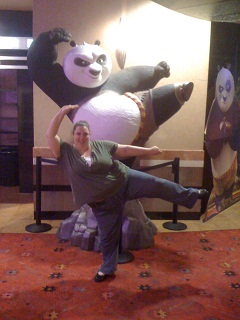
I’m THE Big Fat Panda

Obviously I'm not at full extension but my friend was having trouble with the camera and there is only so long that 100 people will wait for you to take a picture at a crowded theater!

I freely admit that this is an “overthinking it” blog.  I’m going to talk about a cartoon Panda as if he is a real person and a fat activist.  I know it’s a stretch, I’ll understand if you don’t want to come along for the ride! (Also, if you’ve not seen the original Kung Fu Panda, this post contains spoilers).

I love Kung Fu Panda.  Love.  It. Today I made someone drive 30 minutes to get this movie so that I could show it to a friend so that friend and I can go see the sequel tomorrow.

The first very cool thing about this movie is that the main character realizes that he can be an athlete without being thin. He then not only isn’t ashamed of being fat, but he actually uses his size:

He belly bumps, he sits on someone, he uses his size to gain advantage.  He could never do that if he was busy being ashamed of his size and trying to look smaller than he is.

His enemy asks “What are you going to do, sit on me?”.  Po responds “Don’t tempt me”.  What better way to shut down this fat shaming than to turn an insult into empowerment?

The quintessential exchange is:

“You cannot defeat me, you’re just a big fat panda”.

“I’m not a big fat panda.  I’m THE big fat Panda.”

Indeed, he is a fat panda.  It’s just a descriptor, he could just as easily have said “you’re just a black and white panda” but the enemy assumes that since fat has so much negative connotation it will make him feel ashamed. When fat is just a descriptor it takes the power away from those who want to hurl an insult.  When I’m having a business meeting with someone I’ve not met I tell them “I’m a short, fat, brunette”.  Plenty of people have told me “Oh, don’t call yourself fat!” but nobody has ever said “Oh, don’t call yourself brunette!” I purposefully use fat as a descriptor because I think it’s important for me to reclaim the word with no negative charge.  It’s my way of telling the bullies that they can’t have my lunch money any more.

Then of course there is the pure joy of watching him defeat someone who assumes that he is less of an adversary simply because of his size.  Skidoosh.

So maybe we fatties can take some advice from Po:  Take an attempt at shaming and turn it into a statement of pride.  Use fat as a descriptor, not as a judgment. Own our size and find ways to use it to our advantage.  Be the big fat whatever that we are.  For me it sure beats the alternative.

I’m not a big fat dancer.  I’m THE big fat dancer.

How about you?

For a little inspiration here is the final, end of the first movie battle. MAJOR SPOILERS:

My Readers are NOT Idiots and Other Keen Observations

When people disagree with my blog, there are three main points that they tend to make:

1.  I am a liar.  It is impossible to be healthy and obese.  I covered that here.

2.  I’m must hate thin people and encourage thin bashing.  I find this incredibly offensive.  I covered it in detail here.  And Here.   And Here. And about a hundred other places.

3.  It’s fine for me to think what I want (even thought it’s obviously wrong and stupid), but I’m incredibly irresponsible for putting it in a blog because people will read it and choose Health at Every Size like I did and then they’ll die of fatness and it will all be my fault. Oh, where to begin with this one.

The diet industry in this country makes nearly 60 billion dollars a year convincing people they should want to be thin.  They are assisted by almost every major news and media outlet buying into the conflation of weight and health and giving us 386,170 negative messages about our bodies every year, along with extraordinarily irresponsible reporting. Then there is the multi-billion dollar beauty industry.  Self Magazine put 34 weight loss stories on their cover in 2010 alone.  That’s almost 3 cover stories every month for just ONE magazine, and that doesn’t take into account the fact that they choose nearly every model in every picture based on a single standard of beauty . Billions of dollars and billions of work hours going into convincing people that they should want to be thin and that thin and healthy are the same thing.

I am one woman blogging a few hours a week.

What I’m getting at here is that if my message is that much of a threat to the mainstream then I think that they should consider how weak their message really is, and whether or not they want to keep pushing that message.

Even more to the point, my readers (with the possible exception of the people who stumble onto this blog and make this kind of comment) are not idiots.  They are capable of weighing evidence and making their own decisions.

I can’t even count the number of times I’ve said on this blog that I’m not trying to tell anyone how to live, simply demonstrating an option. People are allowed to make choices that are different than your choices or my choices, and that in no way invalidates your choices or my choices. We are all the boss of our own underpants, and we are not the boss of anyone else’s underpants.  Why everyone except these commenters is able to grasp that I will never know.  Of course you don’t have to agree with me but I think that this is just a big sack of not-my-problem.

Dancer’s Body and Other BS

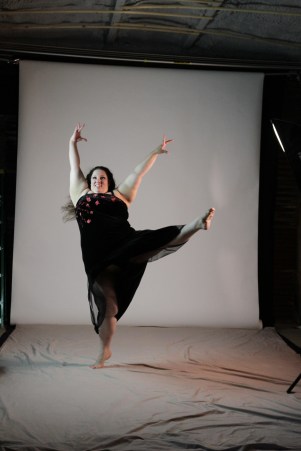
Ragen Chastain: 5’4, 284 pounds. Photo by Richard Sabel

After a workshop that I taught, a participant told me that she was told she shouldn’t take dance class by a dance class instructor because she doesn’t have a “dancer’s body”.  It struck a chord because I’ve heard this countless times.

Dancer’s body.  Swimmer’s Build.  Athletic physique.

Complete, Total and Utter Bullshit.

These ideas are constantly touted by two groups of people:

1.  People who want to sell us something “Buy my Taepilatyogalletboxing System and get that dancer’s body you’ve always wanted”

2.  People who rely on feeling superior to feel ok about themselves: “I have a dancer’s body so it doesn’t matter how well you dance, you can’t possibly be a dancer because you don’t have a dancer’s body.  I am therefore better than you and so my fragile sense of self-esteem and exaggerated sense of self-importance both remain intact”

Except that nobody actually has the right to declare anything about anybody else’s body. Nobody is required to do any kind of athletics or exercise, but anyone who wants to should be welcome.

Do you dance?  Do you want to?  Then you have a dancer’s body.

Do you swim?  Do you want to?  The you have a swimmer’s build. (Let’s try to remember that everything from minnows to whales swims, you know what I’m saying?)

Are you an athlete?  Do you want to be?  Then you have an athletic physique.

People can try to tell us otherwise, but happily we get to decide if we’re going to let people who are trying to sell us something or trying to put us down to make themselves feel better keep us from doing what we want to do. And we get to choose how we do it – do we want to find a comfortable accepting environment (even if it’s our living room)?  Do we want to crash the party with our “non-traditional” bodies?  It’s all up to us.

Like the blog?  Consider becoming a member! For ten bucks a month you can support size diversity activism, help keep the blog ad free, and get deals from size positive businesses as a thank you.

What do member fees support?  I get hundreds of requests a day (not including hatemail) from academic to deeply personal. I get paid for some of my speaking and writing (and do both on a sliding scale to keep it affordable), but a lot of the work I do isn’t paid so member support makes it possible (and let me just give a huge THANK YOU to my members, I really can’t tell you how much I appreciate your support!)   Click here for details

Here’s more cool stuff:

My Book:  Fat:  The Owner’s Manual  The E-Book is Name Your Own Price! Click here for detail

Dance Classes:  Buy the Dance Class DVDs or download individual classes – Every Body Dance Now! Click here for details 

If you are uncomfortable with my selling things on this site, you are invited to check out this post

Nobody Really Wants to Eliminate Ob*sity

I know that with all of “war on ob*sity” stuff you hear it’s hard to believe, but stick with me here for a minute.  First let’s clarify who the War on Ob*sity is actually against. It would seem to be against ob*se people, but that’s not quite true.  “Ob*sity” as currently defined is the result of a mathematical formula involving a ratio of weight and height called “BMI”  We’ve discussed before why the BMI is BS.  Part of the reason is that there are so many exceptions to the rule. Since BMI doesn’t take muscle mass into account, many hardcore athletes (most of the NFL for example) are ob*se based on the formula.  Nobody wants to get rid of athletes or force them to lose muscle to conform and so they are given an exception. If you are mathematically obe*e but without what is considered an excess of adipose tissue, you are excepted from the war.

So let’s just be honest: Nobody wants to eliminate ob*sity, they want to eliminate people who are visibly fat.  There is no war on ob*sity, there is a war against fat people.  And the front lines of this war are everywhere we look and listen – magazine covers, billboards, commercials, infomercials, ads on the internet, random strangers on the street, health care and wellness professionals, talk show hosts etc.

Knowing that, today I’m going to ignore the mountain of scientific evidence that says that  intentional weight loss doesn’t work.  I’m going to ignore all of the evidence that Health at Every Size does work.  I’m going to ignore the many healthy fat people and unhealthy thin people who exist and disprove the efficacy of conflating weight and health.  My question today is: Even if we would all be healthier if we were thin, is the War on Ob*sity a good idea?

Have you ever had something that you hated: a purse, some shoes, a knick-knack that was a gift from someone?  Did you take good care if it?  Were you inspired to dust it and polish it and keep it beautiful.

Me either.

The war on ob*sity has branched out to cover not just the appearance of bodies, but also their health, intelligence and worthiness. The War tells us that if our bodies are fat then they are unhealthy, ugly, unattractive and not worthy of love. We are told that we are not thin because we are lazy, don’t make healthy choices, and lack will power.  We are told that thin is the same as healthy and that we can’t have health without attaining a “healthy weight”.

95% of dieters gain back all of their weight plus more within five years. Yet if we are part of this vast majority,  we are shamed, tsk’d and called weak failures.

The war on ob*sity tells us to hate ourselves.  Then it says that we have to take good care of ourselves.  Then it says that it doesn’t matter if we take good care of ourselves, we have to lose weight or we should keep hating ourselves until we hate ourselves enough to take good enough care of ourselves to lose weight.

It’s ridiculous.  It’s a system that sets us up to fail, participates in our failure, then makes us feel horrible for failing, all the while profiting the diet industry to the tune of almost $60,000,000,000 (yup, that’s sixty billion dollars) a year.

So back to my original question:  Even if we would all be healthier if we were thin, is the War on Ob*sity a good idea?

I think that the answer is no. And I say it’s time to opt out of the war  all together because even if we would be healthier if we were thin, the war  still doesn’t make sense.  Here’s how I think we can do it…

  1. Notice how often this happens.  Decide tomorrow to see how many messages you get about ob*sity – from television, the radio, the internet (how many diet ads are on the pages you look at) etc.  Notice how many of those messages are placed forward by someone who either wants you to buy their product or has something to gain by maintaining the status quo (ie: they derive their self-esteem from being “better” than fat people)
  2. Appreciate your body! Your body is amazing – think of all of the stuff that it is doing for you right now:  you are breathing, your heart is beating, you are blinking, the list goes on and on.  Your body deserves to be loved and appreciated!  Just as it is.  Right now.  Right this minute.
  3. Do things that make you feel good.  If you don’t feel as healthy as you would like, then I would absolutely encourage you to make choices to take care of your amazing body.  Not necessarily so that you change its size or shape, or to fit into a bikini.  Just for the joy of feeling good and taking care of your amazing body.
  4. Stop judging others by their weight. Stop assuming that very thin women have eating disorders.  Stop assuming that fat people are lazy or unhealthy.  Strike words like “skinny bitch”, “fat pig” etc. from your vocabulary
  5. Don’t push your idea of health onto other people.  Practice healthy choices for yourself and stop telling other people how they should live unless they are asking directly for your thoughts or advice.  Your experience is just that – YOUR experience.  Don’t confuse your experience for everyone else’s.
  6. Speak out when you see other people partaking in these behaviors.  Every time someone says something like this they are reinforcing to someone else that they are unhealthy, unattractive and unworthy.  The idea of making someone hate themselves healthy is ludicrous.
  7. Tell your story.  A lot of people don’t even know that Health at Ever Size is an option for them.  That’s the entire point of my blog. I don’t want to tell people what to choose for their health, I just want to make sure they know that HAES is an option.

Speaking of telling my story, an article about me is appearing in the June issue of “All You” magazine (which is found in Walmart Stores).  It was beautifully written by Virginia Sole-Smith from The Beauty Schooled Project.  I love her blog and I just wanted to take this opportunity to thank her for the article and all of the support!

Taking Up Space

I am at La Guardia airport, leaving after spending a week in New York City.  It has been an incredible experience. I watched my Best Friend graduate from NYU at Yankee Stadium (I’m so proud of him that I could burst), and got to hear Bill Clinton speak (and he gave a great speech).  I got to do a workshop with the ever fabulous Golda Poretsky of Body Love Wellness,  at the ever famous Re/Dress plus-sized clothing store in Brooklyn. I got to see all kinds of neighborhoods in NYC that you wouldn’t see as a typical tourist. Got to spend a ton of time with my BF and his boyfriend just relaxing and hanging out which I rarely get to do.

But one of the reasons that I am happy to go back to Texas is space and the taking up of it by me. NYC, while amazing in many ways, does not suit me.  It seems to be an increcible city largely based on inconvenient travel, strangers touching and jostling you, and trying to occupy as little space as possible.  During my week here I had multiple experiences on trains and subways (sometimes very crowded ones) and I noticed that space is at a premium and people try to take up as little as possible – hunching over, collapsing their chests, abandoning their posture.  Nobody said anything about my size (or, at least, not to my face) but then again I never took a seat unless it was beside friends.  Things may have been different had I been sitting alone since I take up ALL of a seat and so someone sitting next to me would be stuck touching me (which I wouldn’t enjoy either, part of the reason that I chose to stand).

What makes this more interesting is a discussion that I had with a stranger on my way to NYC.  I was in the airport in Chicago standing on an escalator.  As I got off a woman said to me “I love the say that you stand. You just…take up space”.  Then a panicked look crossed her face and she stammered “I didn’t mean, I don’t mean to be rude or anything, I just…”. I cut her off and thanked her.  She said that I looked “regal”, thanked me for inspiring her and then walked on to her flight leaving me feeling super awesome.

This experience was with me as I watched people try to take up as little space as possible.  Maybe it’s because I’m a dancer or maybe it’s just me but a big part of feeling good about myself and happy in my body is standing up straight with good posture and that equates to taking up space. I do not apologize for the space I take up and I do not hesitate to make sure that my body has the space it needs (for example, as a short fat person often times if I sit in a booth in a restaurant the height is perfect to dig into my stomach as my boobs rest on the table.  Yeah…no.  I’m absolutely moving to a space that appropriately accommodates me. This is my body and space is it’s birthright and if you feel that it’s not fair that I take up more space than you, there is nothing stopping you from trying to get to my size or wearing a parka so we’ll be even.

This probably brings up the airplane discussion which I already talked about here.

I guess my point is that if you live in a place that encourages you to be small, or if you try to make yourself small as a way to deal with society, or it’s just a habit, that’s absolutely a valid choice.  But maybe consider looking for opportunities to just take up some space. Whether you take a trip to the country or just move the furniture in your living room, consider standing up straight, throwing your shoulders back, moving around and really loving taking up space.