Obesity and Health Care Costs

Last year the Congressional Budget Office (CBO) released a report about the rising costs in health care, including the reasons. Media headline’s based on this report included “CBO – Obesity will Decimate Future Health Costs and Care” and “Obesity’s Punch to the Gut”.

You know, sometimes I feel like a tinfoil hat conspiracy theorist, but I’m pretty sure it’s not me –  The CBO report stated clearly that obesity was NOT a major cause for rising healthcare costs. So what in fat hell happened here?

CBO- Obesity will decimate future health costs and care

This article included a quote from the CBO report: “per capita spending on health care for adults would rise by 65 percent—from $4,550 in 2007 to $7,500 in 2020.”

The quote is accurate, but they cut off the last part of the quote which reverses the meaning.  The actual CBO report says:  ” per capita spending on health care for adults would rise by 65 percent – from $4,550 in 2007 to $7500 in 2020largely as a result of the continuation of underlying trends in health care that have led to rapidly increasing spending for all adults regardless of weight.” (emphasis mine) I have a hard time believing that this was accidental as that would require me to defend the idea that a professional journalist cannot tell when a sentence ends.

“Obesity’s Punch to the Gut”

The Boston Globe ran this headline and also used numbers from the report that seemed large out of context to paint a picture of obesity as the culprit for healthcare costs, thereby grossly misrepresenting the conclusions of the report.  It almost seems like they had decided what it the article was going to say before they read the report. Maybe they just didn’t want to give up this witty, witty headline. (sarcasm meter 10 out of 10)

McKinsey Global Institute (MGI) published a report called  “Accounting for the Cost of Health Care in the United States,”  Using a comparative analysis of the US with Germany, Japan, Italy, Spain, France, and the United Kingdom they found, among other things, that Americans are indeed fatter, but that we are not significantly sicker. We do spend a lot of health care ” $650 billion above expected, even when adjusting for the relative wealth of the US economy.”  So, was obesity the culprit?

Can we attribute this additional spending to the fact that the US population is less healthy overall than people in other developed countries?  Our analysis suggests that the answer is largely no. In fact, disease prevalence in the United States is slightly lower than in peer OECD countries despite an increase in the burden of chronic disease and growth in risk factors such as obesity.

Adam Carroll put information from that report into a very illustrative graph (obesity -which is not a disease- and diseases correlated with obesity are included in the blue section).
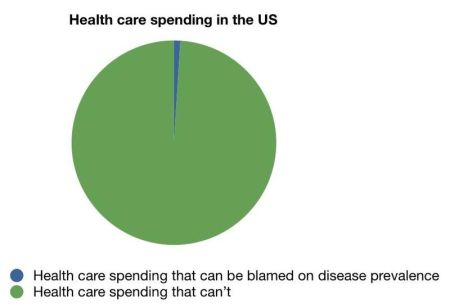
Also let’s remember that “costs of obesity” are not the same as costs of obesity hysteria and that many of the costs of diets are included in this figure, but that’s a topic for another blog.

If you are interested in where our healthcare spending goes, I highly recommend reading the report.  For now, remember that we know that no weight loss intervention ever studied has been proven to effectively get obese people into the “normal” BMI range longterm, we now know that getting them into the normal BMI range isn’t going to have a discernible impact on healthcare costs because fat people aren’t having a discernible impact on healthcare costs.  We know that obesity isn’t the reason for the huge rise in healthcare costs, we cannot even find a causal relationship between health and weight despite a mountain of attempts, and many studies tell us that healthy habits create similar health outcomes in bodies of a wide variety of sizes.

Yet outlets that call themselves “news” continue to lie to us saying that diets work if you try hard enough, that obesity is causing an insurmountable rise in healthcare costs, that we have to get people to lose weight or we’re all going to go broke paying for their healthcare, and that extra weight causes health problems.  Is it because they are getting ad dollars from people selling weight loss? Is it because people like to read about how fat people are the cause of all the world’s problems? Do they really believe what they write?  Are they substituting everybody knows” for actual facts? Are professional journalists really incapable of discerning between the middle and end of a sentence? I don’t know and that’s not what’s most important to me right now.

What’s important to me is that we can choose to stop buying these lies wholesale. We can stop shopping for our information at Merde Mart right now.  We are responsible for verifying our news. Often is doesn’t even take a huge effort, these lies are debunked by a simple reading of the CBO report.  We also need to consider that other people are being lied to and buying the lies.  This may include doctors, teachers, healthcare providers, your mother, and plenty of people who comment on this blog.  We are responsible for making sure that we get good information and unfortunately, that is not always simple or quick. We live in a 24 hour news cycle that produces some highly suspect news. I suggest that you verify your information because, whether accidentally or on purpose, the media is lying to us.

Join the Club…Support the work!

I do HAES and SA activism, speaking and writing full time, and I don’t believe in putting corporate ads on my blog and making my readers a commodity. So if you find value in my work, want to support it, and you can afford it, please consider a paid subscription (it’s like a fan club, you get bonus stuff, discounts, and you’re always the first to know about projects) or a one-time contribution.  The regular e-mail subscription (available at the top right hand side of this page) is still completely free. If you’re curious about this, you might want to check out this post.  Thanks for reading! ~Ragen

HAES When You’re Sick

I recently saw this question posed in an online forum.

I got the results back from my blood panel and aside from the high blood pressure, I also have high cholesterol.

I’ve sort of known this was coming for a while now. I have a family history of high cholesterol, hypertension and heart disease.

So my question is, what the hell do I do now? Is HAES irrelevant for me now? Is there a HAES approach to lowering cholesterol? It makes me wonder if HAES is best for maintaining health, rather than treating specific metabolic disorders, like high cholesterol or diabetes. Thoughts?

This is a really interesting question.  Before I get into it let me be clear that I’m not a doctor or nutritionist.  I’m just a girl with a blog and I encourage people to find practitioners they like and trust. I’m not trying to give any kind of medical advice here, but I do want to give my thoughts.

The first question I always ask when someone blames a medical issue on my weight is “Do thin people get this thing?” The answer is always “yes” so my next question is then “How do you treat it in thin people?” I want to try that before I try a risky prescription that has a 95% failure rate (which is exactly what dieting is).

Based on all the research I’ve seen the relationship between weight and health problems is correlational, not causational.  Therefore fat isn’t  proven to cause disease and weight loss isn’t shown to cure it. Health is multi-dimensional and includes behaviors, access, environment, stress and genetics. We can only control some of these and so my understanding of the Health at Every Size® (HAES) approach is that healthy behaviors, while they don’t guarantee health, are our best chance.

If you have a disease and it is to be managed, my understanding is that it’s managed through behaviors as well. And it seems to me that the recommended behaviors should be the same regardless of the size of the person with the disease. Even if weight loss weren’t statistically impossible for the vast majority of people, if thin people and fat people both get a disease, then being thin is neither a cure nor a preventative.

To me, following food recommendations to manage a health condition is at the very core of a Health at Every Size practice. You eat in ways that nurture you. Eating to manage a disease and eating to make your body smaller are two different things for me, and so eating to manage a health situation would fall well within my HAES practice, while trying to lose weight to manage a health situation would not.

I also think that we have to be careful of the information that is out there. In recent years what was considered “healthy” blood pressure has been lowered several times with the help of the pharmaceutical industry and “healthy” blood glucose levels have also been lowered.   John Hopkins-led research found that “High cholesterol levels in middle age do not appear to increase women’s risk of developing Alzheimer’s disease and other forms of dementia later in life, despite a body of scientific evidence long suggesting a link between the two.”  (See what I mean about correlation and causation…)  That article suggests that you should still worry about high cholesterol because of heart disease, but that has been questioned as well.

Also, it has been my observation that people test extreme diets to mitigate and manage disease, but do NOT test moderate ones. Recently, a study looked at reversing type 2 diabetes with a 600-calories-per-day liquid diet.  I wonder what would have happened if they had done things like eat regular small meals through the day and eat more whole grains? People seem to want to discover a “Break Through!” solution, not just “eat a little differently and move your body.”

In the end I think that we all have to decide for ourselves if, and how, we will use HAES to support us, and what health really means.

UPDATE! 

In our petition asking the National Eating Disorder Association to end is partnership with the STOP Obesity Alliance (an organization funded by pharmaceutical companies trying to get obesity declared a disease so that insurance will cover their products), we are at 567 signatures!  We’ve passed our original goal because you are awesome!!!!!  Now let’s blow the goal out of the water  –  please keep signing, passing it on and reminding people.  We cannot allow people to be declaring physically or mentally ill based on a ratio of their height and weight no matter how many pharmaceuticals it might sell or how many insurance reimbursements it might force.

Ask a stupid question…

I was thinking today of some of the absolutely stupid things that people say to us fatties.  Again, although this isn’t our mistake it becomes our problem.  In that spirit I offer some things to say when people say dumb things:

You have such a pretty face.

  • Sure, but wait until you see my fine, fine ass.
  • Thanks, it matches my beautiful body

Do you need to eat that?

  • I thought that you were an accountant, are you also a dietitian?
  • Yes, because dealing with your rudeness is depleting my glycogen stores at an alarming rate
  • If I want to talk to the food police, I’ll call 911
  • Thanks for trying to give me your insecurities, but I was really hoping to get a Wii for Christmas this year
  • No, but using my fork to eat helps to keep me from stabbing you with it

What are you doing about your weight?

  • Moving it through space with grace, power, and joy
  • Dressing it in fabulous clothes and taking it out on the town
  • My weight is fine, what are you doing about your rudeness?

Don’t you know that being fat is unhealthy?

  • Don’t you know the difference between correlation and causation?
  • Don’t you know what is and is not your business?
  • Show me your evidence or shut up.
  • No, I don’t and you don’t either.  It looks like you need to do some research.

This Health at Every Size® stuff is just fat people justifying people being fat.

  • My fat body is amazing and requires no justification. Your rudeness on the other hand is inexcusable.
  • Health at Every Size says that healthy habits are the best chance for a healthy body.  Are you suggesting that we should tell people to practice unhealthy habits?
  • It sounds like you are just trying to justify your fat bashing.

But [I, my sister, my friend etc.] lost weight and they are healthier that they were.

  • Did they change their behaviors to lose weight?  Then is it possible that the weight loss and the better health are both side effects of the behavior?
  • That’s fine for [him/her] but everyone does not have to choose the same path.
  • I’m happy for [him/her] but with only 5% of people able to maintain weight loss with no guarantee that it will improve their health, and the rest becoming less healthy with each new attempt, I still think that weight loss is too a dangerous choice for me.

People on Dancing with the Stars lose weight , why don’t you? (It’s possible that this one just happens to me)

  • People are able to appropriately interact with strangers, why can’t you?
  • People on Dancing with the Stars appear on television half dressed to detract from poor technique.  I don’t need to do that either.

All you have to do is eat less and exercise more and you’ll lose weight.

  • Right, and all you have to do is click your heels together and say “there’s no place like home” and you’ll be there.
  • Sorry, but that’s not what the evidence says.  Unless you have some proof you’d like to show me we’re done with this discussion.
  • All I have to do is eat healthy and do movement I enjoy and I’ll give myself my best chance for health and that’s much better than a 5% chance at being smaller than I am now.

You’re pretty for a fat girl.

  • I’m pretty for any girl.
  • That’s weird, I was just thinking that you are attractive for a rude person!

You’re not fat! (As in, like those other stereotypical fat people)

  • I am absolutely fat, and there’s nothing wrong with that.  The problem happens when people decide that from looking at our bodies they know what we eat, how much we exercise, how healthy we are, etc.
  • You know, when you say that I’m not fat, when I obviously am, it makes it sound like you think there’s something wrong with the body that I live in all the time, there isn’t.

We can’t have you as a speaker because your lifestyle is obviously leading you to an unhealthy body and we don’t think you make a good example for our staff.  (again, this one might just happen to me)

  • Fuck you.  (Ok, that’s not really one I recommend)
  • Studies show that all it takes to get people to try something previously thought impossible is that one person does it. When I show up as a fat athlete, it lets other fat people know that athleticism may be possible for them to.  That’s important since they get the constant message that they are lazy, unathletic and that they are bad examples no matter what they accomplish.
  • You’ve had other successful athletes as speakers.  It’s interesting that you are comfortable ignoring all of my accomplishments because you can’t set aside your prejudice that I did those things in this body.

Are you being bullied about your weight?  Then do something about it.

  • The solution to social stigma is not weight loss.  It’s ending social stigma.

You can’t tell me that you’re comfortable if you’re fat.

  • You can’t tell me whether or not I’m comfortable since you’re not, you know, me.
  • I can and I am telling you that, despite your best efforts to make me uncomfortable, I am very comfortable being fat.

Selective Reality

On Facebook a woman named Misty responded to my post about Whole Foods horrible benefits by BMI program with the following (spelling and punctuation are copied verbatim):

“Bigger people do have more health issues. If they didnt docs wouldnt stress the importance of being thin. And michelle obama wouldnt be campaigning tn end obesiety.”

This perfectly frames the problem with our conflation of weight and health, and demonstrates the reason for the frustration that those of us who are actually looking at the research and drawing informed conclusions experience.

I can only imagine that this woman is insisting on bloodletting to cure her throat infections, taking thalidomide to cure her morning sickness, using the bumps her head to determine if she is a future criminal, and being treated as mentally ill for being a female who speaks her mind. Doctors have made all kinds of mistakes over time, however well-meaning, and it’s important that we realize that.

I like Michelle Obama, but I don’t think that she is infallible.  I believe that she was well intentioned but dead wrong when she chose to focus on children’s weight instead of on their health.  And I think she knows it.  She seems to have been making a concerted effort lately to talk about health instead of weight.  I appreciate that, it’s a step in the right direction.

But I wish that she would stand in front of the same press to which she called obese children a “problem” that “needs to be fixed”, and tell them that she made a mistake. I wish that she would say “In addition to teaching our kids how to be healthy, I think it’s important to teach them that when you’re wrong you admit it and change course. When I suggested a war on childhood obesity I did what I thought was right, based on the best evidence that I had at the time.  But I have since learned that focusing on their weight poses dangers to children of all sizes including increased risk of eating disorders, body dysmorphia, self-esteem issues, and bullying.  I’ve also learned that BMI is not a useful measurement of health and can cause confusion and harmful misunderstandings.  Our children are precious and they deserve our best efforts to support their physical and mental health.  So moving forward I am removing weight and BMI from the discussion of children’s health.  We are going to focus on providing education, access to healthy foods, and helping our kids develop a lifelong love of movement. And we are going to do it in ways that support kid’s self-esteem and mental health. “

That would be brave.  It would be noble, it would show integrity, and it would help our Facebook friend and people like her understand that First Ladies and doctors are fallible.  (If you are reading this from the White House and want to hire me as a  speech writer I can be contacted at ragen at danceswithfat dot org.  Just sayin’)

I know  that “reality” is a fluid concept.  (The Earth revolves around the sun and is round. Antibiotics are more effective than bloodletting for strep throat. We’re pretty sure that the heart, not the liver,  is what moves blood around the body.).  Therefore, I am extremely selective about the “reality” that I choose to accept and the “reality” that I choose to change.

What I hope fat people remember is that whether people are making the mistake of confusing weight and health because they are well intentioned or because it’s incredibly profitable for them, it’s still a mistake; and even if a million people are screaming a myth at the top of their lungs that doesn’t make it the truth, no matter how powerful or credentialed they might be.

Our weight is not a barometer for anything  – not for our health, value, intelligence, abilities, or anything else. From looking at our size, people can determine our size, and what their prejudices and preconceived notions about people of our size are.  Anything else they think they know is just them making stuff up in their heads based on those prejudices and preconceived notions.  That’s not our fault, though it does become our problem.  There are many ways to deal with this problem ranging from acquiescence to activism, at those are discussions for future blogs.  Regardless of how we deal with the problem it is imperative that we remember that the mistake theirs.

Speaking of activism, the petition asking the National Eating Disorders Association to end their partnership with the STOP Obesity Alliance now has 403 signatures, almost to our goal of 500.  You guys rock so hard! Thanks to everyone who has signed it and passed it along so far!

Bad Editing, Dancing Hippos, and Grown Men

First, this story from reader Jess appeared as a comment yesterday.  It’s relevant to today’s blog and it’s awesome so I wanted to make sure that everyone got a chance to read it:

I’m on my university’s dance team, and let me tell you, there are two big girls on the team and they kill the dances, every time. I am absolutely jealous of the way they move. And I’m not the only one, haha. They’re two of our best.

I remember one time we were performing at halftime at a football game…there were two or three girls behind us who noticed our matching clothes and asked who we were. We told them we were the dance team, exchanged some “How is it?” “Oh it’s fun” smalltalk, and then turned around to watch the game.

A few minutes later, we heard one of the girls who was sitting behind us begin to wonder under their breath about the two bigger girls on our team. Stuff like “I wonder why they let the two fat girls on the team?” “Maybe they just joined to lose weight.” “I wonder if they can do like, leaps and jumps and stuff?” Then, one of the dancers (a really loud, outgoing, no nonsense kind of personality), who was sitting right in front of them, turned right around and said,

“Our two fat girls challenge you to a dance off, after the game, behind the stadium.” And she was totally serious. The girls behind us went redfaced.

“Uh, no, no thanks.”

“Why not? They’re fat, right? So they can’t do leaps and turns and stuff. Doesn’t the fact that you’re thin mean you can automatically do a triple pirouette?”

The girls behind us sort of laughed in a confused, uncomfortable way. “We were just joking.”

“Well I’m not. Behind the stadium, after the game. We’ll grab some football players to be judges.”

“Uh, we don’t want to dance battle.”

Our dancer gave her a, quite frankly, terrifying look. “Damn right you don’t,” she said, and then turned around again.

See I told you – great story right?! It put me in a fantastic mood right up until I heard a story that made my blood boil.   I was talking to America the Beautiful 2 filmmaker Darryl Roberts, who is awesome.  He was telling me that one of the film’s editors really didn’t support the message that you could have health without being thin.  Darryl watched over him and even re-edited some of his work to make sure that the finished product reflected Darryl’s vision.  Now that the movie’s final cut has had several of its premieres, the editor called Darryl to say that he “got him”.  Darryl asked what he meant.

When I am first introduced in the movie, it’s with a clip of me dancing. This editor was apparently quite proud to tell Darryl that the background music for this part of the film is the music that the hippos dance to in Disney’s Fantasia.  See what he did there – he used music associated with hippos. You know, because I’m fat…and hippos…get it?

Now, let me make sure this is clear.  I’m not saying that the editors mean-spirited, emotionally immature, technologically advanced 8 year old kid decided to make a funny by comparing the fat woman to a hippo. This is a grown ass man, being paid to do a job.  And he thought that the best use of his paid time was researching, finding, and cutting music so that he could make fun of me – subtly.

Except that he failed – badly.  The dancing hippos in Fantasia are really graceful. They are shown as happy, confident, accomplished dancers and all of the alligators want to dance with them. How is that insulting? I guess I’m vaguely insulted that his effort on this was so weak.

Let’s do a quick comparison (I know it may be easy to get confused – I’m the one in red…)

This one is the hippo...
This one is me (with my awesome coach Rowdy)

As I drove back from Dallas I was trying to think of what I would say to this guy.  I got home and checked my e-mail and here’s what I decided:

In just the last 24 hours I’ve received e-mails from people telling me that my work:

  • inspired them to try Zumba workout classes that they were “too scared to try before”
  • inspired them to “concentrate on healthy eating and exercise and ignore the people who try to make me feel bad about myself”
  • helped them “reclaim their health”
  • helped them “spend 10 minutes not hating myself… it was the longest I’ve gone in over 10 years”
  • made them ” REALLY look forward to being that doctor who helps patients find the cause of their problems, not the cause of the doctor’s problem”
  • gave them “hope” and made them rethink “committing suicide because I just couldn’t take all the haters anymore”

So, Mr. Editor, what have you done?  Who have you inspired? You had the chance to be part of something that is making a tangible, positive change in the world and you squandered it to make a cheap, pathetic joke at my expense.  Are you proud of yourself?  In the last 24 hours – just like everyday – I’ve also received hatemail from people like you (only, you know, more clever and actually able to come up with something insulting) who thought it was hilarious to make fun of the fatty so that they could sit in a puddle of their own self-satisfaction and feel superior to somebody for a minute.  Please understand, I don’t do this work so that people like you realize the error of your ways (although it would be great if you did).  I’m here to support the people who your behavior drives to consider suicide. I don’t care nearly as much if you think that fat people deserve respect, as I care that fat people understand that they deserve respect.

You picked the wrong girl dude.  I get death threats weekly and they don’t even phase me, so if you want to insult me you’d better come at me with more than just some dancing Disney hippos.

If you want to rethink your strategy I would welcome you to the Health at Every Size®  movement where we concentrate on health instead of body size and support people in making their own choices, setting their own priorities, and getting good information – instead of making fun of them and deluding ourselves into believing that we’re helping them to hate themselves healthy.  I am absolutely prepared to accept your heartfelt apology and move forward as part of the same team.

If not, in the spirit of Jess’s dance team, I challenged you to a dance off.  Pick the time and the place and I’m there.  I even have a suggestion for a song.  There are no fat dancing animals but I like it all the same:

UPDATE:  In good news, we’re making some real progress on the issue of the National Eating Disorders Association’s harmful partnership with the STOP Obesity Alliance.  There are a couple of ways that it can go at this point but either way having the most signatures possible will be really important.   If you haven’t already, please consider signing the petition and passing it along to your network:  http://www.change.org/petitions/tell-neda-to-stop-working-with-the-stop-alliance I hope that have a more comprehensive update very soon!  EDIT:  We won! NEDA pulled the partnership off the website and stated that they have no ongoing relationship with the STOP Obesity Alliance.  We are making a difference!

I’ve Been in a Ditch, But I’m Not There Now

Today my friend Amy and I drove from Austin to Dallas for an America the Beautiful 2 – The Thin Commandments Premiere.  Along the way Amy took her eyes off the road to look at something and we started to drift right.  When I teased her about it she said “I’m a very successful driver based on the fact that I’m still on the road.  I’ve been in a ditch, but I’m not there now.” (Amy is both feisty and clever, and so this phrase was uttered with a feisty cleverness that made it hilarious.)

It also clarified for me everything that is pissing me off about this completely inappropriate partnership between NEDA and the STOP Obesity Alliance.  The idea that someone would call me diseased or claim that I have an eating disorder just based on the size of my body, my amazing body that does amazing things, is ridiculous and offensive beyond all human reason, not to mention completely unethical.  (No matter how much more money it makes them because of forced insurance reimbursements and a huge new target demographic for their products.)

Tonight during the film Q&A a woman felt the need to continuously assert that obese people as a group don’t exercise and are unhealthy.  Conveniently, the two examples right in front of her were “exceptions to the rule”.  At one point she said “You are the exceptions, most of the rest of them don’t exercise!” (Information that she seems to have acquired via rectal pull.  We already know the two things that you can tell by looking at a fat person.) I think that history has shown us that anytime you characterize an entire population as “them”, and proceed to make broad sweeping generalizations about them, you are headed down a bad road.

And what makes it even more frustrating for me personally is that when I had the body that everyone seems to think would prove that I’m disease free and have a healthy relationship with food, I was suffering from an eating disorder and sicker than I’ve ever been in my life. Which is why I’m a more competent witness to my experience than someone with a scale, a yardstick, and a BMI app on their iPhone, or someone with the ability to state the same prejudice loudly and often during a Q&A session.  I’ve been in a ditch, I know what it looks like, and I’m not there now.

Hey, do you suppose that’s why diagnostic tools exist?  You know, so that Medical and Mental Health professionals don’t make up stuff based on their preconceived notions and prejudices or what will bring them the biggest profit potential? Hmmm…

My ditch was all about dieting and trying to lose weight because I thought that was the path to health.  When it didn’t work I just tried more and harder.  Eventually it occurred to me that my strategy basically amounted to trying to get out of the ditch by digging out the bottom – which of course just leaves you in a deeper hole.  When I put down the shovel and started using my brain things came together for me and I found a path to health that I love and that works great for me.  It’s not that I’ve never been in a ditch (I certainly have), or that I’ll never be in a ditch again (it could happen), it’s that I’m not there now. And jumping up and down and claiming that I am – because it means that you can sell me your stuff and force my insurance company to pay for it, or because it makes you feel superior- does not make it so.  Please sell Concern Trolling for Fun and Profit somewhere else, we’re all stocked up here.

Picture Pages!

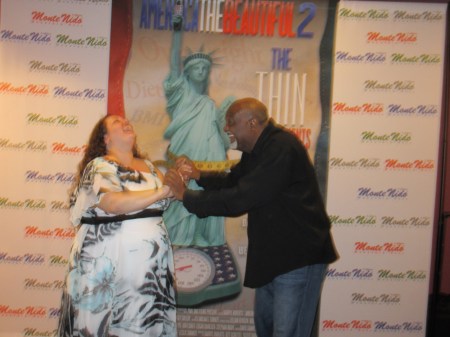
Now that I’m all packed for the Dallas Premiere tomorrow (there’s still time to get in on the fatty/fatty friendly lunch at Twisted Root Burger on Saturday at 11:30ish).  I realized that I hadn’t posted an update with all of the pictures from the Los Angeles Premiere. In cases where I do not know the people in the photograph well I kept the names out of the picture, but rest assured that I do know your names and you are awesome.  Almost all of these pictures were taken by Rose who was my tourguide in LA and is a super cool person and an excellent photographer.  These pictures would be in some reasonable order except I’m being defeated by technology at the moment and so they are captioned and in completely random order.  Enjoy!

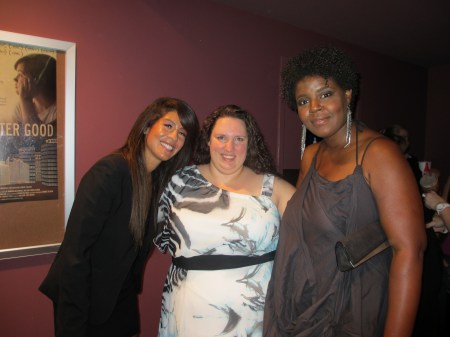
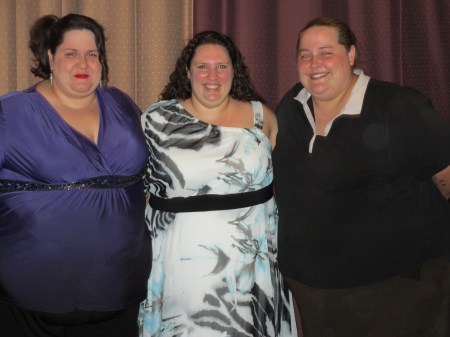
Darryl calls us "The Divas". Candie - a Realtor from Chicago, Chan - his sister, and me. Each of our stories is in the film. Why yes, that is another awesome dress provided to me by the fabulous designers at http://www.igigi.com
Rose steps from behind the camera for a picture in the lobby!
With two lovely ladies of NAAFA Los Angeles. I heart them muchly!
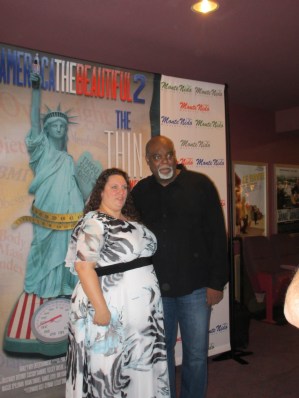
Darryl and I taking official PR shots.
Darryl (the filmmaker) and I high fiving after he told me that a picture of him, Candie, and I from the NYC premiere had been picked up by the AP Wire was was on the front page on Yahoo!
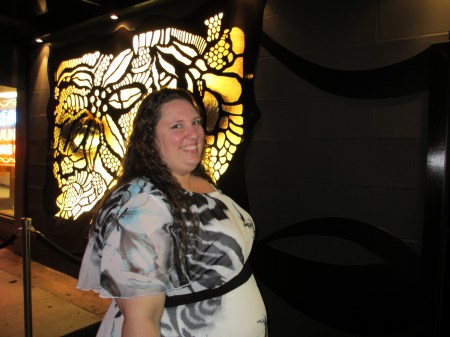
We started out at a lovely cocktail reception put on by Kantor & Kantor in honor of the movie and Carolyn Costin's new book. It was at the Hyde Lounge, a velvet rope night spot much cooler than I. The door guy was so cool as to be absolutely no fun and so he declined to be in the picture.
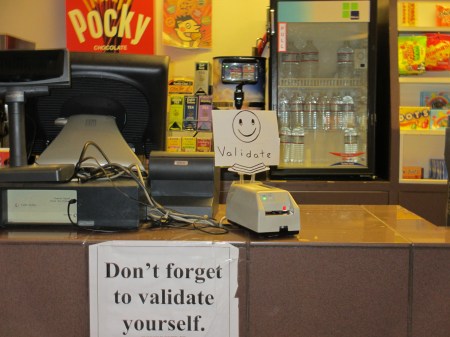
We fell in love with this sign when we walked into the theater. It's good advice in parking and in life.
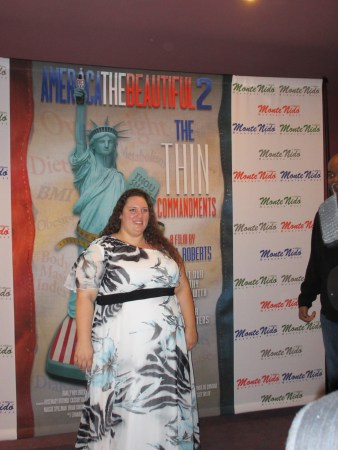
Here's me in front of the step and repeat. Yay I got to feel like a movie star.
Here I am with the fabulous Jeanette of The Fat Chick
With Dr. Barry Norman who I first met at the IADEP screening. Barry is awesome and is a stats geek like me so much fun geeky conversation was had.

The Five Percent

Before I get into today’s blog, there is now an official petition asking the National Eating Disorders Association to end their harmful partnership with the STOP Obesity Alliance.  Of course these things run on signatures so if you would like to add yours that would be awesome (and if you passed it on via FB, Twitter etc. that would be even awesomer!)  The signature goal is 500 but I’d like to blow that out of the water.  Just Click Here to Sign! (The link to pass it on is http://www.change.org/petitions/tell-neda-to-stop-working-with-the-stop-alliance)

On to today’s blog:

I got the following comment on my blog about Fat Activism, and it’s a question that I hear a lot so I thought now was a good time to address it:

5% of people DO SUCCEED in losing weight and maintaining the loss. Thus, 5 out of every hundred, 50 out of every 1000, 500 out of every 10,000… 5,000 out of every 100,000 succeed, In spite of the now near constant chant that it “can’t” be done About the same number of people who manage to turn around failing businesses, become proficient at difficult skills of any kind, – you see my point?
I am against fat-phobia, and I agree that people are healthy at many weights. What I am tired of is “why try since it can’t be done?” – when what is really meant is “It is extremely difficult and means life changes at several levels, not a temporary diet… but some do succeed”.
My point is, that if people want to give it a try to lose some of their weight, for whatever reason (unless they are anorexic), the it is equally offensive for you and other bloggers to keep telling them “It’s nice to see you “try” but it won’t work” as you find the remarks of those who you helped with your consulting.

My answer

Thanks for the questions. The reason lies not just in the “can it be done” (and it should be noted that the 5% success rate is generally within the margin of error for the studies), but also in whether it makes sense to do it. The 95% of people who are likely to fail at weight loss are also likely to become less healthy than they were before those attempts (including markers of physical and mental health) which means that the most common outcome of weight loss attempts is weight gain and endangerment of health. The consequences become worse the more that people attempt weight loss.

There is also no proof that losing weight causes an increase in health – as weight has not been proven to cause health problems (only to be correlated with them) and weight loss has not been proven to cure them since it’s most likely that the behaviors and not the weight loss are responsible for the health changes . A Health at Every Size perspective where we concentrate on health rather than weight offers all of the health benefits of a weight loss regimen without the risks. Therefore the only benefits of weight loss are social which makes it a civil rights issue and not a health issue at all.

You’ll note that I never tell people not to lose weight, but I think it’s important – especially in a world where weight loss is marketed as a successful cure for things – that people understand that suggesting weight loss is prescribing something that nobody has proved is possible for a reason that nobody can prove is valid. I was always honest with consulting clients about their odds of success and also about the consequences of lack of success as I am when it comes to weight loss.

But there’s more to it than that.  When the commenter says ““It is extremely difficult and means life changes at several levels, not a temporary diet… but some do succeed”, that makes it sound like most people fail because they just don’t try hard enough or aren’t willing to make “life changes” and that’s simply not what the data reflects.  In truth the body has a series of very strong psychological and physiologic deterrents to weight loss that may make long term weight loss impossible for many people.

She says “About the same number of people who manage to turn around failing businesses, become proficient at difficult skills of any kind”.  The trouble is that this isn’t about being proficient at a skill, this is about our health. If Viagara worked 5% of the time and 95% of guys who took it became LESS able to get erections, I seriously doubt that we would be telling guys to keep taking it and just try harder.  If  a health intervention only works 5% of the time with a negative outcome 95% of the time, then we call it a failure and go looking for another health intervention.  For some reason dieting and weight loss have been exempted from this rule. That’s dangerous because the rule exists to protect our health.

The commenter is tired of “why try since it can’t be done?”  For the record, I’ve never said that.  I make  great effort to avoid telling other people how to live since I want the way that I live to be respected.  If you want to diet, that’s fine but I think that you should have access to true and correct numbers about success rate, possible side effects, and long term dangers.

As far as being offensive, people are allowed to decide to be offended by the truth but that’s entirely their deal and I’m certainly not going to gloss over it or ignore to protect someone’s delicate sensibilities. The truth is that dieting leads to weight gain and endangered health in 95% of the people who try it.  If someone disagrees that’s fine, but in the immortal (paraphrased) words of Jerry McGuire: SHOW ME THE RESEARCH!

Don’t forget to sign the NEDA petition if you are so inclined (and pass it on!)

WORLD TOUR UPDATE

The Schedule is F&#$ed.  It’s nobody’s fault – the first leg was intended to be in the States and follow the American the Beautiful 2 Premiere schedule.  The premiere schedule has changed quite a bit and is in flux so it doesn’t make a lot of sense for me to follow the movie around since we can’t get everything scheduled and marketed in time (although it’s super fun to go to the premieres and feel like a Movie Star and meet cool people and Darryl -the film-maker- is awesome).

I will be in Dallas this weekend for the Friday and Saturday premieres (and if you want to have lunch on Saturday then e-mail me at ragen at danceswithfat dot org and we’ll get an awesome Fatty and Fatty Friendly lunch together)

After that we’re continuing with an independent tour.

My awesome PR Team is hard at work with connections in a series of cities in the US, Canada and overseas both booking gigs and getting the cities in some kind of reasonable order.  It’s no small feat! In the meantime I’m using this time to finish my book, get the dance classes ready to go online and blog until 2am.

If you want a tour stop in your city you can definitely e-mail me (ragen at danceswithfat dot org) and we’ll see what we can do! I’ll get the new and improved schedule up as soon as possible and hope to see you soon!

Movement and Looking “Right”

I'm not a big fat panda. I'm THE big fat panda.

I took a Zumba class tonight that had a lot of latin hip movement.  After class one of the women came up to me and said that I was a “great dancer” but that she thought I should “tone down the hip movement” because it “just looks dirty on someone your size…it’s not your fault…I mean, no offense…” she trailed off, I assume because I was looking at her like she was out of her damn mind.

Okie dokie.  First of all, I don’t know why people say these things to me.  I was wearing a shirt with a picture of Kung Fu Panda that says “I’m not a big fat panda.  I’m THE big fat panda” so you would think that she might have caught the Fat Pride wave but I guess not.

I got some control over my facial expression and decided to try responding with a series of questions in the faint hopes that she would lead herself to some kind of  revelation: “Why do you think you feel that way?”

“Um, I guess it’s because you have so much more body – it just looks more…decadent… when you do it.  Obviously you have great technique.”

“And you feel that’s a bad thing?|

“It makes me uncomfortable”

“And you feel that the solution is to tell me that I should move my own body based on what makes you comfortable?”

“I don’t know what else to do”

“May I make a suggestion?”

“Sure”

“You could try looking at your own biases and prejudices about people of size.  Would you have said that same thing to a dancer about her skin color?”

“Oh, I honestly hadn’t thought of that.  Oh my gosh, I’m …holy cow I was totally out of line – I’m so sorry.  Thank you for talking with me about this.”

I love it when a plan comes together.  (I also love it when somebody says “holy cow”, I don’t know why.)  Seriously, I’m really happy that I could help her through that and that she was willing to be open to rethinking her strategy.  But it brings up an issue that I still sometimes have as a fat dancer.

I typically dance “kinesthetically”- When I watch someone do a move, I feel how it feels to do it in my body and then my body can reproduce it without much trouble.  That’s all well and good but my coach Rowdy will back me up that this does not work for me in Waltz or West Coast Swing. For whatever reason, I just don’t “feel” those dances.  This created a problem because, not matter what I did I never looked like other dancers. I would work on something, then look at the mirror or video and it wouldn’t “look right”.  My attempts to look like other people’s bodies lead me far away from proper technique.

I realized the problem one day when my friend, the brilliant plus sized model/actress/life stylist CJ Legare, was talking about the difficulty of making clothes for fat people because of the varied three dimensionality of our bodies.  In other words, our bodies are so differently shaped from each other and from the way that thin people’s bodies are shaped that it’s much more difficult to make clothes for us.  Eureka!  That was the problem with my dancing. I almost exclusively see dancers who are thin and so I’ve become conditioned to think that what looks “right” is however a thin body looks.

The bad news is that the is really prevalent, and that some jackasses try to make themselves feel better by making fun of the way fat people look when we move.  (Because they are so very concerned with our health that they discourage us from moving our bodies.  Wait, that doesn’t make any sense….)

The good news is that just because that’s the way it’s always been doesn’t mean that’s how it will always be. And those of us who enjoy movement and athletics have the power to start changing it.  One of the super coolest parts of my trip to San Francisco (and there were many super cool parts) was attending a rehearsal of Big Moves Bay Area.  They were so incredibly welcoming to me and their rehearsal was a lot of fun and hard work (Kick Army!!!) It struck me as we leaped, transitioned to the floor, spun and kicked, that dancing looked amazing on us.  We didn’t need to look like thin people to be dancers, we are dancers and so the way that we look is perfect.  Dance has always been about evolution, and we fat dancers are evolving it in our own awesome way.

I think that can be the case for lots of types of movement.  Most of the people we see moving are thin but that’s just what’s happening – not what has to happen in the future.  Not only is it rarely about “looking right”, but in truth “looking right” is different for us than what we are used to seeing, so we get to create that for ourselves.  And this is one of those awesome times that we can change things just by doing what we love to do.  The more fat runners, cyclists, mountain climbers, dancers, soccer players, Zumba participants etc. there are, the more we get to see what movement looks like on a fat body. Hell we may even *gasp* normalize fat athleticism and how awesome would that be?!

And if people have something negative to say about that then let’s marvel at the fact that they can still be heard with their heads so very far up their asses and hope that they get that colorectal head extraction for Christmas this year, then go about the business of being us and changing the world.

An Open Letter to NEDA

UPDATE:  We did it!  After only a few days NEDA sent a letter saying “The National Eating Disorders Association (NEDA) does not have any ongoing partnership with George Washington University’s program, Strategies to Overcome and Prevent (STOP) Obesity Now Alliance.”  They have removed the STOP Obesity Alliance partnership from their website. You can read my full report our successes here.

Thanks to everyone who signed and everyone who passed the petition on.  Activism works!

Want to get involved?  Sign the petition to tell NEDA to STOP working with the STOP Obesity Alliance

Dear National Eating Disorders Association (NEDA),

As someone who has recovered from an eating disorder, and who has worked with people who are struggling with eating disorders, I have deep respect for your organization and the work you do.  I am writing you this open letter to express my concern about your partnership with the Strategies To Overcome and Prevent (STOP) Obesity Alliance.

In a May press release that you released in conjunction with STOP you stated that in dealing with weight the media should:

“Focus on the concept that weight status and the importance of maintaining a healthy weight is not about appearance, but about health”

Pathologizing body size by claiming that there is such thing as a “healthy weight” is highly problematic on multiple levels.  Use of the term “healthy weight” ignores the multi-dimensionality of health, and the fact that there are healthy obese people and unhealthy thin people. It sends a dangerous message to people of size that healthy habits are not enough unless they lead to weight loss, and to thin people that they are healthy regardless of their habits. Both of these statements are incorrect.

Obesity is defined by Body Mass Index – a statistical tool that was never meant to be an indicator of health. If your weight in pounds times 703 divided by your height in inches squared is greater than 35 you are considered obese.  That does not constitute a physical or mental health diagnosis.  The diagnostic tools that we have at our disposal mean that we can abandon the dangerous practice of using body size as a proxy for mental or physical health.

Since all of the other organizational partners listed on your website are eating disorder related, I am very concerned that the addition of the STOP Obesity Alliance to that list may give people the mistaken impression that obesity constitutes an eating disorder diagnosis.  Of course you are aware that ED is a mental illness that includes emotions, attitudes, and behaviors surrounding weight and food issues and not a body size, but I feel that your partnership with an organization that considers obesity to be a disease may make it unclear, and I believe that your use of “healthy weight” type languaging muddies those waters.

I’m also concerned that you are sending very conflicting messages. Your website says:

“No Weight Petition: Signing this declaration of independence from a weight-obsessed world may help you accept your body’s natural shape and size”

“Shut down those voices in your head that tell you your body is not “right”

“Become a critical viewer of social and media messages. Pay attention to images, slogans, or attitudes that make you feel bad about yourself or your body. Protest these messages: write a letter to the advertiser or talk back to the image or message.”

“Encouraging the media to present more diverse and real images of people with more positive messages about health and self-esteem may not eliminate eating disorders entirely, but it would help reduce the pressures many people feel to make their bodies conform to one ideal, and in the process, reduce feelings of body dissatisfaction and ultimately decrease the potential for eating disorders.”

“Your “ideal” body weight is the weight that allows you to feel strong and energetic and lets you lead a healthy, normal life.”

These messages seem to be in conflict with the suggestion that obese people should view their bodies as diseased based only upon their size and regardless of their health or how they feel.

My final concern is conflicts of interest.  The STOP Obesity Alliance is funded by:

  • Sanofi-Aventis:  a French pharmaceutical firm that manufactured the weight loss drug Rimonabant (aka Acomplia, Zimulti et al.). They refuted reports about the medicine’s psychiatric side effects until the European Medicines Agency issued a press release stating that the benefits no longer outweighed the risks for the drug based on data that patients had twice the risk of psychiatric disorders as a group on placebo. Approval of the drug was officially removed in January 2009 and they have, so far, failed to gain approval in the United States. They continue to pursue weight loss drug development.
  • Allergan:  This company manufactures and sells the lap band that is used in weight loss surgery, has sponsored a contest to give away a surgery whose possible complications include death, has consistently pushed to have the weight at which a lap band is approved lowered, and created an organization to urge “Congress to recognize obesity as a disease and support legislation to provide greater access to and acceptance of all effective treatments, including weight-loss surgery”.  In other words, creating a problem that they will then sell their product to solve.
  • Amlyn: a pharmaceutical company which, until August of this year, was seeking approval for the weight loss drug pramlintide/metreleptin.  Per Christian Weyer, M.D., Senior Vice President, Research and Development “With our partner, Takeda, we look forward to continuing to explore new options for the obesity market.” (Although they are listed as a source of funding on the May 2009 press release, they are no longer listed on the STOP website as a source of funding since they abandoned approval attempts for their diet drug.)

As Dr. Weyer points out, these companies look at obese people as a market for their product.  Obviously they stand to profit from a health paradigm that treats body size as a disease since no actual health issues will we be required for prescription of their products, and insurance companies may have more reimbursement requirements.  I’m concerned that you are partnering with a group that was founded and is funded by those who stand to profit from the pathologizing of a group of people based on their body size and regardless of their actual health.

People of size face tremendous stigma in our society – stigma that may already be negatively effecting our physical and mental health.  For that reason and those above I respectfully request that you reconsider your partnership with the STOP Obesity Alliance, and cease using all language that uses body size as a proxy for mental or physical health.  I would also implore you to take the utmost care to avoid stigmatizing or pathologizing obese people as part your work, and to instead endorse a Health at Every Size® Philosophy that puts focus on health rather than body size.

Sincerely,

Ragen Chastain
www.danceswithfat.org

Want to get involved?  Sign the petition to tell NEDA to STOP working with the STOP Obesity Alliance