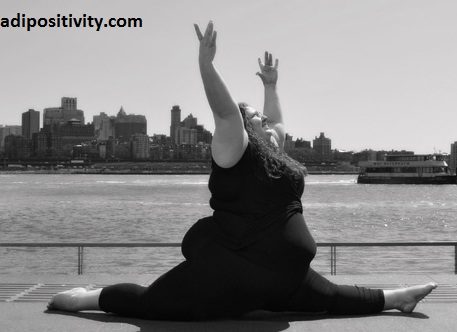
Dating Fat

When Darryl Roberts interviewed me for the documentary America the Beautiful 2 he asked me a lot of really good questions to which I had ready answers, but he asked me one that I stumbled with  – he asked me if dating would be easier if I were thin.

The answer I gave him was that it was a good screening process.  Those who want to date me have overcome the cultural brainwashing that says that “fat is bad” and I think that’s a big deal because I don’t want to date someone who will just follow the status quo.  It means that I won’t date someone who treats women like a prize, these idiots who say that they “deserve” a hot girl (where “hot” means fitting the cultural stereotype of beauty).  It means that when I find my future partner I’ll have a really good chance of avoiding that thing that happens when someone’s “perfect wedding body” changes as the marriage moves forward.  Those are all true and they are all upsides but there are also some difficulties and I think it’s important to get them out in the open and talk about them.

Let’s preface this with the fact that I know plenty of thin people who struggle with dating.  I don’t think that being thin is the magic bean that grows the marriage beanstalk.  But there are some issues that happen with fat dating that I want to talk about.

As a fat woman I know that my potential partners live in a culture that tells them that no amount of achievement, education, personality, flexibility etc. can overcome the supposed sin of having a large body, a culture that suggests that you can tell by looking at me that I am lazy and weak-willed and unhealthy.  I also know that this standard is arbitrary since when my mom was in Mali, West Africa with the Peace Corps she received marriage proposals for me almost every day, and men promised her everything in the world to try to convince her that I should marry them. Were I born in another time or place, I would be the standard of beauty.

So I think it’s important to realize that there is a nothing wrong with our bodies that a little culture shift can’t fix. Still here we are, with a dating pool inundated with the message that fat=bad.

Recently a dating company exclusively for married people looking to have an affair posted an ad with a picture of a fat woman that said “Does your wife scare you at night?” with their slogan “Life is short, have an affair.” The model, who was “under the impression at the time that people purchasing these photos from the photographer would be doing so for their own personal use”, said “I am mortified that my image and likeness would be used as advertisement for two things I am so vehemently against: namely cheating and, to an even greater extent, body shaming.”  But there’s this dating site, trying to profit by telling men married to fat women that they “deserve” an affair.  Keep it classy.

I imagine that all of this makes it Christmas every day for the diet industry since it likely drives people back to them time and again, people who might otherwise look at their 5% success rate and say “Thanks but no thanks”.  I wonder how far this idea that you must be thin to get a mate sets the Health at Every Size movement back?  I know people who have admitted to doing unhealthy things to their bodies to be thin in the hopes of finding a partner.  (And I worry that if they succeed they are setting themselves up for heartbreak in five years when they’ve gained the weight back).

But the culture doesn’t just affect potential dating partners, it affects us as well.

A recent scene from Glee illustrated one of the issues (note, if you haven’t seen the episode The First Time you might want to skip this paragraph for spoilers.)  Shannon Bieste is the large, not stereotypically beautiful football caoch played by the amazing Dot-Marie Jones.  She is a 40 year old virgin.  A traditionally attractive male recruiter is interested in her and keeps trying to ask her out but she doesn’t realize it.  When he finally very specifically asks her on a date, she is immediately suspicious that someone has “put him up to it” and can’t imagine why he wants her when he could have “any pretty woman he points at” and ends up crying.

When people who look like you are used as the to show what is unattractive and a reason to cheat, it can mess you up around dating,  and make you suspicious of someone who wants to date outside the cultural norm.  I know fat people who’ve been asked on dates as jokes.  The classic “wing-man” story is the guy who “takes one for the team” and spends the night with the fat friend.  The dating site that must not be named would like you to believe that having a fat wife is a good reason to break your marriage vows.  It’s not paranoia if they’re actually after you, and so those who want to date a fat person in this culture may have to be ready to work through some of that, and those who are fat in this culture might do well to examine how it is affecting them.

Then there are our own standards when we decide who we date.  I’ll speak for myself on this one.  I will not date anyone who is interested in me in spite of my body. I was part of a dating experiment that a grad student was doing and we self-selected into one of three groups.  A group who made being fat the first thing that they talked about on their profile, a group who made it part of the profile but not the first thing, and a third group who avoided telling people that they were fat until it became unavoidable.  In discussions that we had, the women in group three believed that their only chance was to get someone to fall in love with their personality enough to overlook their bodies.

If it works for them that’s completely cool, but before I will date someone who feels that my body needs to be overlooked I will get a bunch of rescue Great Danes and grow old as the crazy dog lady, you know what I saying?  On the other hand I’m not willing to date someone who only loves me for my body.  With some regularity I get e-mails from guys (I’ve so far only received them from men) saying something to the effect of “I didn’t read the blog but I saw your picture and you are just so damn hot, let’s get it on”.  Um, no.

So my truth is that being fat may indeed make dating harder.  But that doesn’t mean that I’m trying to get thin. My options are to try something that fails 95% of the time and is most likely to leave me less healthy than I am now in the hopes of getting a mate who wouldn’t consider dating me as I am and then rolling the dice that they won’t leave me if I am one of the 95% who gains their weight back. Or, I can hold out for someone who is interested in all of me.  I choose option two.

By way of inspiration, if you’re in an awesome relationship then today might be a great day to leave a comment and tell us about it!  Also, check out the Museum of Fat Love (thanks to reader Petra for finding the link!)

This blog is supported by voluntary reader subscription rather than corporate ads.  If you feel that you get value out of the blog, can afford it, and want to support the author’s work and activism, please consider a paid subscription. The regular e-mail subscription (available at the top right hand side of this page) is still completely free.   Thanks for reading!
10 Reasons to Practice Health at Every Size

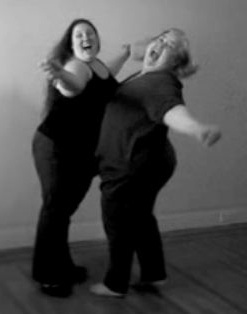
The Awesome Marilyn Wann and I sharing a Belly Bump, the not-so-secret handshake of rad fatties! Photo by Linda Garber

The Health at Every Size® movement suggests that focusing on healthy habits is our best chance for a healthy body.  Somehow that is considered highly controversial.  Here are ten reasons why it’s actually a no brainer.

1.  You have a much better chance of taking care of something that you like than something that you hate.  HAES allows you to take care of your body and like it at the same time.

2.  Research from the University of Califoria, Davis found that Health at Every Size practitioners are more likely to maintain long-term behavior change and health improvements than dieters.

3.  Because HAES focuses on fitness rather than fatness. Steven Blair of the Cooper Institute, a non-profit founded in 1970 whose mission is scientific research in the field of preventive medicine and public health and communicating the results, said “We’ve studied this from many perspectives in women and in men and we get the same answer: It’s not the obesity—it’s the fitness.”

4.  HAES tells the truth – that healthy habits matter regardless of your weight and size; rather than the lie we currently hear that if you’re fat healthy habits don’t matter unless they make you thin and if you’re thin healthy habits aren’t important unless you get fat.

5.  HAES works with the fact that health is multi-dimensional and includes genetics, environment, stress, access, and past, present, and future behaviors by putting the focus on the health that is possible for each individual body; instead of ignoring that and chasing an amorphous, unattainable concept of “perfect health” and the ridiculous notion that our health is only a matter of our current behaviors and is entirely within our control.

6.  HAES encourages choosing movement options that you enjoy rather than punishing your body with exercise that you hate.

7.  Health at Every Size helps you find peace with your weight which is important because studies show that women who are concerned about their weight have more physical and mental illnesses regardless of their weight.

8.  Because research repeatedly finds that, contrary to common opinion, intentional weight loss attempts predict weight gain and eating disorders but do not predict weight loss or improved health.

9.  HAES encourages developing a healthy relationship with food.  That can replace or prevent food relationships that are obsessive, fear-based, unhealthy, and even disordered.

10.  Because weight and health are two separate things and if you want to be healthier it makes a lot more sense to focus on health than on body size.

For more information about practicing Health at Every Size I would suggest checking out Linda Bacon’s HAES community resources!   While you’re there, sign the HAES pledge!

This blog is supported by voluntary reader subscription rather than corporate ads.  If you feel that you get value out of the blog, can afford it, and want to support the author’s fat activism, please consider the $10 subscription. The regular e-mail subscription (available at the top right hand side of this page) is still completely free.   Thanks for reading!

Casualties in the War on Obesity

A couple of days ago I told you about a young special needs student who had been physically and verbally abused by her teacher and her teacher’s aide for being fat.

Yesterday I saw a report that a couple were charged with neglect for starving their daughter in an effort to keep her from becoming obese.  The girl had gained only three pounds in her first 14 months of life.  Christopher Sultze, the girl’s father, told one of the physicians treating the girl for failure to thrive that he “doesn’t want to have obese children”.  Dr. Mary Bartel told reporters that both of the girl’s parents kept insisting that she was going to “get fat” from her treatment for malnourishment.

According to a report on the peer-reviewed journal “Pediatrics” hospitalizations for eating disorders among children under 12 years old are up 119% in the last decade

My friend’s boyfriend went to the doctor for severe, sudden onset backpain. Without so much as touching him, the doctor told him that the pain was due to his weight.  He explained to the doctor that the pain was new but the weight was not, but the doctor was unmoved.  A second doctor, after poking him a couple of times agreed with a diagnosis of fat and a treatment protocol of weight loss.  A third doctor, through the handy use of simple diagnostic tools that were readily available to the first two doctors, discovered disc damage requiring medical intervention. He suffered in pain for three weeks and, had he not sought a third opinion (and been able to afford three doctor’s visits), he would still be trying to lose weight with herniated discs which could have caused chronic back or leg pain and loss of control or sensation in his legs and/or feet.

I got an e-mail from a mother distraught that one of her daughters has organized her entire family to spend the holidays confronting a fat sibling about her weight.  The family is coordinating and planning to bully this girl at what is supposed to be family feast centered around thankfulness.

A young man went into the doctor for constant pain consistent with gallstones, and a family history of gallstones, then got an ultrasound confirming gallstones.  His doctor did not follow up with him after the tests and when he finally called  she insisted that the gallstones weren’t the problem and he just needed to lose weight.  He got a new doctor who performed emergency surgery and told the man that he could have died if he had waited much longer.

My friend Deb eats almost exclusively processed food and never exercises (she is fond of saying  “if we were meant to walk, God wouldn’t have invented cars”).  Deb weighs about 100 pounds.  She went to a doctor who tested her and found that she had high blood glucose, high blood pressure and high cholesterol and other metabolic risk factors.  Without asking her any questions he gestured to her body and said “You’re obviously doing everything possible for your health, don’t feel bad – sometimes these things are genetic- let’s get you on some medication.”

Earlier today I saw Kelly Bliss use the term “Casualties in the War on Obesity”, and she’s exactly right.  You can’t separate us from our fat.  A war on a obesity is a war on obese people, and a war on people has injuries and deaths and collateral damage and that’s exactly what’s happening.  And the casualties are all sizes and all ages – including 14 month old infants. Are we really to believe that a starved 14 month old is necessary collateral damage in an effort to get fat people to buy into a weight-centered health approach?

We must end this war. The casualties are completely unnecessary and we could stop them tomorrow by being for healthy options instead of against fat bodies.  Doctors would need to get themselves together, leave their size bias at home, and provide a proper standard of care based on health and not weight for their patients (which would include, you know, using a diagnostic tool besides staring at us fully clothed and guessing).  Fat bashers would need to find a new sport.  Everyone would need to be for access to health without being against people’s bodies.

But the first step, the very first step, is that fat people need to decide that they deserve respectful treatment and then demand it.  Even if they want to change their bodies, even if they want to lose weight, they can still claim their right to be treated with respect in the bodies they have now.  Respect is not contingent on body size and the more fat people who demand respectful treatment in every area of their lives, the more allies who will come forward to support us,  and one by one we will deplete the armies in the war on obesity and without armies there can be no casualties.

This blog is supported by voluntary reader subscription rather than corporate ads.  If you feel that you get value out of the blog, can afford it, and want to support the author’s fat activism, please consider a paid subscription. The regular e-mail subscription (available at the top right hand side of this page) is still completely free.   Thanks for reading!

Maybe that’s why you’re fat…

One of the things that happened when I started being vocal about my Health at Every Size Practice is people’s desire to guess why I’m fat.  This seems to happen more when people find out how much I work out.  Typically it involves something that I’m doing at the moment.  If I have a cup from Starbucks often someone will say “Oh, I heard that the drinks from Starbucks have a ton of calories…” usually they don’t say it, sometimes they do, but if not there’s  an implied  – maybe if you gave up Starbucks you’d lose weight.

I’ve had perfect strangers passing by me in a restaurant point to my plate and say “This is why you’re fat”.  The last time it happened I was eating the same thing as three thin people at the table, I didn’t have time to point that out as the hostess picked her jaw up off the floor and practically hauled the people away from my table, turning her head all the way around  like the exorcist to apologize profusely to me as she speed walked them away.

I understand the confusion.  We’re told over and over again that all you have to do is eat healthy and exercise and you’ll be thin.  People who are naturally thin often mention to me that they don’t eat that great and barely exercise but they stay thin so they assume that fatties must be eating even more than they do and be even less active.  We’ve already talked about the flaw in that logic.   When fat people do those things and don’t lose weight, then others – in an attempt at maintaining belief consistency – typically find it easier to question the individual than the the belief system.  They assume that there must be something that allows them to keep their belief and explain the seeming anomaly in front of them.

Maybe it’s the lattes.  I saw her eat a hamburger the other day, maybe that’s it.  Maybe her workouts aren’t as hard as they look.  She had popcorn at the movies, is that it?  She must binge eat when nobody is looking.  Maybe she’s just lying.  And on and on…

These typically ignore the fact that most of us tried giving up these things any number of times and it didn’t make us thin.  And that thin people engage in all of these behaviors and it doesn’t make them fat. And there are fat and thin people who eat the same diets and have very different sizes and levels of health.  There are healthy and unhealthy people of every shape and size.

But it’s not like there’s just one or two anomalies, a study from the Einstein School of Medicine found that “Among US adults 20 years and older, 23.5% (approximately16.3 million adults) of normal-weight adults were metabolically abnormal, whereas 51.3% (approximately 35.9 million adults) of overweight adults and 31.7% (approximately 19.5 million adults) of obese adults were metabolically healthy.”

And that’s in a society where fat people have to achieve health despite a constant stream of stigma and prejudice which, According to Dr. Peter Muennig from Columbia “are intensely stressful.  Over time, such chronic stress can lead to high blood pressure, and diabetes…Women who say they feel they are too heavy suffer more mental and physical illness than women who say they feel fine about their size – no matter what they weigh.”

So I think that we need to consider the possibility that the current paradigm is wrong.  That bodies, like everything else in nature, come in different sizes. That, just like we have vertical diversity of bodies (I personally know people from 4’10 to 6’6), we have horizontal diversity of bodies.   That healthy habits give us the best chance for the optimal amount of health that is possible for each of us, but in no way guarantee health or a specific body size.

We also need to consider that the weight-centered diet-loving culture in which we live may be contributing to size diversity –  A 7 year study from the University of Minnesota found that “None of the behaviors being used by adolescents (in 1999) for weight-control purposes predicted weight loss[in 2006]…outcomes associated with dieting and the use of unhealthful weight-control behaviors, included significant weight gain.”  In various studies weight loss attempts have been shown to predict weight gain, obesity, and eating disorders, but not weight loss. And girls are now starting to diet at age 8.

We can’t see the forest for the french fries.  We’re so busy policing our active fat friends’ food to find the secret reason for their fatness that we are missing the big picture.   The truth is we don’t know why people are bigger (and there is a lot of argument about whether we even are really bigger and if so, by how much.)  I’m not claiming to have all the answers but I think that there are enough questions to warrant that we at least push pause our current  weight centered approach (which seems to be having the opposite of the intended effect with some other negative effects on the side).

We’re not sure if or why people are fatter, we’re not sure if that’s actually causing health problems, we have no Earthly idea how to make them thinner since every diet ever tested has had an abysmal success rate and we don’t know why they don’t work.  The time for making “everybody knows” arguments is over.  It is absolutely illogical that we are still recommending dieting as a health or weight loss intervention.  With the evidence that we have, a health-centered approach is a much more responsible choice than a weight-centered approach.  With a health centered approach you work on the actual metabolic indicators of health without the side effects that shame, stigma and body hate create, and without dieting which is basically playing Russian Roulette with your health using a 95% loaded gun. To borrow a phrase – STOP THE INSANITY!   Let’s take weight out of the conversation and focus on making health information and options accessible to everyone.

This blog is supported by voluntary reader subscription rather than corporate ads.  If you feel that you get value out of the blog, can afford it,  and want to support the author’s fat activism, please consider subscribing. The regular e-mail subscription (available at the top right hand side of this page) is still completely free.   Thanks for reading!

Dieting, Size Acceptance and Health at Every Size

This is not a blog about whether you can love your body and still want to lose weight,  the brilliant Deb Burgard already tackled that one in The Health at Every Size Blog.  This is about how these groups interact with each other.

First, I take great pains never to tell anybody else how to live, but I  make an exception when it comes to civil rights.  I think that everyone should be for Size Acceptance, regardless of their size, the path to health that they’ve chosen, or the path to health they think is best for others.  Civil rights are not up for debate or determined by a majority vote, or by how important those rights are to you individually.

Bodies are not barometers for health, intelligence, value, work ability, or anything else.  We have a right to life, liberty and the pursuit of happiness and that doesn’t start 50 pounds from now for me, even if you decide that it starts 50 pounds from now for you.  I would not personally recommend it or choose it, but I support people’s right to choose dieting. I can’t argue to limit their choices while simultaneously arguing that my choices should not be limited. By the same token I think that even fat people who don’t want to be fat and are actively trying to be thin should be for Size Acceptance.  True power is in having the right and choosing whether to exercise it – it’s not about taking rights away from others because you don’t want them for yourself.

So let’s talk about how HAES and Size Acceptance people interact with dieters.  I know that there are SA and HAES advocates who tell dieters, online or in person, that what they are doing is unhealthy and that they should stop dieting and do what HAES says is right, and they  say that they tell people this for their own good.  I’m asking those people to consider stopping that behavior.  If the message sounds familiar to you, it’s because it’s the exact same thing that fat people who practice Health at Every Size get from those who think we should try to lose weight; and we RAIL against these messages and their messengers, flatly stating that they have no right to tell us what to do with our bodies.  So how about we avoid looking like, or actually being, hypocrites?  I hate it when people come to my blog and preach dieting,  so I would never, ever go to someone’s blog about dieting and preach HAES.

Please understand, I believe that weight centered health and Health at Every Size are two completely separate paradigms and I’m not suggesting that they “kiss and make up“, I’m working for a paradigm shift here.  I’m just suggesting that we stop attacking individuals who make different choices than us, using tactics that we don’t like having used on us.

We don’t need to resort to that because we are not a Potemkin movement. We have evidence, experts, and success stories on our side.  So let’s keep getting our information out there.   Let’s comment on news stories and get our experts in the media and create our own news.  Let’s create our own spaces on the internet and in the world to present our beliefs, explain them, and support them with evidence. (While I wouldn’t go to someone else’s site and talk about the dangers of dieting I sure as hell do it on this blog.)  Let’s get into debates and mix it up and let people hear what we have to say.  Let’s make sure that if people choose dieting it’s not just because they never heard of Health at Every Size or Size Acceptance.  And let’s make changes at an institutional level – get the medical community and the media on our side.  Let’s work to end the constant stream of body hate that so many people try to change their bodies to avoid.   But let’s commit to never bullying people the way that we’ve been, and continue to be, bullied.

While we’re talking about this – bashing thin people:  Not ok, not ever, not for any reason.  It’s wrong, wrong, wrong, wrong.  Let’s just put an end to all the body snarking and make room for everyone on the Size Acceptance Ark.

There are so many choices when it comes to prioritizing health, paths to health, food and movement etc. I am not interested in convincing everyone do what I think is right.  I am interested in all of us having the right to make our own choices about our bodies and  health, and in our ability live in our bodies and with those choices without losing civil rights, job opportunities, access to good healthcare or life, liberty and the pursuit of happiness as a consequence.  I’m also interested in working to make sure that everyone has access to all of the information, foods and movement options that they require to implement and support their choices, which I will respect as I want my choices respected.

This blog is supported by voluntary reader subscription rather than corporate ads.  If you feel that you get value out of the blog, can afford it,  and want to support the author’s fat activism, please consider subscribing.

Success and Progress

Remember our petition asking NEDA to end their partnership with the STOP Obesity Alliance?  I got an e-mail from NEDA saying “The National Eating Disorders Association (NEDA) does not have any ongoing partnership with George Washington University’s program, Strategies to Overcome and Prevent (STOP) Obesity Now Alliance.”  They have removed the STOP Obesity Alliance partnership from their website.  NEDA did the right thing, and they did it with class. They do important, difficult work and I have tremendous respect for them as I stated in the petition. If this is a victory it is a small one,  I’m just happy that we got it done. Huge thanks to everyone involved!  The experience brought up some interesting things for me:

When I started this petition I got plenty of private e-mails saying one of three things:

  • They agreed with me but were afraid to get involved because they feared that NEDA would become upset with them and that it would hurt their careers.

I can understand this.  Fearing for your livelihood is a big deal.

  • Telling me that it was impossible and a waste of time

This group I don’t get.  And I run into these people all the time – people who thank me for my work around fat rights then tell me that we’ll never make progress.  If you don’t want to try to make changes, that’s fine, I’m not trying to tell anybody how to live.  But if you think what I’m trying to do is impossible you can save yourself an e-mail because I don’t care.  My activism started in kindergarten when I was accused my Mrs. Neff of “leading small revolts” because I organized a group of students to protest the fact that we were spending too much time playing and napping and not enough time learning. That started a life of not being scared of power, and not just trying to do things that were possible, but doing things that I think need doing.

I know that we can make change.  Change that seems impossible.  On June 28, 1969 GLBT patrons at the Stonewall Inn fought back against persecution, oppression, and physical abuse that was not just government sanctioned but government sponsored.  A month ago I watched my best friend legally marry his wonderful husband in New York City.  If you are 41 or older that happened within your lifetime.  On August 28, 1963 Martin Luther King Jr. gave the “I have a dream” speech from the steps of the Lincoln Memorial.  On January 20, 2009 this country inaugurated its first African American President.  If you are 46 years old that happened within your lifetime.

We can make change, substantive change, seemingly impossible change and we’ve done it before in less than 50 years.  Things aren’t perfect for the gay community or the African American Community but they are better now than they were 40 years ago and people gave their lives to get that done.  Nobody is obligated to continue their work, but what good are you doing telling people who are already swimming upstream that the change they are working for is impossible? I’m happy to argue about the agenda and the message, but hope is not up for debate.

  • The third group said that what I was doing was “dangerous” and that I should be “careful” to not upset NEDA

I appreciate their concern but somebody has to be willing to stick their neck out.  A couple of days ago I announced that I was taking this blog to a voluntary subscription format and this is exactly why.  I got a bunch of e-mails asking why I didn’t just do ads.  It’s because I don’t want to be supported by corporations,  if I’m going to be supported I want it to be by the people who get value out of my work and feel that it’s worth their support.   The idea is that if you read the blog, if you think that you get $10 a month of value from it, and if you can afford it, you can choose to subscribe.  The subscriptions support the activism work that I do. I don’t have to worry about corporate affiliations holding me back from doing what’s right, the people who are supporting my work are the people whose opinions I actually care about.  This is what allows me to stick my neck out and do things that others think are dangerous.

Like the NEDA thing.  Again, a huge thank you to everyone who signed the petition, passed it along, or helped in any way on this.  People said that it was impossible and we did it. There’s no such thing as false hope.  It’s done, we won, what’s next…

It Gets Better?

I read this article today [Warning:  Triggering in almost every possible way]  A special needs student was repeatedly verbally and physically bullied in school.  Not by students, but by her teacher, Christy Wilt, and her teacher’s aide, Kelly Chaffins.  The girl’s parents hid a tape recorder in her clothes to get tangible proof.  The aide was fired but the teacher signed a statement that said that she “engaged in conduct unbecoming to the teaching profession when she made inappropriate comments to a student with disabilities and allowed a co-worker to make inappropriate comments to a student with disabilities.” She was given probation and has to take an 8 hour class on how to recognize child abuse and bullying.

We MUST do better by these kids. A teacher shouldn’t need an 8 hour class to know that it’s not ok to tell a kid that because she’s fat “No wonder nobody likes you.”  I’m a big fan of the “It Gets Better Project”. People create videos to give hope to GLBT youth who may be dealing with bullying from classmates, teachers, even their parents now, that it will get better.  But can we tell fat kids that it gets better? And if not, what can we do?

Bullying is Bad for Kids’s Health

I think that we need to decide that even if we’re not in agreement about what would be best for kid’s health, we are sure that making them feel bad about themselves isn’t it.  Kids live in their bodies 100% of the time and they don’t separate themselves from their bodies.  If you say “childhood obesity is a problem that needs to be fixed, let’s have a war on childhood obesity” they hear “I am a problem that needs to be fixed, they are fighting a war against me”.  In order to make good choices for physical health, it helps a bunch to be in good mental health and to feel like you are worth taking care of.

Food is Their Friend

Studies show that girls are starting to diet at 8 years old and that they would rather lose an arm, a parent, or get cancer than be fat. According to this report  in the peer-reviewed journal “Pediatrics” hospitalizations for eating disorders among children under 12 years old are up 119% in the last decade.  Research published in the October Archives of Pediatrics & Adolescent Medicine found that twice as many Canadian kids had eating disorders as had type 2 diabetes. I think that we can teach kids about healthy food without terrifying them about becoming fat.

Studies have shown that dieting is a predictor of weight gain, obesity and eating disorders, but not a predictor of weight loss or normal weight in later years. Childhood weight loss programs lead by the Child and Adolescent Trial for Cardiovascular Health and Johns Hopkins University (which were quite similar to the First Lady’s “Let’s Move” Initiative) were spectacular failures at creating thinner kids, but they did create healthier kids which, based on all of the above, might be what we want to focus on.

The End of Dodgeball as We Know It

We need to design physical education programs that give kids a chance to develop a lifelong love of movement and pride in their bodies.  In school we can look at PE with options – you can walk around the track, take yoga, or play basketball for example.  After school we can start fun movement programs and  sports leagues for competitive kids and sport leagues for kids who just want to play around.  We can provide safe places for kids to play, community centers with free, low cost, and sliding scale options.  Everybody giving them the message that the best thing that they can do is find some movement that they love (rather than telling them that they need to punish their bodies with exercise because they’re too fat or might get fat).

Role Models

After a dance competition once a fat little girl came up to me with her dad in tow.  She told me that she didn’t take dance class because her dad told her that she was too fat to dance.  I said that her dad was wrong.  Her dad then apologized and said that she would be starting dance classes on Monday.  That was one of my happiest moments as a dancer.  But I and several of my friends who do talks about Health at Every Size have been invited into schools by a teacher and then had the school cancel because administrators are scared that seeing us be athletic will promote obesity.   Mary Lou Retton is a very popular motivational speaker but nobody’s afraid that she’s promoting shortness. (just to be clear, I’m not IN ANY WAY comparing myself with Mary Lou Retton, just making a point.)

It is foolish to think that we can give fat kids a constant message of “Your body is wrong, you’re lazy, you’re unhealthy, you’re unattractive”, then never let them see anyone who looks like themselves being active, and expect them to believe that health is possible for them.

Let’s keep working until we can say that not only does it get better, but that it IS better.

Fat People Are Not Idiots

It seems that whenever someone brings up the concept of Health at Every Size® or suggests anything other than our current concept of weight-centered health, they are met with the ridiculous:

If we don’t tell people what to eat, they’ll just eat Twinkies all day!

What if they think that getting their oil changed regularly means that they are living a Health at Every Size life?

You can’t tell people to do movement that they enjoy, they’ll think that doing dishes is the same as taking an aerobics class.

This kind of attitude doesn’t do anyone any good.   In the 1850’s William Banting started the first low carb craze, the Grapefruit Diet was introduced in the 1930’s.  In the 40’s and 50’s, the first “ideal” height/weight charts were introduced.  What I’m trying to say here is that we’ve been at this weight loss thing for some time and there are serious, valid questions about efficacy.  If you aren’t sure what the Health at Every Size concept is then ask.  If you have actual questions then let’s have a real dialog, but acting like fat people will not be able to tell the difference between a Twinkie and a Veggie stir fry is not bringing anything to the conversation.

This is a serious conversation for serious people.  Our health is at stake.  If people are confused about what foods to eat, I would ask if the diet culture might be to blame?  Diets that tell people to eat restrictively 6 days a week and binge eat on the 7th. Diets that tell people to eat cabbage soup and only bananas on Tuesday, and cabbage soup and only steak on Wednesday etc.  The cookie diet.  Snackwell’s.  Low fat, low cal.  Low carb, high fat.  Vegan.  Gluten free.  No processed food.  All processed food. It’s incredibly difficult to get true information about health separate from weight loss because people get paid so much to sell weight loss.

We can’t get away from the incessant message that we’re experiencing a panic-worthy rise in the rates of obesity. However in his book The End of the Obesity Epidemic,  Australian scholar Michael Gard points out that obesity rates for people of all ages leveled off or declined all over the world, including in the United States, over the last decade.  He also points out that life expectancy rates have risen in line with obesity rates.  But if you say that to people you get shunned because “Everybody knows that 99% of Americans are going to be obese by next week and we have to treat fat people like they are complete morons because they haven’t become thin.”

And don’t bring up the fact that since 1959 all the data suggests that only 5% of people are physically capable of changing their body size long term and a number of those people are on their first diet.   And don’t mention the research that shows that early dieting attempts predict weight gain, obesity, and eating disorders but do not predict weight loss, because people will accuse you of being unable to ascertain the health benefits of doing dishes versus going on a brisk walk.

The Cooper Institute for Aerobics has been looking at fitness since 1970 and they say “We’ve studied this from many perspectives in women and in men and we get the same answer: It’s not the obesity—it’s the fitness.”  However studies also show that working out doesn’t lead to weight loss and so I have seen articles in major news media outlets suggest that we skip physical activity, even though it is proven to make us healthier, because it’s not likely to make us thinner. What are we doing?

Instead of acting like anything other than a weight-centered health paradigm will lead to massive Twinkie eating cults of doom, can we all agree that our goal is for people to have access to everything that they need (information, foods, safe movement options that they enjoy) to make choices about their health; and then can we have an evidence–based conversation about what that means and how to get the information out?  That would be great and I hope to be at the table for that talk. In the meantime would suggest Ellen Satter’s work as a great place to start.


Exercise of the Day: Common Sense

There’s a lot of confusion about Size Acceptance, Health at Every Size® (HAES), and those of us who promote one or both. Here is my understanding:

What Size Acceptance Says

Size Acceptance says that body size should not be used as a barometer for a person’s value.  It states that people’s body size is their business and that it’s nobody’s job, and is in fact inappropriate, to judge people or discriminate against them based on size. It’s not a health practice, it’s a civil rights/anti-discrimination movement.

What Health at Every Size Says

Health at Every Size says that weight shouldn’t be used as a proxy for health, and that weight loss shouldn’t be used as a proxy for healthy behaviors.  HAES acknowledges the fact that health is multi-dimensional, and includes not just our current and future behaviors, but also the effects of past behaviors as well as genetics, access, and stress.  So HAES says that healthy habits offer us the best opportunity for the optimal amount of health that is possible for us in the body we have and the situation that we are in; and that health problems should be treated with health interventions and not body size interventions.

What Nobody Says

Nobody in either movement is suggesting that not taking care of your body is a likely path to health.

Nobody in either movement is suggesting that it’s ok to bash thin people (and if there are, those people are hypocritical idiots.)

Nobody is saying that being fat is inherently healthy or unhealthy.  The point is that there are healthy fat people, there are unhealthy thin people, and everyone who wants to be healthy or healthier would benefit from healthy habits which may or may not lead to weight loss.

Of all the crazy hate mail and death threats I receive, the only thing that ever really upsets me is when someone says that I’m a bad role model.  It’s upsetting because it means that in these people’s eyes, despite reaching a level of fitness that very few people ever reach, and having worked very, very hard to have success in my sport and life, I do not deserve to be seen in a positive light because those things have not made me thin. The most ridiculous of these arguments being that showing a fat person practicing healthy habits promotes obesity.  I covered that in some detail here. I disagree, I get a tremendous amount of inspiration from seeing other fat people being athletic so if I can give that to someone else I’m going to do it.

But having this attitude means that these people think that fat kids and fat adults should never see anyone who looks like them shown in a positive light, and should never feel good about themselves, even for a minute, until they are thin.  It means that there are people who believe that fat people should experience a ceaseless stream of societal stigma and self -hatred until we get thin (which 95% of us are statistically unlikely to ever do)

It’s antithetical.  People don’t take good care of things that they hate. The message that we are getting is “your body is unhealthy, unattractive, and a problem that needs to be fixed, now go take good care of it”.  You can either promote healthy habits or you can promote body hate but you can’t do both and make sense.

Here’s how the typical discussion goes:

Weight loss proponents:  You need to lose weight!

Me:  How should I do that?

W:  Eat well and exercise.

M:  I’ve done that for a long time and it doesn’t make me thin. Now what?

W:  Um, do it better.

M:  What?  I told you, I’m practicing healthy habits.

W:  Are you just lying about your habits?

M:  No, and I’m healthy.

W:  You’re going to get sick if you don’t lose weight!

M:  Ok, what should I do?

W:  Practice healthy habits!

M:  Again, doing that already, still fat.

W:  … … .. … um, You have to lose weight!

M:  AAAARRRRRRGGGGGGHHHHH!

Promoting obesity isn’t real, but promoting thinness is, and it’s dangerous.  It is incredibly irresponsible to send the message that healthy habits don’t matter unless they make you thin. When people don’t get thin from the habits (as 95% of them won’t) then you’ve told them that there is no reason to keep up those habits and that’s incorrect, and dangerous, and will lead to the exact opposite of what you want to promote.

We’ve got to get together on this – healthy habits are our best chance for a healthy body no matter how fat or thin we are.  Telling fat people that their bodies are wrong, that you can tell that they are unhealthy by looking at them, that healthy habits won’t make them healthy unless they also make them thin, and making sure that they never see someone who looks like them being active and practicing healthy habits WILL NEVER HELP.  The first thing that we need to exercise here is some some common sense.

A Real Fat Intervention

The stress from constant stigma heaped upon us by society is correlated to the same diseases that obesity it.  So for our best chance at health, in addition to eating well and moving our bodies, we must also find a way to counteract the 386,170 negative messages that we are getting about our bodies each year.

I thought I would make some suggestions for ways to do just that.  Remember, it’s not just fun, it’s for our health!  (Thanks to reader Rebecca for the suggestion. Fyi, I’m not paid for any of the things I mention below, I just like them bunches.)

Put it in Perspective

They can’t stop telling us that 60% of us are fat  It that’s true then we’re the majority.  So there are a whole bunch of people working fat, dating fat, playing sports fat, kissing fat, driving fat, doing dishes fat, having sex fat, shopping fat etc.  There’s nothing wrong with your body and people of your size are already doing whatever you want to do so just do it!

Seek out pictures of people who look like you.

Again, we get completely bombarded with images that aren’t even representative of the people in the pictures let alone of us.  I have a friend who was a bikini model who looked at a magazine and thought that they gave her bikini to someone else.  One of her friends had to tell her that the picture was of her – she didn’t even recognize herself because of the photoshopping!  With a little bit of effort you can look at amazing, beautiful people who look like you every day.

Flickr Athletes of Every Size Photo Group

The Adipositivity Project (NSFW unless your W is super cool)

Corvetta Curves Photo Pages  (Again with the NSFW)

When you listen to songs, or read books picture them being about fat people

Since we don’t really see ourselves represented very much in television or movies, it can be easy to picture everyone else in the world being thin. If you’re one of those people who picture song lyrics, picture the people fat.  I’m pretty sure that Eric Clapton’s Layla was fat.   Delilah from the Plain White T’s song – fatty.  Jessie’s Girl shopped at Lane Bryant. You get the idea, same thing with books that you read, picture main characters fat.

Surround Yourself with Art that Makes You Feel Good About Yourself

There’s a fantastic list of fat positive art and artists here (I love it when someone’s already done the research!)

Leonard Nimoy did an AMAZING group of photographs called The Full Body Project.

I have personally bought a bunch of stuff from VoluptuArt  I just love having cute dancing fat girls all over my house.

My best friend got me the most amazing fat figurines, one is lounging in a bathing suit and one is lifting weights and they make me happy every day.

Get Involved on the Fatosphere

Check out the Blogs I Love page to get you started.

I read a ton of blogs every day and it’s time well spent earning the Sanity Watchers Points that I so desperately need to deal with the rest of the world!

Go Back To Basics

Read Linda Bacon’s Book – Health at Every Size, The Surprising Truth About Your Weight

Read Marilyn Wann’s Book – Fat!So?

Movement for us by Us

Heavyweight Yoga by Abby Lentz

Curvy Yoga by Anna Guest-Jelley

The Fat Chick Works Out by Jeanette DePatie

Get Involved with Activism

Not only can we create change, but we are already doing it.  The more time you spend on the blogosphere, the more likely you are to have chances to get involved with campaigns, petitions, fundraising etc. I believe that we can make change and I think that it’s more possible when more of us are involved.  If you’re looking for a way to get involved may I suggest signing the petition to ask the National Eating Disorders Association to end its ties with an organization funded by pharmaceutical companies that seeks to get obesity treated as a disease.  We’ve surpassed our original goal of 500, let’s see if we can get 1,000.  Some people posted their reasons for signing, some of my favorite are:

Just like body & scale obsession is unhealthy regardless of size, healthy behaviors are important at any size.  Focusing on my weight, rather than my actual health & my abilities, puts the priority on the wrong end.  This can lead to some very unhealthy behaviors, which I would think an organization like NEDA would already be aware of.  Don’t encourage the stigmatization of fat people by the very messages you fight against for the skinny people.

I am an eating disorder survivor, and I survived because I finally found a way to focus on my health and not my weight.  The perpetuation of the idea that weight is an indicator of health only feeds eating disorders.  Please stop the myth.

I am a fat person. I am also a person who is recovering from eating disorders. My journey to recovery was delayed for many years, my disordered and destructive behaviors were even encouraged encouraged, because I did not meet weight and BMI based diagnostic criteria for Anorexia, which later developed into Bulimia before I was able to obtain treatment.

Gang Up

So far, on my world tour stops, I’ve been doing a Fatty Meet-up and it has been amazing to be around people who are like minded and having amazing conversations about Health at Every Size and everything else.  If you can’t find them in person, find them online but find a group of people who support you with your goals.

I think there’s a reason that “happy and healthy” are so often uttered in the same breath but we don’t hear “miserable and healthy” very often at all.  If we want happiness then let’s go after it!