A Year Without Diets

In the year 2012, Americans will likely spend more than sixty billion dollars on diets.  95% of those diets will result in people being as heavy or heavier than they started, with the medical dangers involved with weight cycling, and having taken the self-esteem hit of trying and failing at a diet.

Or, according to numbers from Marilyn Wann’s Awesome Fat!So? Dayplanner we could:

  • Fund the Environmental Protection agency for 5 years (based on their 2011 budget)
  • Spend 9 times what the US did in 2010 on foreign AIDS funding
  • Increase annual spending on plus size fashion 3.6 times

There’s some other stuff we could do:

  • We could build 60,000 million-dollar community centers that accept a sliding scale fee and give people in 60,000 communities safe movement options that they enjoy
  • We could buy 60,000 hundred acre tracts suitable for sustainable farming and supply them with a barn, fences,  tractor, implements, improvements, animals, and seed
  • We could give full scholarships to 1,819,505 students to four year public colleges to study health separate from weight, fat studies, and a million other awesome things
  • We could buy a pair of good, supportive athletic shoes and a one year membership at a HAES friendly gym for every person who wants them (even if that included every single person in the United States)
  • We could spend $10.75 more on every school lunch (According to the USDA the national school lunch program serves 31 million kids a day for the 180 day school year.  Currently we spend about $1 for every school lunch so this could dramatically increase the quality of kid’s food)
  • Instead of serving one $1 meal to 31 million kids, we could serve three $3.58 cent meals to all of those kids every school day. Or we could serve those same 31 million kids three $1.76 meals every day of the year.
  • We could give $522 to every US household
  • And that’s just the US – imagine what we could do for the world if we re-captured the money that we throw out the window on pills, shakes, and “lifestyle changes” that leave us less healthy than we started.

Instead of continuing to pour money into an industry that has to include the phrase “results not typical” anytime they suggest that their product might actually work, and that has a success rate that barely rivals the lottery, we could do any of the things above (or a combination of them!) and focus on healthy habits for ourselves – for which you don’t not have to pay $12 a week, get weighed in public, drink nasty soy protein shakes, or buy special expensive highly processed food.  If we just eat a little healthier and move about 30 minutes 5 days a week, not only would we accomplish something with our sixty billion dollars, but we would actually have a chance of ending the year healthier than when we started it.

Just some food for thought.

This blog is supported by its readers rather than corporate ads.  If you feel that you get value out of the blog, can afford it, and want to support my work and activism, please consider a paid subscription or a one-time contribution.  The regular e-mail subscription (available at the top right hand side of this page) is still completely free.   Thanks for reading! ~Ragen

Repairing Our Relationships with Exercise

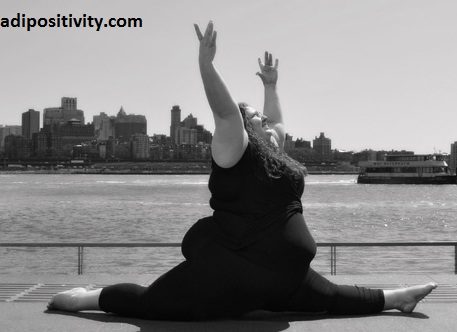
Me! 5'4 284 pounds. Picture taken by the Amazing Kate Wodash - owner/instructor at the Mindful Body Center http://www.mindfulbodycenter.com

I posted a couple of days ago about we get information about fitness and health twisted in ways that end up with people having less of both.  I mentioned in that blog that I had to repair my relationship with exercise and several people asked me to post about how to do it. To be clear, you can choose not to exercise – it’s a completely valid life choice. This blog is just about what to do if you want to exercise but you have some issues around it and/or are feeling stuck.

There are lots of ways that a relationship with exercise can go horribly wrong.  It seems like gym class is custom designed to reward kids who are into sports and shame those who aren’t so badly that their relationship with exercise is damaged well into adulthood.  I think that we can do better by our kids but for those of use who are just dealing with the aftermath we can still have a knee jerk reaction of never wanting to exercise again.

It could also have to do with unrealistic expectations.  One of the things that I think is the most damaging about how we deal with exercise is that people are led to believe that exercise will result in weight loss and that health comes from weight loss.  So people start exercising, they don’t lose weight, and they quit because they think it’s “not working”. In truth the research tells us that exercise will make us healthier but is unlikely to lead to weight loss (even if it does, the health and the weight loss are both side effects of the behavior – weight loss doesn’t make people healthier, it just makes them smaller.)  So if you are looking at weight (instead of metabolic health markers and/or intrinsic messages like how you feel)  you are likely to miss the actual benefits that you are receiving from your movement.

Sometimes a dysfunctional relationship with exercise is the result of rebellion.  If you are fat you are probably tired of hearing “just eat less and exercise more” or having people tell you that you should exercise without bother to ask you if you exercise to begin with.  Sometimes people just say screw it and don’t exercise as a way to give the finger to everyone who says that they need to exercise because they are fat.

So I think that if we want to repair our relationship with exercise the first thing is probably to let go of whatever way you got hurt around it in the past.  If you want health now then you probably have to forgive or at least forget your idiot gym teacher – unless you’re cool with them affecting your current health.

Next I think you have to figure out why you want to do this. If weight loss is your goal, you’re probably barking up the wrong treadmill.

You may want to decide who you are doing this for.  In my experience the problem with rebelling against people by being unhealthy is that we are the ones who suffer and we end up less healthy because of it, and the problem with doing healthy habits for other people is that we tend to resent them if we don’t like the habits.  But that’s just me.

Finally, decide what you are going to try first, set some reasonable expectations, and then decide what – if anything – you want to measure.

I always recommend figuring out what you want to try first in terms of exercise.  Then get a baseline and be totally ok with whatever it is.  So if you want to try walking, go for a walk.  If you make it 5 minutes that’s awesome.  It’s 5 minutes more than if you didn’t go.  Then set some kind of reasonable plan:  Maybe your goal is 5 minutes a day 5 times a week with the goal of increasing to 10 minutes in a couple of weeks.  Take it easy, you have your whole life to move your body and you do not want to be the fittest person in traction. You have nothing to punish yourself for and nothing to prove.  This is a whole new thing and this is the first day of it.

If you don’t like the first thing you try, try something else.  Try exercise with friends and alone to see what you like.  Consider mixing it up.  Consider not planning – Set aside the time to do the exercise, but allow yourself to choose whatever is appealing to you on the day.  Remember that you can break up the exercise into chunks – it doesn’t have to happen all at once to get the benefits.  Ten minutes in the morning, ten at lunch, ten after dinner is your thirty minutes – walking from the back of the parking lot or up and down the stairs totally counts.

If you are one of those people who just doesn’t like exercise I feel your pain – as a dancer I do stuff that I don’t like –  flexibility is really important for example but I do not enjoy flexibility work.  But it’s worth it to me to do it to meet my goals so I try to make cut down the misery as much as possible by listening to music I like or watching TV and I do it.  I also I find it helpful to remember that it’s me and my body tackling flexibility – not me against my inflexible body.

Maybe you want to consider getting a baseline of your metabolic health markers – blood pressure, glucose, etc..  Maybe you want to work with a health care practitioner (perhaps one who comes from a Health at Every Size(r) perspective.)

In my opinion the absolute best thing that you can possibly do is come to exercise on your own terms.

  • If you find the word exercising triggering, then substitute something else – movement, working out, whatever.
  • Celebrate every single victory.  Walked 2 minutes more today than yesterday?  Booty shaking happy dance – rock on!
  • Get the best equipment that you can afford.   Look for deals on shoes on ebay or zappos.com or whatever.  If you are going to walk regularly your body will thank you for having good supporting walking shoes.  Danskin has a line called Danskin Now that is plus sized and (a reader told me) available in Walmart.  Old Navy has some stuff, there’s also Xersion wear, so does Junonia.  I’m not associated with any of these, it’s just what I’ve heard about.  Sometimes you can find deals on ebay as well.
  • Stretch.  It does wonders to prevent joint pain (much of which is from muscular imbalances or tightness that pulls on the joints and has nothing to do with weight).
  • Consider adding a little strength training- more muscle will help you move that big body around, support your joint health (since the muscle will take the load and not the joints)
  • Consider adding pilates – core strength is has been key for me.  It wasn’t until I was working with a trainer that I realized how wrong I was doing the DVD – if you can’t afford a class or trainer, consider paying for one session with a trainer to show you proper form and create a workout for you,  then you can work at home. (Sometimes you can go with friends and split the cost) When you master that workout, go in for another session. (If you’re in Austin I highly recommend the Mindful Body Center – I workout there and they are amazing!)
  • Go slow and if you feel some discomfort, honor that and take it easy.  Remember that mixing up your workouts can help you avoid injuries due to repetitive motion.
  • If you have access, water workouts are awesome, even done once in a while to give your body a break from walking or other higher impact activities.
  • Decide what you want from this experience and create the entire experience to work just for you.

Exercise serves you, you do not serve exercise. You are the boss of your exercise underpants!  Occupy your exercise underpants!

If you are looking for a place to talk about fitness from a Health at Every Size Perspective, join us at the Fit Fatties Forum!

This blog is supported by its readers rather than corporate ads.  If you feel that you get value out of the blog, can afford it, and want to support my work and activism, please consider a paid subscription or a one-time contribution.  The regular e-mail subscription (available at the top right hand side of this page) is still completely free.   Thanks for reading! ~Ragen

Can’t You Just Take a (Fat) Joke?

George Takei is awesome for many reasons. There’s the Star Trek awesomeness, the outspoken queer rights and anti-bullying advocate awesomeness, and the Facebook page with the very funny pictures awesomeness.  Yesterday he posted a picture of three actors who had played Star Trek Captains.  Two of them are more chunky and one is ripped.  The caption said “Apparently only one of the ships came equipped with a gym.” the accompanying note said “help me spread this like a virus”.

Before I get into the whole joke thing, one thing I will never understand is GLBT people who don’t support fat rights. I don’t know George Takei’s take (except that he was ok with making this fat joke), but Dan Savage comes to mind here as well as any number of non-famous gay people who I’ve heard and seen make this argument.  Let’s take a minute to examine this.

One argument often used against queer rights is that being queer is a choice.  GLBT people rightly argue that we are better witnesses to our experience than those who are not us, and that even if we could choose to be straight, we shouldn’t have to because we have the right to love any adults we want.

One argument used against fat people is that being fat is a choice.  Fat people rightly argue that we are better witnesses to our experience than those who are not us, and that even if we could choose to be thin, we shouldn’t have to because our bodies are our business.

Another argument used against GLBT people is that our “lifestyle” is unhealthy, both physically and mentally. Queer people rightly argue that physical health risks can be mitigated or eliminated in ways other than becoming straight (which is a good thing because the chances of that are very low)  and that mental health issues that exist are most likely due to stigma and the cure for social stigma is not becoming straight, it’s ending social stigma.

Another argument used against Fat people is that our “lifestyle” is unhealthy, both physically and mentally.  Fat people rightly argue that physical health issues can be mitigated or eliminated in ways other than becoming thin (which is a good thing because the chances of that are very low) and that mental health issues that exist are most likely due to stigma and the cure for social stigma is not becoming thin, it’s ending social stigma.

The comparisons go on but hopefully you get the idea. Get it together queer people and get on the fat rights bandwagon.

Anyway, back to George Takei.  I left a message on his FB saying “It seems inconsistent to me that you would be against bullying and shaming people for their sexual orientation and participate in bullying and shaming people for their size. Nobody hates themselves healthy and this kind of body stigma hurts everyone.”  I also posted it on my Facebook page and said that I would love it if other people who were bothered would comment as well.

And then it started.  Before I had left a comment plenty of people on George’s FB had made anti-fat comments about the people in the picture.  Once I and other people  made comments people said that we were oversensitive, lazy fatties who don’t exercise and are fighting for our right to a double chin, that we have a stick where normally there is not one, there were a bevy of fat hating and body shaming comments,  they are friends so it’s ok, or “I’m fat and I think it’s funny”  On my Facebook page someone posted that George Takei is a really cool and that we need to pick our battles – like worrying about the little boy who was ripped from his home because he is fat.

Ok, first I can “take a joke”. His Facebook post did not affect my self esteem.  I’m comfortable with myself and my choices, and I’m well aware that some people do jackass things.  That doesn’t make it ok to stigmatize me or people who look like me.  And isn’t it a problem when we tell some people that they need to toughen up and become better at being stigmatized and made fun of so that other people can laugh at our expense without having to consider the consequences?

If George is such good friends with these people and he feels the need to make fun of them for their size, he should call them up instead of body shaming them on Facebook.  Because then it’s not just about them, it’s about letting everyone who looks like them know that George Takei is comfortable stereotyping them and publicly stigmatizing them.

I think each of us individually needs to “pick our battles” since we can’t do everything, but I don’t think that as a community we should tell each other to  ignore people who stigmatize fat people because they are otherwise cool people, or we think the joke is funny, or if we don’t think it’s a big deal.  If people didn’t think it was ok to make the original fat joke, then there is no way that they would have thought all of the fat shaming comments were ok.  That 200 pound boy got ripped from his home because of an irrational wave of fat phobia and these kind of fat jokes are part of that wave.  What I think makes body shaming like this particularly harmful is that so many people defend them.  When we say that body shaming is ok if it’s funny, if it’s between friends, if it’s done by a person who is oppressed in another way, if it’s done by a person who is famous, if it’s done by a person who is generally cool,  all we’re really saying is that body shaming is ok.

People make mistakes.  I’ve made jokes on this blog that people pointed out could be offensive and I have fixed the issues. I think it’s important to point out these mistakes when people make them and I think we can see where they are at based on their response. I think that consistency is really important, otherwise we get stigma-creep wherein more and more things are considered ok, or a not worth the battle or whatever.  Once it starts it’s hard to put the toothpaste back in the tube, so I think it’s far better to say that body shaming is never ok in any guise – then we don’t have to decide where the line is between body stigma that’s “hilarious” and body stigma that is shaming and wrong.

This blog is supported by its readers rather than corporate ads.  If you feel that you get value out of the blog, can afford it, and want to support my work and activism, please consider a paid subscription or a one-time contribution.  The regular e-mail subscription (available at the top right hand side of this page) is still completely free.   Thanks for reading! ~Ragen

Fitness, Fathletes, and Thirty Minutes

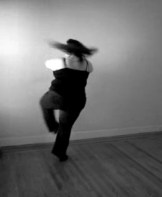
Me, mid spin, preparing to sweep kick out. Photoraph by Linda Garber thanks to Marilyn Wann.

Today I want to talk about health, fitness, and being a fathlete. But before I do as always I want to point out that health is not a moral, social, or personal obligation, nor is it a barometer to judge anyone by.  People get to choose to be professional bull riders, climb Everest, and jump out of a helicopter wearing skis even though none of those things prioritize their health.  Each individual gets to choose how highly they prioritize their health and what path they take and nobody gets to judge anybody else’s choices or results.

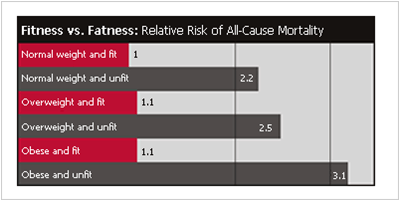
That being said, if health is something that you want to prioritize, it’s interesting to note that more and more research is showing that the best thing that we can do for our health is be physically active.

(Source: Wei et al. “Relationship Between Low Cardiorespiratory Fitness and Mortality in Normal-Weight, Overweight, and Obese Men.” JAMA. 1999;282: 1547-1553.)

And I’m not talking about running a marathon –  the research is showing about 30 minutes a day, about 5 days a week is all that’s needed.  It doesn’t even have to be 30 consecutive minutes, you just need to get your heart rate up 30 minutes a day most days.  I know that’s a lot different than what I used to think a few years ago- that I had to spend hours in the gym or it wouldn’t do any good.   I’ve got a video at the end of the blog that I think does a great job talking about this, but first I want to talk about how we get the idea of physical fitness so twisted in this society.

We celebrate people who run farther, go faster, push the boundaries of human endurance. Those of us who push the boundaries tend to be proud of the level of our athleticism. But is this the best or only way to be healthy?

No! Abso-freaking-lutely not.

In fact, we might be healthier if we just took a few walks every week.  Over a lifetime of playing sports, athletes usually end up with any number of injuries that a normal healthy person would never have.

That’s not bad, necessarily, but it concerns me that celebrating hardcore athleticism in society discourages people who could reach their health goals if they just moved 30 minutes a day on most days.  I worry that instead of happily getting their heart rates up 30 minutes a day, people feel like they need to run a marathon or they just shouldn’t bother moving at all.  I wonder what would happen if society would glorify dancing around your living room, gardening, hoop dancing, walking around the block – whatever kind of movement you would like to do, instead of glorifying only those at the most extreme. There are so many ways to be an athlete (and/or fathlete) and I think that we would do better to celebrate all of them!

There are people for whom testing the limits of their bodies is part of what they love about movement. That’s fine. Health at Every Size doesn’t preclude that, it just says that there are lots of movement options and all are equally legitimate.

I once heard an Ironman competitor say that “To make it through the Ironman you don’t need to be the best, you just need to be consistent and keep pushing forward.” I think that’s good advice for anyone who wants to incorporate movement.  If you feel like you’re not getting enough movement in your life, find some stuff you like to do and do it. Try something new. If you like it do some more of it.  If not, you don’t need to do it ever again.  If you like to run and feel like you’d like to try a 5K,  or whatever – try it.  If you’ve had a dysfunctional relationship with exercise (i know that I did – I don’t even like to use that word), then try redefining that relationship.

Remember that you get to choose what movement you want to do. You can do a grueling solo workout in the gym or go on a walk with friends in the neighborhood.  You can be healthy and happy even if you never run a mile, or you could run a marathon or triathlon or do any number of cool fathletic things!  If you want to be healthier and/or feel like you’d like to move more then try moving a little more and see what happens.

No marathon necessary.

I thought that this video did a fabulous job of talking about the benefits of a little movement:

This blog is supported by its readers rather than corporate ads.  If you feel that you get value out of the blog, can afford it, and want to support my work and activism, please consider a paid subscription or a one-time contribution.  The regular e-mail subscription (available at the top right hand side of this page) is still completely free.   Thanks for reading! ~Ragen

The Measure of a Person

I recently had a huge dust-up on my Facebook led by someone who took exception to my Health at Every Size message because they were able to lose weight and so, they argued, anybody can.  This is an oft-repeated argument but it doesn’t make it any less wrong.  I explained that losing weight and keeping it off makes you a statistical anomaly, not proof of weight loss efficacy. Unfortunately at that point I got on a plane.  He started “accusing” people he doesn’t know of being sedentary.  As the conversation continued he mentioned that he “respected” me because I exercise.

This exchange represents a massive problem.

First of all, you can’t accuse someone of being sedentary because that’s a valid life choice – there’s nothing to “accuse” them of.  Being sedentary may not prioritize someone’s health but neither do being a professional bull rider, or jumping out of a helicopter with skis, or not getting enough sleep, or having a stressful job.  People have the right to prioritize their health however they want, and choose whatever path that they want.

We also need to stop acting like people’s health is entirely within their control and that it is completely changeable through their actions.  Health has a number of components including past behaviors that can’t be changed, genetics that are out of our control, access to the foods that we would choose, safe movement options that we enjoy, and appropriate healthcare which is a massive issue for many, and fat people in particular.  It includes our past environment which we cannot change, and our current environment ( including things like being under constant stigma) which we may not be able to change. We can obviously influence our health by our current behaviors, but acting like it’s appropriate to judge people based on their health because it’s entirely within their control is just plain wrong. Also, if people are dealing with health problems that are their fault it’s still not your business.  (And if you’re thinking of making a “but my tax dollars pay for…” argument then head over here.)

People who follow whatever you think is the correct path to health do not deserve any more respect than those who don’t.  Basic human respect is not reserved for humans who do what you think that they should.  Health, and any measures thereof, are  not a barometer by which we should judge respectability or worth.  The idea that we are all required to do whatever someone else thinks is the most healthy for us is deeply flawed.  The idea of the longest life being the most important thing is flawed. We in the US have the right to life, liberty and the pursuit of happiness.  We do NOT have the obligation to pursue those things by someone else’s definition, and then be judged based on someone else’s scale.

This type of reasoning is doing nothing to increase our health or the quality of the discourse about it.  What if we took all of the time and energy we spend judging people and instead we put that into making sure that everyone has access to healthy food choices, safe movement options that they enjoy, and robust healthcare.  Then we can sit back and respect the decisions that they make just like we want our decisions to be respected.

This blog is supported by its readers rather than corporate ads.  If you feel that you get value out of the blog, can afford it, and want to support my work and activism, please consider a paid subscription or a one-time contribution.  The regular e-mail subscription (available at the top right hand side of this page) is still completely free.   Thanks for reading! ~Ragen

Of Houston and Hoop Dancing

So, while I was in Houston for the America the Beautiful 2 Premiere  I got to do many cool things.

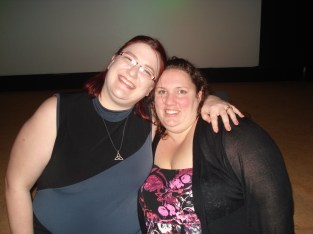
If you’ve been around the blog much you’ve probably seen comments from Karen R.  She is a prolific commenter (she even comments when she’s sick and on Vicodin).  My favorite comment of hers is “That, my dear, is the sound of a paradigm shifting without a clutch.”  Then, one fateful day, after reading one of my posts  about our ridiculousness with kids and weight, Karen asked me to “marry her” and she became my blog wife.  It’s been a running joke ever since.  She drove down for the premiere and we finally got to meet in real life where she is even more awesome as she is online:

I also got to see my friend Heather who just moved back to Houston from El Paso.  We realized that we have known each other a looooooong time!  Heather is a super cool woman who was brave enough to take a hoop dancing class with me (more on that in a minute)

Karen wasn’t able to come in until the premiere but we did a fatty and friends meet-up lunch during with the lovely and amazing Rowan (of Punk Rock Hoops) agreed to do a hoop dancing lesson for Heather and I.  It was so much fun!  We got to work in the beautiful Nia Moves Studio.

It turns out that I’m not a hoop prodigy, my record for waist hooping was six times before it dropped, but I did have fun trying this rollover.  For the record, this is in no way an instructional video, this is not how the move should look, I don’t care because it was super fun.

Rowan agreed to do a quick demo so that you could see how it’s really done.  She is a beautiful dancer, and a fantastic teacher.  If you ever have a chance to take class with her definitely do it!

You can’t stop me from posing though!

So, that’s enough of me, but what about you?   I’m always inspired when I see other fatties out there  doing cool stuff.  So if you feel like it leave a comment of something awesome that you have done.  Write about it, link to a video or picture, whatever!

This blog is supported by its readers rather than corporate ads.  If you feel that you get value out of the blog, can afford it, and want to support my work and activism, please consider becoming a member or a one-time contribution.  The regular e-mail subscription (available at the top right hand side of this page) is still completely free.   Thanks for reading! ~Ragen

The “Promoting Obesity” Myth

I was on the news with Darryl Roberts, filmmaker of America the Beautiful 2 for the Houston premiere.   As almost always happens when I’m in the media, they brought up the concern that I am “promoting obesity”.  I’ve observed that this happens almost any time a fat person is shown in the media being good at anything or having any kind of success not tied to weight loss.  This is among the most ridiculous things that I’ve ever heard.  As if someone will see me dancing and think “I wish I could dance like that.  The secret must be her obesity – screw dance lessons, I’m going to try to get fat!”.  It’s insulting to my years of hard work and training, and it’s insulting to your intelligence. Like’s it the new V8 commercial:  millions of thin people, who see the same 386,170 negative messages a year about fat people, will see one of us being successful in some way, smack their foreheads and say “I coulda been fat!”

Promoting a body size is what got us into this mess in the first place. I think that being thin might be the most aggressively promoted idea of my lifetime and while it hasn’t made everyone thin (in fact if you believe the statistics the majority of people are not thin), it has insidiously created a second class of citizens.  The (completely wrong) idea that the only path to health dead ends at a thin body has led to the mistaken belief that every fat person hates their body and wants to be thin and has put their entire life on hold, vowing not to be successful at anything unless and until they can be successful at weight loss.  And as soon as someone shows a fat person who doesn’t fit neatly into the story of  body hatred and weight loss goals above all else, they get shouted down and pulled out of view based on the ridiculous notion that they are “promoting obesity”.

Look, if you see a fat person and immediately think you know everything about their behaviors, choices, and inner thoughts then you have a problem – you someone who stereotypes fat people.  If the sight of a fat person being happy makes you angry, then you have some very serious issues to deal with. If you think that happy successful fat people are promoting obesity then you are a dangerously delusional. If they are promoting anything, they are promoting being happy and successful.

Not to mention that if we follow the “logic” that putting fat people in the public eye as anything other than a negative representation or an ad for stomach amputation is “promoting obesity”, then what we are actually saying is that fat people should never see anyone who looks like them in a positive light.  We seriously believe that the best thing that we can do is make sure that fat people should never see someone who looks like them being successful or happy.  How messed up is that?  How cruel?  First they tell fat people that they are all miserable, then they purposefully hide all the evidence to the contrary under the guise of not “promoting obesity”, then they use the lack of evidence that you created to “prove” that all fat people are miserable.  Step three:  Profits!  Sixty billion a year, in fact, for the diet industry.

We have GOT to stop promoting any body size at all.  We need to show, and celebrate, the diversity of the human experience and that includes all colors, shapes, sizes, sexual orientations, athletes and couch potatoes – everybody. Our diversity is what makes us strong – it’s what makes us survivors and pretending otherwise for your own profit ought to buy you a special place in hell.

I’m just happy that there are people standing up to this preposterous notion, who are brave and strong enough not to cave to the pressure, and who are getting fat role models out into the light where they belong. And I’m so proud and thankful for all the fatties who brave the responses – from ridiculous to utterly hateful – to live their lives out loud!

Like my blog?   Here’s more of my stuff!

My Book:  Fat:  The Owner’s Manual  The E-Book is Name Your Own Price! Click here for details

Become a member: For just ten bucks a month you can help keep this blog ad-free, support the activism work I do, and get deals from cool businesses Click here for details

Dance Classes:  Buy the Dance Class DVDs or download individual classes – Every Body Dance Now! Click here for details 

Fit Fatties Virtual Events:  If you’re looking for a fun movement challenge that was created to work just for you, you can check it out here.  There’s still time to get in on Early Bird Rates.

If you are uncomfortable with my selling things on this site, you are invited to check out this post.

Health at Every Size Is About Giving Up

Nobody panic, I’m not pulling a Jess Weiner or anything.  One of my readers asked me to respond to this blog [Warning:  triggering in many ways]. Basically, it is the response of a blogger who does a weight loss challenge on her blog, to one of my readers who suggested that she educate herself about the Health at Every Size(r) concept.

I have a policy of not going to other people’s blogs and trying to convince them that they are wrong.  My work is more about creating a safe space here where people can come for support, information, a point of view outside the mainstream (that is not funded by corporations) and respectful discussion (one of my favorite things about this blog is how respectful the regular commenters are).  I did find the blog interesting and so, in keeping with my policy, I’ll blog about it here.  If you want to skip the possibly triggering bits you can skip the indented material and just read my responses:

What is HAES (Healthy at Every Size)?
From the website and an excerpt from Health at Every Size: The Surprising Truth About Your Weight by Linda Bacon, PhD:

” Let’s face facts. We’ve lost the war on obesity. Fighting fat hasn’t made the fat go away. And being thinner, even if we knew how to successfully accomplish it, will not necessarily make us healthier or happier. The war on obesity has taken its toll. Extensive “collateral damage” has resulted: Food and body preoccupation, self-hatred, eating disorders, discrimination, poor health… Few of us are at peace with our bodies, whether because we’re fat or because we fear becoming fat.”

We’ve lost the war on obesity so is she saying we should just give up? I don’t agree with that philosophy at all. However, I do agree “food and body preoccupation, self-hatred, eating disorders, discrimination, poor health” are the results of being obsessed with losing weight and trying to be thinner. But believe it or not, I don’t believe the diet industry is the root cause. It is certainly a huge part of the problem, but I personally feel all of it has deep roots in patriarchal society. The problem is that we are trying to fit an ideal that doesn’t exist and that was originally created by men. Women buy into it and perpetuate it. We absolutely should work on accepting ourselves as we are, building self-esteem, and loving ourselves. But that does that mean that we stop improving ourselves? Of course not. We need to do it for ourselves. Not for society, or a man, or because we think we are supposed to look a certain way.

This issue I have here is the confusion of the concept of “improving ourselves” with the concept of weight loss.  The scientific truth is that weight loss has an abysmal success rate.  It doesn’t matter if you’re doing it for yourself, society, a man, or to meet expectations.  It doesn’t matter if you call it a diet, a lifestyle change, an eating plan or something else.  Almost everyone who attempts weight loss fails at weight loss and the majority end up heavier than they started within a few years.  I’ve talked before about the idea of HAES as “giving up”.  In a way it is.  It’s giving up the goal of being thin, giving up on a fantasy that leads to exactly the opposite of what we are trying to achieve most of the time and, instead, choosing a goal of better health which is possible for almost everyone.  (Since health is multi-dimensional and not entirely within our control, we can never guarantee health with our behaviors, but we can give ourselves our best chance for a healthy body with healthy behaviors.) Although I am a fan of  Linda Bacon I’m not a fan of the phrase “we’ve lost the war on obesity”.  I think the truth is that there is no real enemy to fight and we never should have had a war on body sizes, and that we will win the “war on obesity” in the  exact moment that we stop fighting it.

[From Dr. Bacon’s book]”Very simply, it acknowledges that good health can best be realized independent from considerations of size. It supports people—of all sizes—in addressing health directly by adopting healthy behaviors.”

I agree that adopting healthy behaviors is the most important thing you can do for your body and yourself, regardless of size. I agree 100% that you should focus on adopting healthy behaviors first and worry about losing weight and getting thinner second. However, I do not agree that you should just give up on reaching a healthy body weight and a healthy body size.

Again here she is conflating the concepts of weight and health.  There is no such thing as a healthy weight or healthy body size.  There is no weight or body size that you can attain that will assure your health.  Thin people get all of the same illnesses that fat people do and so being thin is neither a preventative nor a cure.  Knowing that healthy behaviors are our best chance for a healthy body, and knowing that the most common outcome of weight loss attempts is actually weight gain, it does not make sense to focus on weight if your goal is health.


Wikipedia
says:

The major components of HAES, as described by Jon Robison, are:

  1. Self-Acceptance: Affirmation and reinforcement of human beauty and worth irrespective of differences in weight, physical size and shape.
  2. Physical Activity: Support for increasing social, pleasure-based movement for enjoyment and enhanced quality of life.
  3. Normalized Eating: Support for discarding externally-imposed rules and regimens for eating and attaining a more peaceful relationship with food by relearning to eat in response to physiological hunger and fullness cues.

I absolutely love the idea of promoting self-acceptance and I will admit that I felt I did not focus enough on that during the first round of this challenge. I fully intend on making self-love and acceptance part of the challenge in the future rounds. As a pagan and a feminist, this is a significant part of my philosophy. But at the same time, I believe that wanting to be thinner doesn’t make you bad or wrong. Maybe it’s just me, but I feel like HAES wants me to feel shame for wanting to be fitter and thinner.

I can’t speak for every HAES practitioner but I don’t know any who believe that wanting to be thinner makes you bad or wrong and I don’t know anybody who would want anybody to feel ashamed of wanting to be thinner.  In a society where being fat comes with a tremendous amount of stigma, and being thin comes with a tremendous amount of privilege, it makes a lot of sense to want to move out of the stigmatized group. I’ve been very clear about my support of people’s right to choose dieting.   All HAES does is offer an alternative based on the facts.  I want to be able to fly but that’s not currently possible so I’m not going to spend my time throwing myself off of buildings and flapping my arms really hard.   If you want to be thin you should know that the research says that it’s probably not possible and that it’s likely that your attempts will leave you fatter than when you started, you then get to to decide if you want to spend your time dieting.

I have no issue with supporting social, pleasure-based movement for enjoyment. However, this is not the only type of exercise that I support. For example, I happen to like grueling weight training and I prefer to exercise in solitude. I truly enjoy challenging my body and feel that I am invoking the beautiful archetypical goddesses such as Athena, Artemis, and The Morrigan. When I am working out, I am not thinking “Wow, I’m going to look so hot in a bikini and I will get a great husband.” I am thinking “Wow, I bet this is what it is like to be strong and independent like Artemis.”

The idea that a workout can either be pleasurable or difficult is an often misunderstood part of HAES.  Evidence shows that we only need about 30 minutes of moderate exercise 5 times a week for health.  Most people are more likely to get this amount of exercise regularly if they do something that they enjoy.  For some people that is gardening or walking, for some it’s interval training and powerlifting.  HAES doesn’t preclude difficult or solitary workouts, it simply seeks to disabuse us of the incorrect notion that if you’re not miserable and killing yourself alone in the gym then you’re not contributing to your health.

What is normalized eating anyway? The fact that HAES even uses that word “normal” contradicts the entire philosophy! Why? Because they are claiming that the way they say you should eat is what is normal. Isn’t that the problem in the first place? That someone out there decided what is normal for us women? HAES is doing the exact thing they are criticizing everyone else for doing!

First of all, he does not say “Normal” he says “Normalized”.  This term, used in the HAES context, is about letting go of the idea that your information about eating must come from an external sources and instead encourages eating based on your body’s cues.  Normalized here relates to each person individually, not to everyone as a whole and speaks to the fact that due to dieting many people have lost connection with their internal cues.  HAES practitioners come to their eating a number of different ways.  Some work with a HAES based nutritionist, some use intuitive eating practices, still others have to account for allergies or a health diagnosis when they eat so their eating may be very different from someone else.  Normalized is used as opposed to the diet mentality where you ignore your bodies hunger queues and use external information (calorie counting, weight loss programs etc.) to tell you what to eat.

Health at Every Size: The Surprising Truth About Your Weight by Linda Bacon, PhD says in the manifesto:

Find the joy in moving your body and becoming more physically vital in your everyday life.

Eat when you’re hungry, stop when you’re full, and seek out pleasurable and satisfying foods.

Tailor your tastes so that you enjoy more nutritious foods, staying mindful that there is plenty of room for less nutritious choices in the context of an overall healthy diet and lifestyle.

Well of course! This is common sense. I have been watching the diet and fitness industry for the last decade and while there are still snake oil salesmen out there, the fact is there are some very good fitness experts that are sharing this exact same philosophy! This philosophy is actually the mainstream now. Extreme dieting no longer is. I do not understand why HAES chooses demonize the entire industry rather than acknowledging that there is good, sound advice out there.

HAES criticizes the weight loss industry because they say the same thing that HAES does but then add “and then you’ll lose weight”.  Except that the vast majority of people will not maintain weight loss. Advice is neither good and sound if it is wrong almost all the time.  In fact, a study of fitness and fatness found that the obese people who did not have health issues “were more likely to be physically active and eat more fruits and vegetables” and “less likely to report engaging in weight loss practices.” (emphasis added)

In fact, Dr. Bacon tells all the experts in a message for fitness professionals that what they are doing is wrong and damaging their clients. She says tells them that everything they have learned may not supported by scientific evidence. This would be the equivalent of me telling everyone who reads my blog that “the way you have been practicing paganism may be wrong and I am here to tell you how to do it right.” Is that an extreme metaphor? I don’t think so. I don’t understand where Dr. Bacon gets off thinking she is the be all and end all to nutritional and fitness knowledge. Her holier than thou attitude is extremely off putting and arrogant. Why is she so angry and full of judgement? How ironic that she is trying to spread a message of peace, love, and self-acceptance.

I have trouble wrapping my head around this because I’ve met Dr. Bacon and she is one of the least arrogant, angry or judgmental people I have ever met.  I’m admittedly surprised that anyone would compare giving advice about religion (which is based on faith and unprovable) and giving advice about science (which is evidence-based and all about proof).  Do you feel that science teachers telling students that the Earth revolves around the sun and not the other way around is the same as telling them that they aren’t praying correctly?

Telling people that they are practicing their religion incorrectly is very different than saying that a health practice is not supported by research.  Would you have asked the doctors who pointed out that thalidomide causes birth defects why they were so “angry and full of judgment”?  Would have have called them “holier than though and arrogant”? Linda Bacon earned her doctorate in physiology, specializing in weight regulation. She also holds graduate degrees in psychology, specializing in eating disorders and body image, and kinesiology, specializing in exercise metabolism, and has professional experience as a professor, researcher, psychotherapist, exercise physiologist, and consultant, so when she gives advice it’s from a basis of an extremely highly educated expert who is steeped in the research around the issue.

While I agree with the overall message of HAES, I find the delivery quite disturbing. In fact, that is just one of the messages that she has. Here is an entire list of messages for different groups where Dr. Bacon proceeds to tell every person or group in the entire industry just what they are doing wrong. I’m sorry but her arrogance makes Donald Trump look humble.

Do you find Copernicus arrogant?  Galileo?  Mendel?  I observe that Dr. Bacon is part of a time honored scientific tradition of looking at evidence, observing that the popular opinion is not supported by that evidence, making that information known, and then being roundly criticized for it.  I guess we are lucky that she can’t be forced to recant and be put under house arrest like Galileo.

In my research, I have learned the the #1 cause of illness is stress. The media ignores this and chalks us up to New Age nuts. However, there are facts that cannot be ignored regarding obesity and health.

Some of these facts include:There is a very clear link between diabetes and obesity – 80 per cent of people with type 2 diabetes are obese. Hypertension is approximately three times more common in obese than normal-weight persons.

I take exception to these statistics but let’s just say that they are true.  First, we have to be aware that there is also a clear link between disease and the stress of constant stigma.  Further, doctors test obese people earlier and more often for these diseases and often ignore the symptoms in thin people erroneously believing that they are “immune” because they are thin.  If you have two groups and you test the first group earlier and more often for a disease and ignore the symptoms in the second group you cannot be surprised if the first group has higher incidence.  Finally, healthy habits have been shown to mitigate these risks whether or not the people lose weight and weight loss fails 95% of the time, so even if these statistics are correct, weight loss is still not the answer.

Obesity also interferes with mobility. Quite simply, extra weight makes movement more difficult and, often, uncomfortable. People who are obese often experience pain in the knees and back due to increased pressure on the joints and vertebrae.

Feel free to see this video to observe my mobility as a Type 3 Super Obese Person. We’ve talked about obesity and joint pain already. Thin people get joint pain and we treat it with health interventions.  Fat people get joint pain and we treat it with a rarely successful body size intervention. Regular exercise can help these issues and more fat people would probably get regular exercise if they weren’t stigmatized when they go, and if they could find appropriate affordable workout wear in their size, and if they didn’t give up because it doesn’t lead to weight loss which they incorrectly believe is the path to health.  Once again, dieting does not predict weight loss but it does predict weight gain and obesity so  encouraging dieting means that you put people at 95% greater risk of having any issues that are associated with obesity.

Obesity:

  • raises blood cholesterol and triglyceride levels.
  • lowers HDL “good” cholesterol. HDL cholesterol is linked with lower heart disease and stroke risk, so reducing it tends to raise the risk.
  • raises blood pressure levels.
  • can induce diabetes. In some people, diabetes makes these other risk factors much worse. The danger of heart attack is especially high for these people.

This is simply misinformation.  While these things have been shown to be correlated with obesity, they are not shown to be caused by obesity, reinforced by the fact that not all obese people have them and many thin people do.  As I mentioned previously, all of these issues have also been correlated with the stress of constant stigma.  Once again, a Health at Every Size approach where we remove size stigma and encourage healthy behaviors is a much better approach then to tell people that the way to be healthy is to try something that leaves them less healthy almost all of the time.  We do not know how to make people thinner (as much as we would like to believe that we do) but we do know how to make them healthier.

My conclusion about the HAES (Healthy at Every Size) philosophy is it has good intentions and some great aspects. It definitely deserves further study. However, the delivery of the message has underlying anger, judgement, and arrogance. In the end, it may also do serious harm by continuing to keep people in denial about the real state of their health. While they are “fat and happy” they may continue to be at risk of severe illness or death. Ironically, the natural effects of eating healthy and getting exercise that HEAS promotes is weight loss. The very thing it seems to be trying to avoid in the first place.

If the natural effects of eating healthy and getting exercise were weight loss, then we would not see a 95% failure in weight loss.  Weight loss is a possible (but not guaranteed), typically temporary side effect of healthy behaviors.  I also cannot imagine how someone would research HAES and come away with the idea that promoting healthy behaviors is tantamount to keeping people in denial about their health.  The tremendous amount of denial that I see is the fact that there are still people encouraging weight loss when we know that it almost never succeeds.

Research from the University of Minnesota found that “None of the behaviors being used by adolescents (in 1999) for weight-control purposes predicted weight loss[in 2006]…Of greater concern were the negative outcomes associated with dieting and the use of unhealthful weight-control behaviors, including significant weight gain. These findings demonstrate that these behaviors should not be viewed as innocuous and should be addressed in primary and secondary prevention efforts.”

“There isn’t even one peer-reviewed controlled clinical study of any intentional weight-loss diet that proves that people can be successful at long-term significant weight loss.  No commercial program, clinical program, or research model has been able to demonstrate significant long-term weight loss for more than a small fraction of the participants. Given the potential dangers of weight cycling and repeated failure, it is unscientific and unethical to support the continued use of dieting as an intervention for obesity.” — Wayne Miller, an exercise specialist at George Washington University (emphasis added)

You are the boss of your own underpants and I support everyone’s right to do what is right for their bodies.  However, I think that it’s absolutely irresponsible for anyone to promote weight loss without telling the truth – that 95% of people who attempt weight loss fail, that weight loss attempts don’t predict weight loss but do predicts weight gain, obesity and eating disorders; and that healthy habits have been shown to mitigate issues associated with being overweight and obese   even if they do not result in weight loss.

Like my blog?  Here’s more of my stuff!

The Book:  Fat:  The Owner’s Manual  The E-Book is Name Your Own Price! Click here for details

Become a member: For just ten bucks a month you can keep this blog ad-free, support the activism work I do, and get deals from cool businesses Click here for details

Dance Classes:  Buy the Dance Class DVDs or download individual classes – Every Body Dance Now! Click here for details 

Interviews with Amazing Activists!!  Help Activists tell our movement’s history in their own words.  Support In Our Own Words:  A Fat Activist History Project!

If my selling things on the blog makes you uncomfortable, you might want to check out this post.  Thanks for reading! ~Ragen
11 Reasons to Focus on Health Rather than Weight

If you are interested in being healthy/healthier and you start to do some research, you will find that there are currently two competing paradigms when it comes to health. One is a weight centered approach – the idea being that we can typically judge health based on weight and that health problems can be solved through weight loss.  The Health-Centered approach says that health should be looked at separate from weight, and that health problems should be solved through health interventions.

Here are 11 reasons why I think a Health Centered paradigm makes more sense (I know the graphic says 10 but you know that I like to give you all a little something extra – and since I can’t make this blog scented I decided to give you an extra reason instead!):

1.  It is observable

We know that there are healthy fat people an unhealthy thin people so weight=health does not hold up to simple observation.

2.  Thin people get all the diseases that are correlated with fatness

And since thin people get all of these diseases, then being thin is neither a cure nor a preventative. Further, since we treat thin people for these diseases we have treatment protocols that do not involve weight loss.  Those same protocols could be used on fat people who have these diseases – so that we are treating the actual disease and not just a body size.

3.  Correlation does not equal causation

Just because a disease is correlated with obesity does not mean that it is caused by obesity.  In some cases, sleep apnea for example, a condition is thought to cause obesity leading to a chicken and the egg problem. By focusing on the health problem instead of the weight we avoid this issue altogether.

4. Confirmation bias

We seek evidence that confirms our existing beliefs.  For example doctors test obese people earlier and more often for diseases thought to be correlated with obesity, thin people who have the symptoms of diseases that are correlated with obesity are often ignored because the doctors assume that thin people are “safe” from these diseases.  If you have two groups and you test one earlier and more often for a set of health problems, and subsequently ignore the symptoms of those health problems in the second group, of course the first group is likely to have a higher diagnosis rate.

5.  Third Factor Issues

One of the reasons that correlation does not imply causation is because the two thing could both be caused by a third factor.  It’s entirely possible that a third factor is responsible for both obesity and disease in which case weight loss attempts will do nothing to address the problem and may even exacerbate it.

6.  The wrong measurements

When people set weight loss as a goal, they are typically assuming that along with that weight loss they’ll get a host of metabolic health benefits: good cholesterol, blood pressure, triglyceride and blood glucose numbers etc.  So when, like 95% of people, they fail at weight loss they assume that they failed at all of the health outcomes as well.  But studies show that this isn’t the case.  Had they measured their metabolic health rather than their weight they are likely to have seen health increases, even though they would not be accompanied by weight loss.

7.  Confusing the standard of beauty with health

As a culture we tend to have a single standard of beauty (which is a whole other problem).  Unfortunately it is all too easy to assume that this single standard of beauty is also the single standard of health. That is simply not true.

8. Human diversity

We accept a huge amount of human diversity.  Large variations in skin color, shapes and sizes of feet, hands, and noses, heights, hair colors and textures etc. are all considered normal.  And yet we expect healthy bodies to conform to a narrow height weight ratio or we consider them “abnormal” or “unhealthy”

9.  The dieting effect

In studies dieting (particularly dieting young and/or repeatedly) predicts weight gain and obesity.  It makes sense then that as we have continued to diet younger and more often we see larger bodies. The solution is unlikely to be more dieting.

10. The Unlikelihood of Weight Loss

In studies since 1959 weight loss has shown a success rate of only 5%.  Doctors are prescribing a solution that only works 5% of the time to 60% of Americans. The diet industry makes 60 Billion dollars a year taking credit for their successes, and blaming their clients for their failures. Would you use birth control with a 5% chance of success?  Would you be okay with the company (and the world) blaming you if you were one of the 95% who got pregnant?

11.  The likelihood of increased health

We know that health is multi-dimensional, not an obligation or a barometer of worthiness, and not entirely within our control.  That said, studies show that most people will get a health benefit from participating in healthy behaviors (healthy eating and movement).  Studies also show that most of these people will not experience significant long term weight loss.  But, again, they will give themselves the best odds to support their health.

So there you go, 11 reasons why focusing on your health and not your weight makes the most sense if you want to be healthier.

Like this blog?  Here’s more cool stuff:

Like my work?  Want to help me keep doing it? Become a Member! For ten bucks a month you can support size diversity activism, help keep the blog ad free, and get deals from size positive businesses as a thank you.  Click here for details

Book and Dance Class Sale!  I’m on a journey to complete an IRONMAN triathlon, and I’m having a sale on all my books, DVDs, and digital downloads to help pay for it. You get books and dance classes, I get spandex clothes and bike parts. Everybody wins! If you want, you can check it out here!

Book Me!  I’d love to speak to your organization. You can get more information here or just e-mail me at ragen at danceswithfat dot org!

I’m training for an IRONMAN! You can follow my journey at www.IronFat.com

If you are uncomfortable with my offering things for sale on this site, you are invited to check out this post.

War on Obesity Side Effects May Include

I think that the War on Obesity should come with a side effect warning:

Caution:  The war on obesity may cause issues with your hearing.  If someone says “Health at Every Size suggests that you eat healthy and exercise” and you hear “Health at Every Size suggests that you eat twinkies and sit around on the couch” you should stop participating in the War immediately.

The war on obesity may also cause issues with your vision. To avoid looking like an idiot, until you know how the war on obesity affects you you should avoid going to videos and websites of athletic fat people and claiming that what they do is easy or that they are lazy.

You may lose the ability to do math.  Call your local Health at Every Size Practitioner if you start to think that dieting’s 5% success rate and 95% failure rate seem like good odds.

In extreme cases the war on obesity can lead to a complete loss of your ability to treat people appropriately or make good choices.  Discontinue the war immediately if you find yourself spending time looking for fat people on the internet to make fun of them, claiming that “Eat healthy and exercise” is an irresponsible message, or claiming that the research doesn’t matter because Dr. Oz is just so inspiring.

Contact your local Health at Every Size Professional if you have a fat hating episode lasting more than four hours.

This blog is supported by its readers rather than corporate ads.  If you feel that you get value out of the blog, can afford it, and want to support my work and activism, please consider a paid subscription or a one-time contribution.  The regular e-mail subscription (available at the top right hand side of this page) is still completely free.   Thanks for reading! ~Ragen