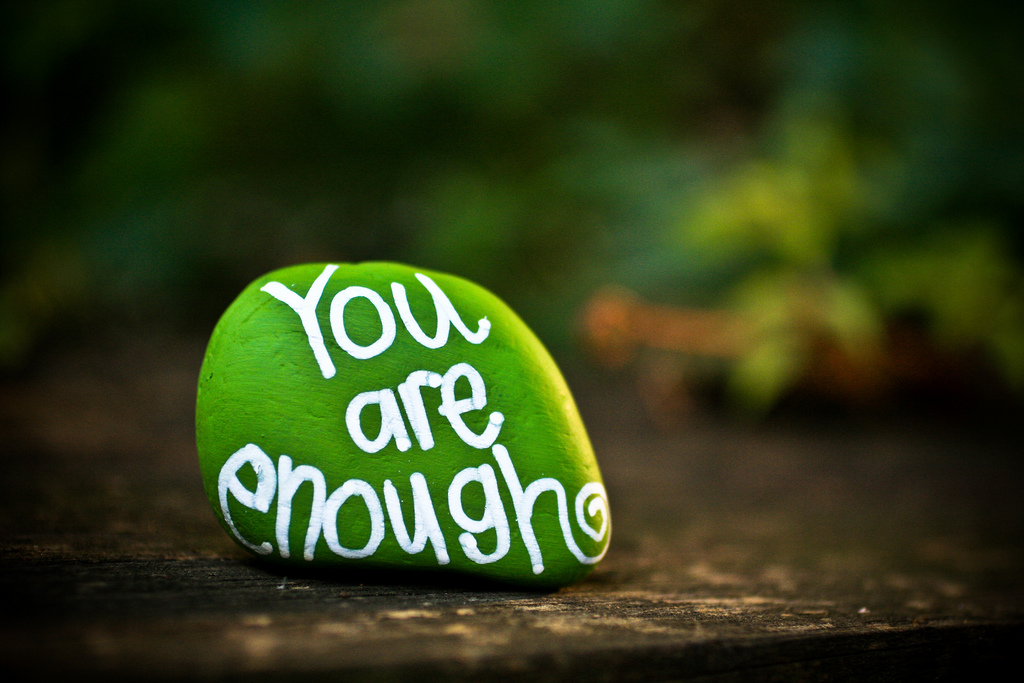
The Lie of Just the Way It Is

Dream WorldI got an e-mail today about the blogher Fat Talk survey results.  I would first like to say that I wish they would say “negative body talk” instead of fat talk so as to avoid piling more stigma onto people who are fat.  But that’s another blog.  For now, I’m just going to refer to it as negative body talk.

I wish I were more surprised by the results.  Seventy-four percent of women, across all age groups, engage in negative body talk.  When asked why women engage in fat talk, answers included:

Because most women are not happy with their bodies.

In some ways, it’s bonding over a common interest. We all have things we don’t like about our bodies.

It’s the social norm. Sadly, it’s just part of life.

That reminded me of the blogger who is supposedly a health and beauty expert who, discussing her feelings toward her body said “And I’m female so I’m never happy!”

While a case could be made that negative body talk  is currently a part of life, let me suggest something:

It doesn’t have to be a part of life.  We do not have to talk badly about our bodies.  Ever.  We can simply stop.  Maybe we’re not in a place where we love our bodies yet, maybe we aren’t interested in the concept of loving our bodies.  But our bodies push air in and out of our lungs, blink our eyes, beat our hearts, and we do not have to talk badly about them as part of some horrible social norm.  Many of the functions of our body are autonomic, but the way we talk about them is not.

We are each absolutely allowed to speak poorly of our bodies if we choose. But when we buy into the belief that negative body talk is some sort of unavoidable part of life, we are buying into a lie that has been foisted upon us and perpetuated by those who profit from it, whether it’s monetarily, socially, or emotionally.   They are asking us to hate ourselves for their benefit.  We do not have to oblige.

Of course this is easier said than done.  We have been and continue to be absolutely indoctrinated with the idea that engaging in negative body talk is natural and normal, and that sucks and it’s not fair.  But we are each the only person who can decide how we talk about our bodies.  Women have everything that we need to end negative body talk- we can simply refuse to do it.  We can refuse to talk badly about our own bodies, and we can refuse to talk badly about other people’s bodies. Nobody is obligated to do this, but it is an option that is available to all of us.

Of course it may take some, perhaps a lot, of work to kick the negative body talk habit- especially if its become ingrained.  But I submit that it may be well worth the effort.   I understand that for some people positive body talk feels like bragging so I’m not even suggesting that – that’s a blog for another day.

All I’m suggesting is we simply stop talking badly about our bodies.  I’m suggesting that we can become conscious of our thoughts and words about our bodies and interrupt and redirect them. In the beginner version you just stop yourself and start thinking or talking about something else.  In the intermediate version you might replace them with a simple thank you to your body.  In the advanced version you state your intentions and then do either the beginner or intermediate version.

Here are sample scripts to get you started:

Beginner Version:

Ugh, I just feel so ugl….how about that local and/or college sporting team?

Tell me about it Pam, my stomach..Hey I meant to ask, did you see Michelle Chamuel on The Voice last night?

God I totally hate my… hey look, bundt cake! (Points for the knowing the movie reference)

Intermediate Version

Ugh, I just feel so ugl… hey body, thanks for breathing, you are kicking ass at breathing and I really appreciate it!

Tell me about it Pam, my stomach… Wait, have you ever thought about how much our bodies do for us?  I think they deserve some love.

God I totally hate my…actually, I really appreciate my butt because if I didn’t have a butt where my butt is supposed to be, that would be very inconvenient.  So thanks body, for having a butt where my butt’s supposed to be, rock on.

Advanced Version

Ugh, I just feel so ugl… No, I’m not doing this anymore.  How about that local and/or college sporting team?

Tell me about it Pam, my stomach…actually, I’m going to interrupt myself because I’ve decided that I don’t want to talk badly about my body anymore – it deserves some love.

God I totally hate my…fuck this body hating bullshit, rock on body.

Seriously, you could make the decision, right now – right this second – that you are done with negative body talk. And then you can make it happen.

Like the blog?  Here’s more of my stuff:

Become a member: Keep this blog ad-free, support the activism work I do, and get deals from cool businesses Click here for details

The Book:  Fat:  The Owner’s Manual  The E-Book is Name Your Own Price! Click here for details

Dance Classes:  Buy the Dance Class DVDs or download individual classes – Every Body Dance Now! Click here for details

Pay Up! No Evidence Required

WTFThe rules about workplace wellness programs under the Affordable Care Act were released jointly by the U.S. Departments of Health and Human Services, Labor and the Treasury. The include provisions to charge employees up to a 30% penalty (sometimes couched as an “incentive”) if they fail to meet a” specified health-related goal such as a specified cholesterol level, weight, or body mass index.”

There are a couple of obvious issues.  BMI and weight are body size measures, not health measures (there are healthy and unhealthy people of every weight and size); and, body size, cholesterol and other measures are multi-dimensional and not entirely within our control.

And it’s not like they don’t know.  At a briefing sponsored by the Alliance for Health Reform and the Robert Wood Johnson Foundation, panelists were refreshingly honest that there is no proof of the financial or health improvement value of these wellness programs.  In fact, a Rand Corporation study on wellness programs that was  actually requested by HHS found:

  • No significant reductions in levels of total cholesterol
  • Insignificant cost savings
  • People typically quit smoking for the short term only
  • Almost no reduction in emergency rooms or hospital cost or use
  • Participants lost an average of only 3 pounds in 3 years

So, employees are going to be penalized for failing at programs that have been shown to fail in a study that was requested by the people who created the penalty structure.  Charming.  I wish for the good old days when the government was just going to give every fat person a pony.

But the absolutely most ridiculous bit for me was the quote by Troyen Brennan.  He is the Executive Vice President and Chief Medical Officer of pharmacy chain/pharmacy benefits manager for CVS Caremark. He said “We’re not sure what works. There’s got to be peer-reviewed data and it’s simply not there…[CVS Caremark is] embedding experiments in all of our wellness programs…The annals of health care are full of things that seem like a good idea but show no effect.”

I know you’re thinking “that makes a lot of sense Ragen, why would that upset you?”  It’s because CVS Carmark bragged about implementing a so-called wellness program in which employees must go to a doctor to get their weight, body fat, glucose, cholesterol, and blood pressure measured, and submit those measurements to a third party healthcare company. They are required to sign a form saying that they are giving this information voluntarily, but if they don’t “volunteer” they are charged an extra $600 a year by CVS. The CVS policy states “Going forward, you’ll be expected not just to know your numbers – but also to take action to manage them.”  If Troyen Brennan knows that “peer reviewed data” is necessary, why in the hell is he bragging that they are conducting poorly controlled, non peer-reviewed “experiments” that are funded by the subjects (also known as typically lower income workers.)

When I did a piece for iVillage on Michelin’s corporate wellness program that fines employees up to $1,000, I contacted the Employment Equal Opportunity Commission to see if this is even legal.  Justine Lisser, Senior Attorney-Advisor for the EEOC informed me that  “While normally the ADA [Americans with Disabilities Act] would prohibit an employer with 15 or more employees from asking questions about disabilities or requiring a medical exam (like a blood test to measure cholesterol), an exception is made for voluntary wellness programs…[But] if an employee fell outside some of the metrics imposed by the employer due to an underlying disability — for example, if a person needed to take medication for a psychiatric disability that caused weight gain — it might violate the ADA for the employer to penalize that individual for not meeting certain benchmarks.”

According to the HHS,  “The final rules also protect consumers by requiring that health-contingent wellness programs be reasonably designed, be uniformly available to all similarly situated individuals, and accommodate recommendations made at any time by an individual’s physician based on medical appropriateness.”

Which might help in a world where fat people aren’t prescribed weight loss to cure everything from strep throat to broken bones by doctors who don’t know the difference between body size and health and often carry a serious personal prejudice against us.  But I’m sure they’ll be super happy to sign our “Please don’t charge me more money for existing” permission slip.

Penalizing people for their body size sets a precedent that it’s ok to charge people more because they share a single physical characteristic.  Penalizing people for their health ignores the complexities of health, and since their tends to be a strong link between lower socioeconomic status and lower income, the burden of these programs is likely to be shifted to those who are least able to afford it.  Also, and this can’t be said enough, it doesn’t work.

Like the blog?  Here’s more of my stuff:

Become a member: Keep this blog ad-free, support the activism work I do, and get deals from cool businesses Click here for details

The Book:  Fat:  The Owner’s Manual  The E-Book is Name Your Own Price! Click here for details

Dance Classes:  Buy the Dance Class DVDs or download individual classes – Every Body Dance Now! Click here for details

Hell Yeah 400 Pound Athlete

_Gneiting_MRT_You may have already heard about Kelly Gneiting.  He is a 400 pound trained sumo wrestler who just finished his second LA marathon in 9 hours, 48 minutes.  This was an improvement of more than 2 hours over his previous time. And it was no ordinary marathon – according to reports it was extremely cold and the rain has been described by some of the participants as “torrential”.  He is also a hero of mine and so, with all the talk about fat athletes going around, I thought I would re-post a piece.

I was searching for stories about him today, and I came upon a runners forum discussion about him (WARNING:  reading this may make you want to reach for the brain bleach).  Maybe I’m naive, but I was honestly shocked to find the comments largely unsupportive.  Since I have a rule about not seeking out people who disagree with me and commenting on their blogs, I thought I’d respond here:

“At his size, this just doesn’t seem like any activity is healthy.”

You have to love a lose/lose scenario.  “I think you’re too fat, but I don’t believe that you should move your body because of your epic fatness”.  Seriously?  To me this always sounds a whole lot like “I like feeling superior to fat people, so stay where you are fatty and I’ll keep putting you down to make myself feel better”.

“I guess it’s hard for me to comprehend how a body in that shape could PHYSICALLY handle the stress when it has to deal with the stress of keeping his body going on a normal day.” and “is running in that poor of physical condition dangerous?”

You don’t know what shape he is in.  You only know how much he weighs.  THEY ARE NOT THE SAME THING.  Since you’re writing this comment after the marathon, you could certainly have chosen to respect the fact that he is an athlete of the same caliber as anyone who finishes a marathon.

“At 405 lbs he probably has a very difficult time just walking”

Not that difficult – since he just finished a 26.2 miles race.  The truth is right in front of you, how are you missing it? Please re-evaluate your assumptions or, you know, fuck right the hell off.

“The energy expended in his bid to have others qualify/validate him would be better spent improving his circumstances and his physical health.”

He ran a freaking marathon – why do you think that you should judge his circumstances or health?  Also, let’s be clear – I won’t speak for other fat athletes but when I use my platform to point out that I don’t fit people’s stereotypes, it’s not a bid for their validation.  It’s a courtesy to them.  I’m not asking for their approval,  I am doing them the favor of providing them with an opportunity to rethink their stereotypes.

A blog by Rick Chandler at NBC Sports said “But taking half a day to finish a marathon, and walking the great majority of it, is not really a sports accomplishment, is it? It’s just kind of a long walk to the store.”

He.  Finished.  A.  Marathon.  How dare anyone think that they have the right to dole out the title of “athlete” or try to belittle his accomplishment?  According to several sources I looked at, only 0 .1% – 1% of people in the US have ever completed a marathon.  I don’t care how much he weighs, or how long it took him – he is in ELITE company and Rick Chandler can go straight to hell.

Of course, nobody is obligated to be an athlete, but I hope that these kinds of attitudes don’t discourage people from pursuing movement options that they love or want to try. And if you identify as an athlete then I believe you and I support you –   athlete to athlete!

If you are interested in a weight-neutral discussion about fitness (for people of all sizes and abilities) you can check out the Fit Fatties Forum at www.fitfatties.com.

Like the blog?  Here’s more of my stuff:

Become a member: Keep this blog ad-free, support the activism work I do, and get deals from cool businesses Click here for details

The Book:  Fat:  The Owner’s Manual  The E-Book is Name Your Own Price! Click here for details

Dance Classes:  Buy the Dance Class DVDs or download individual classes – Every Body Dance Now! Click here for details

They Will Not Keep Me Down

Photo by Richard Sabel

I discussed before my love for Rudyard Kipling’s poem “If”.  One of the stanzas has come back to me recently as I’ve been dealing with some trolling.

Something that I’ve found in my experience with trolls is that people who revel in their bigotry will stoop to any level to keep the people they are oppressing down.  I’ve dealt with this in many ways but most recently I’ve seen it around a piece I wrote about doing a 5k with my dance team.  As usual, many of my haters experienced a failure of reading comprehension.

The piece was about being an athlete, doing an athletic endeavor unathletically.  Specifically I wrote “I struggled with not being “good” at the 5k.  I benefit from a tremendous amount of athletic privilege, and the athletic things that I do are typically things at which I am naturally talented and have put many, many hours of hard work so I’m used to being among the best.  I’m not naturally good at this type of running and I didn’t train hard so of course it’s not a shocker that I wasn’t very good.”

In the hands of the haters it became “This fat bitch claims that she is an athlete because she walked a 5k.”  There are now, literally, entire forums online devoted to repeating and commenting on the “fact” that I claim to be an athlete because I walked a 5k.  Since I have no insecurities about being an athlete, I also have no need to try to make it an exclusive club, so I think it’s absolutely fine for people to claim to be an athlete for walking a 5k.

The issue here is that the point of the article was that I am an athlete (national champion dancer) who was doing something out of my realm and, because of outside circumstances, not even to the most athletic of my ability. These people’s sense of self is so frail that they are just desperate to discredit me,  to make sure that I don’t upset their bigoted world view, even if they have to twist my words or make things up to do it.  Which bring us to the Kipling that’s been running through my head:

If you can bear to hear the truth you’ve spoken
Twisted by knaves to make a trap for fools

Fat people face tremendous stigma in our society and those of us who choose to fight back against the onslaught of bullying and oppression will almost certainly face a backlash from those who are benefiting from the situation.  Among those things will be having our words twisted by those who are willing to do whatever it takes to keep us down.  The only solution I know is to just keep rising up.

I think that fat people, whether or not they consider themselves fat activists, are truly underestimated.  In the face of a tremendous amount of bullying and stigma, in the face of the government recruiting our friends, families, and employers to fight a war against us, in spite of the intense oppression that tries its best to crush us, that we keep living our lives is a testament to our incredible strength.

In a world where waking up as a fat person and not hating yourself is considered an act of rebellion, I’m proud to be a rebel.  In a world where refusing to feed my body less food than it needs to survive in the hopes that it will eat itself and become smaller is considered a crime against society, I’m proud to be a criminal.  In a world where loving my body is an act of revolution, I’m proud to be a revolutionary.  They can say what they want, they can twist my words as they will, but they will not keep me down.

Like the blog?  Here’s more of my stuff:

Become a member: Keep this blog ad-free, support the activism work I do, and get deals from cool businesses Click here for details

The Book:  Fat:  The Owner’s Manual  The E-Book is Name Your Own Price! Click here for details

Dance Classes:  Buy the Dance Class DVDs or download individual classes – Every Body Dance Now! Click here for details

Flying Fat on Southwest Airlines

fight backIn a recently blog I discussed how Julianne and I were planning to use a trip to Austin to test Southwest Airline’s new policy which is that people who “need two seats” can purchase both of them in advance and then they will refund the extra seat after travel, but that “Customers of size who prefer not to purchase an additional seat in advance have the option of purchasing just one seat and then discussing their seating needs with the Customer Service Agent at their departure gate. If it is determined that a second (or third) seat is needed, they will be accommodated with a complimentary additional seat(s).”

We decided to test the second half of the policy and not buy the extra seat in advance because we don’t believe that fat people should have to have twice as much money as thin people at the time of ticketing for many reasons.  Several commenters asked that I let everyone know how it went so here it is:

Julianne is recovering from a knee injury and when we got to LAX they hurried to find a plus-sized wheelchair while I checked us both in.  They proactively offered us a second seat and pre-boarding and we were on our way.

It was all good until we got to Austin.  They did not have the proper size wheelchair for us and the head of Southwest Customer Service said “We don’t have a bigger wheelchair” with a finality that suggested that this declaration would somehow make Julianne suddenly able to sprint through the airport to baggage claim with her injured knee.  We explained that they needed to do something – check with the wheelchair vendors for the other airlines, call durable medical equipment rental companies etc. because we needed a plus-sized wheelchair, we requested a plus-sized wheelchair, we were promised a plus-sized wheelchair, and we were not about to spend our vacation on the Southwest Airlines Jetway.

While the representative worked to find a solution a member of airport staff walked by us with a plus-sized wheelchair.  I ran to catch up with him and he said that he couldn’t help us because he contracted with a different airline. After more confusion and more work by the customer service representative we had a chair that worked.

We had a great time in Austin (thanks to CJ and Josh for the incredible hospitality) and when we got to the airport for our return trip, Southwest had someone waiting for us with the proper wheelchair and a Julianne’s ticket said “Handle with care.”  The extra seat and pre-boarding were as easy as they had been on the trip out.

Every flight attendant and Southwest employee was polite, professional, and kind.

I have had people criticize me or using Southwest and suggest that I should never use them again because of the massive mistakes they made in the past.  I can certainly understand the sentiment and support whatever decisions people make as they are the boss of their flying underpants.  The reason I decided to give them another try is what I blogged about in depth a couple of days ago:  that they responded to the criticism and worked to improve their policy and service.  If I don’t let go of their past transgressions and patronize them when they make changes, then what incentive do they have to respond to complaints? And what message does that send to the next business whose policies and practices we challenge?

I will admit that I have some envy of people for whom the hassles of flying are limited to flight delays and lost luggage, and not whether they’ll be left clinging to the last shreds of their dignity by their connecting flight.  It also makes me aware of, and grateful for, the luck that I have in that I do fit in a single seat (primarily a function of the fact that my fat goes forward and back instead of to the sides.) Still, I feel like we’re making progress and the more the airlines know that fat flyers are here and not going away, the more progress we can make.

Like the blog?  Here’s more of my stuff:

Become a member: Keep this blog ad-free, support the activism work I do, and get deals from cool businesses Click here for details

The Book:  Fat:  The Owner’s Manual  The E-Book is Name Your Own Price! Click here for details

Dance Classes:  Buy the Dance Class DVDs or download individual classes – Every Body Dance Now! Click here for details

New Fat City

Bad DoctorReader Abby let me know that Karen Hitchcock is a doctor, and I mean that only in the strictest definition that she completed medical school, not the she is someone to whom anyone should turn for actual professional medical care.  She has penned a piece for The Monthly, called Fat City – What Can Stop Obesity.  It is a tribute to bigotry, poor science, and perhaps the old adage that the person who graduates last in their med school class is still called “doctor.”  Trigger Warning:  the article is truly awful and I will not link to it.  Her quotes are indented, you can skip them if you haven’t banked enough sanity points this week. Also, if you have trouble picking up on sarcasm this post is going to give you a bit of trouble.

I think the phrase that best encapsulates the multitude of issues with the article is this one:

I have moments of clarity – I think of the way Emily ate – and obesity seems simple: more in than out. Then I am engulfed once again by the high science of genetics, by the concept that obesity is a disease.

Nothing says “medical professional” quite like ignoring science and just assuming that if you know one person you can extrapolate a treatment plan for a population of millions.  Not to mention that Emily was a fat person who, in “doctor” Hitchcock’s estimation, ate a lot- at no point are we told that she ate less and lost weight.  So Hitchcock isn’t creating a treatment protocol based on one successful case, she’s basing it on someone who never tried the protocol.  But who needs pesky science? Let’s just cut off all this ridiculous money for medical research and get one of each person who shares a single physical characteristic.  Treating a brunette?  There’s an app for that.  Not to mention that we’ve been giving fat people the same advice for 2500 years and it’s never worked but don’t worry about it because we have Karen Hitchcock and Emily.

So is fatness a doctor’s problem? Studies show that verbal interventions during an episode of serious acute illness can result in a change in behaviour – people quit smoking, cut down on their drinking and sometimes lose weight. But usually counselling people to lose weight is hopeless.

You know what else doesn’t work – counseling people with joint problems to fly.  Don’t they know how much better their joints would feel if they would just fly?  Sure there’s no study that shows that it’s possible, but I think we should blame the people with joint pain both for their joint pain and for their lack of flying.  These people just refuse to respond to treatment.

Is fat inherently ugly? Ask Aristotle, Susie Orbach, Naomi Wolf.

Why would I do that?  Why do these three people get to decide what beauty is? Why don’t we ask Maya Angelou, Peter Paul Reubens, and me (hey, if we’re just picking random people I thought I’d throw my hat in the ring.)

Today when we look at those who are thin, part of what we see is a triumph of will over gluttony, so the beauty is a moral beauty; it has little to do with health.that also doesn’t make it true.

It also has little to do with reality.  The fact that we’ve made body size about morality doesn’t make it true.

Obesity is bad because it causes disease

Obesity is correlated with diseases which, if “doctor”Hitchcock had managed to stay awake during class, she would know is not the same as causation.  (Many studies have shown that habits, and not body size, are a much better determinant of future health, but we’ll get to that in a minute.)  Obesity is, in fact, correlated with with almost all the sames diseases with which being under stress over a long period of time is correlated.  Unlike Dr. Hitchcock in her article, I’m going to go ahead and cite some of that high science of which she is so dismissive.  Research by Peter Muennig at Columbia University found that “Obese persons experience a high degree of stress, and this stress plausibly explains a portion of the BMI-health association. Thus, the obesity epidemic may, in part, be driven by social constructs surrounding body image norms.”  Driven, for example, by doctors who write articles like this.

Fat men and women make less money, marry less often and are less educated than the lean. They are more often depressed.

And if you think that the solution to that is changing fat people, and not changing the society that stigmatizes them, then you are working the wrong end of the problem.

If you quit smoking and get fat, you may as well have kept on smoking.

Please stop being a doctor now, you have no business practicing medicine.  Her suggestion here is that the life expectancy is similar but she doesn’t define “fat” nor does she mention that studies show that overweight people live longer than their thin peers

Prescribe exercise? Walk for an hour at an average pace and you’ll only burn off the equivalent of one slice of bread.

Seriously, please find another profession because you are unbelievably incompetent.  There is literally a MOUNTAIN of evidence showing how about  30 minutes of movement a day 5 days a week has tremendous health benefits.  This is what happens when we substitute body size for health, and caloric intake for healthy habits and ignore research in favor of “The Emily Diet”

Matheson, et al:  Healthy, Lifestyle Habits and Mortality in Overweight and Obese Individuals

“Healthy lifestyle habits are associated with a significant decrease in mortality regardless of baseline body mass index.”

Steven Blair – Cooper Institute

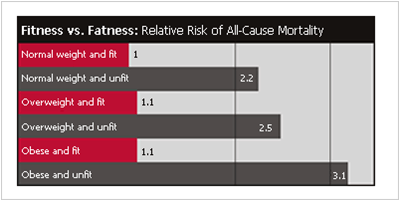
“We’ve studied this from many perspectives in women and in men, and we get the same answer: It’s not the obesity, it’s the fitness.”

Glenn Gaesser – Obesity, Health, and Metabolic Fitness

“no measure of body weight or body fat was related to the degree of coronary vessel disease. The obesity-heart disease link is just not well supported by the scientific and medical literature…Body weight, and even body fat for that matter, do not tell us nearly as much about our health as lifestyle factors, such as exercise and the foods we eat…total cholesterol levels returned to their original levels–despite absolutely no change in body weight–requiring the researchers to conclude that the fat content of the diet, not weight change, was responsible for the changes in cholesterol levels.”

Paffenbarger et. al. Physical Mortality:  All Cause Mortality, and Longevity of College Alumni

“With or without consideration of …extremes or gains in body weight…alumni mortality rates were significantly lower among the physically active.”

Wei et. al. Relationship Between Low Cardiorespiratory Fitness and Mortality in Normal-Weight, Overweight, and Obese Men
I wish you could get really fat and stay healthy. I wish you could get morbidly obese and be considered beautiful. Maybe it will change with time, as we all become enormous, and we’ll look back on the skinny-is-beautiful era with distaste, regarding high cheekbones, defined jaws and long sculptured thighs as skeletal and ugly.

You don’t have to wish angel, there are plenty of healthy fat people, and everyone is beautiful if you just learn to see it.  But as long as we’re making wishes, I wish we didn’t act like seeing the beauty in fat people means diminishing the beauty that we see in those who are not fat.  I wish doctors would treat actual health instead of body size and quit adding to the stigma and shame that fat people face by also giving us lazy, incompetent medical care.  I wish they would understand that Health is multi-dimensional and includes things within and outside of our control including genetics, environment, access, and behaviors. Health is not an obligation, nor is it a barometer of worthiness. Nobody owes anybody else “health” or “healthy behavior,” and those who aren’t interested in health are not better or worse people than those who are interested in health. Prioritization of health and the path that someone chooses to get there are intensely personal and not anybody else’s business. The rights to life, liberty and the pursuit of happiness are not health or healthy habit dependent. Public health should be about providing access and information, not making the individual’s health the public’s business.  People who have health issues should be given shame-free, future oriented options for care and accommodation as they wish, not judged or asked to prove that their health issues are not their fault.”

This year I started work as the physician in an obesity clinic with a group of bariatric surgeons.

Well, that’s absolutely terrifying.

The attempt to help people lose weight is generally seen as one of the most futile acts we as doctors of internal medicine can perform: pretty much all we can do is make you feel crappier about yourself than you already do.

This is half true. There isn’t a single study where more than a tiny fraction of participants have successfully lost weight long term and doing the same things that those studies did is likely to lead to the same failure.  I don’t feel crappy about myself at all and you won’t be able to make me, but there are certainly plenty of fat people who have been beaten down by the type of stigma and stereotype with which this article is laced. You have a choice – if you would  practice from a Health at Every Size perspective research shows that you would help people become healthier and increase their self-esteem. Why not give that the old college try?

I once attended a hospital lecture on the genetic determinants of obesity delivered by a specialist physician. The doctor giving the talk was very fat. As he went on, his face got red and stains of sweat spread from his armpits. Obesity is genetic, he argued, wiping his brow

Wow, way to keep your eye on the ball there, that explains why you did not seem to learn anything from the presentation.  If, god forbid, you are ever asked to give a talk like this you will find that it’s hot under those lights and giving a talk, at least a good one, is a physical endeavor.  I have been part of conversations with very thin speakers, some of whom are physical fitness professionals, who were discussing how to deal with sweat on stage.  Also, there’s a word for using the way someone looks to discredit what they say, and that word is bigotry.

Throughout the piece she goes from saying horrible things about fat people…

Emily was white and loud and the fattest person I had ever seen outside a caravan park.

To acting like she’s the victim for having to say them…

Globally, we are carrying 18.5 million tonnes of excess fat under the skin of the overweight and obese, which – if it were still food rather than adipose tissue  – would feed 300 million people for life. Fat people have been compared to petrol-guzzling cars. I feel terrible typing these sentences. I apologise; they are ugly.

You know what’s better than apologizing?  Not saying ridiculous, inflammatory, stigmatizing things with no evidence basis to begin with. Not repeating ridiculous inflammatory statements.  Adding something to the discourse on global hunger slightly more sophisticated than my mother’s admonition that I should eat all my broccoli because kids are starving elsewhere in the world.  Not taking a group of people who are identifiable by sight and then trying to calculate their cost on society in support of their eradication.

The pro-fat bloggers are smart, sassy and pissed off. I’d hang out with them. Yet, if they could click their fingers and be thin, would they?

No, you wouldn’t, at least not with this blogger.  And no, I wouldn’t.  When I say that I love and cherish my body, I don’t mean “I guess if I can’t have a thin body I’ll just like this one.”  I love my body and I entrust my health to that high science of research that you are so willing to eschew for a treatment program that didn’t worked for one person one time.  Since you doctors have no good options that are likely to make fat people thinner, I’m also very glad that I can model the option of falling in love with the bodies that we have, and give people like you an opportunity to question their stereotypes.

This isn’t a complete discussion of the piece because, as science is to Dr. Hitchock’s medical practice, so brevity is to her writing.  The piece is interminable and packed with prejudice, assumption, stereotype, bigotry, and a devil may care attitude toward science that I find seriously disturbing in someone claiming to be a medical professional.  Let me end with this bit of research from Rebecca M. Puhl and Chelsea A. Heuer “In a study of over 620 primary care physicians, >50% viewed obese patients as awkward, unattractive, ugly, and noncompliant. One-third of the sample further characterized obese patients as weak-willed, sloppy, and lazy.”

Welcome to the club Dr. Hitchcock, I wish you weren’t such a proud member. Especially since people are going to come to your clinic in the hope of getting compassionate, competent, evidence-based medical care and instead they’ll get you.

Like the blog?  Here’s more of my stuff:

Become a member: Keep this blog ad-free, support the activism work I do, and get deals from cool businesses Click here for details

The Book:  Fat:  The Owner’s Manual  The E-Book is Name Your Own Price! Click here for details

Dance Classes:  Buy the Dance Class DVDs or download individual classes – Every Body Dance Now! Click here for details
Target Market My (Fat) Ass

wtfplus:the completed plus size clothing bingo card.Bingo! BINGO! BIN-GO!!!!
From the fabulous WTF, Plus Size Clothing Manufacturers http://wtfplus.tumblr.com/

I was on Alberta Primetime last week to discuss “target marketing” from the springboard of the Abercrombie and Fitch issue (video below).  I’ve heard plenty of excuses and justifications for why companies don’t choose to make clothes in plus sizes.  In this segment one of the things that kept coming up was that stores have to target their marketing and therefore excluding plus sized people is completely normal and justifiable part of marketing strategy.

First of all, saying “we want to target our marketing” is not the same thing as saying “we want to make it impossible for people who look a certain way to wear our clothing.”  You can have a target market that is based on the aesthetic that the customer is looking for (what the customer wants to buy), rather than the aesthetic of the customer (what the customer looks like).  So a store can make clothes in a wide variety of sizes and then market those clothes to people who are interested in a “preppy” look, or a “goth” look, more classic or more modern etc.  I learned about a company today that sells Victorian style couture gowns up to a size 28 (and gives a portion of their proceeds to bulldog rescue!)  They’ve got a couple target markets – people who enjoy Victorian style clothes, and people who are interested in bulldog rescue, and they didn’t have to discriminate based on size at all.

I was also asked if stores that only sell plus-sized clothing should be accused of the same type of discrimination.  If considered technically and in a vacuum, I suppose it’s possible.  But based on the actual reality of the current culture, I think it’s a derailing and basically indefensible position to take.  When you realize that, as things are, I can be in a huge mall in LA and not find a single piece of clothing in my size, it seems ridiculous to begrudge me the few stores that do sell clothes that fit me.  Those stores aren’t discriminating because they don’t want thin people in their clothes, indeed most of their clothes mimic those already available in straight sizes, these stores fill a gap so that fat people don’t all have to learn to sew or make our lives into some sort of endless toga party.

“People who wear Catherine’s Brand are just cooler than everyone else!” said nobody ever.  Fat people aren’t asking for specialty stores, we just want some clothes that we like and that cover us at least as the law requires.  Unfortunately we often have to settle for only the latter, and the only place many of us can get these clothes is specialty stores (and for some fatties plus-sized stores don’t carry their sizes and they have to order online or from catalogs) because all the other clothing stores just happen to have chosen to “target market” by making sure that people who look like us can’t wear their clothes.

I think that the fashion industry has long taken advantage of how easy it is to discriminate against fat people by simply not making clothes to fit us, and acting as if that’s simply an aesthetic choice and not a discriminatory one.  I would love to see fashion become about personal expression rather than defining who is cool and who is not (are we seriously adults still trying to be the “cool kids”, could we maybe stop doing that?), or becoming a way to tear each other down (Who has that kind of free time?  If I ever find myself with enough time to sit around and judge other people for their clothing choices,  I will immediately volunteer somewhere.)

There are some signs of positive change in the fashion world right now.  H&M used a “plus-size” model to advertise their swimsuit collection, some Cornell students created a plus-size dress form that actually makes sense, and the “fatkini” sold out in record time which, though not without its problems, gives a real word example of what happens when designers make clothes that plus size women want to wear  (rather than clothes that the rest of the fashion world thinks plus size women “should” wear.)

As a fat person I know that I’m the target market for all kinds of crap I don’t want, courtesy of conferences like “Marketing to the Overweight American,” Since I’m not paying money to these companies that want to sell me diets or stomach amputation, I have some money just waiting to spend on a store that chooses to target their marketing to the aesthetic I’m looking for, rather than trying to score “cool points” by specifically not making clothes to fit me and then encouraging their customers to see the fact that they can get clothes that I can’t as some kind of status symbol.  I guess I’m saying that I wish that particular segment of the fashion world would stop delighting in the fact that they act like junior high school bullies, using justifications that are thinner than that cute gauzy top I can’t get in my size.

You can check out the Alberta Primetime Interview here.

Like the blog?  Here’s more of my stuff:

Become a member: Keep this blog ad-free, support the activism work I do, and get deals from cool businesses Click here for details

The Book:  Fat:  The Owner’s Manual  The E-Book is Name Your Own Price! Click here for details

Dance Classes:  Buy the Dance Class DVDs or download individual classes – Every Body Dance Now! Click here for details

Enough Already

enoughI think that one of the most damaging, despicable and erroneous messages that the diet industry uses to sell us their products that don’t work, is that unless we’re thin, we will never be enough.  Our lives will never be enough, our accomplishments will never be enough.

Sure you won a Grammy for your first CD and an Oscar for your first film, but are you thin?  You’re the governor of a state and people want you to run for President, but are you thin? You’re thin now so we expect you to maintain that obsessively so that you are never not thin.  You eat nourishing foods and move your body regularly, but are you thin? You’re a great mother but are you thin?  You’re a successful business person but are you thin? You’re 4 years old but are you thin? You’re 94 years old but are you thin? You cured cancer but are you thin?

Enough already.

Let’s take a moment to consider that this is an artificial construct.  That being thin is only valuable because of what our culture values at this time.  The body size that is culturally valuable has been different at different times, and currently varies tremendously in different cultures and under different circumstances.

Let’s also be honest that if our body doesn’t match the ideal body for the culture and time in which we live, that can well and truly suck. We have some options:  we can try to change our bodies, we can try to change the culture, or we can live outside it (somewhere on the spectrum from deliriously happy to miserable).  But I’d like us to consider something.  Consider that doing any of those things doesn’t change one simple thing:  We are, each of us, already enough. Our intrinsic value is already beyond measure and, though we can forget that or try to profess it away, our inherent amazingness cannot be diminished by an arbitrary cultural stereotype of beauty, or an industry that seeks to make us hate ourselves so that we buy their useless products.

Consider that we are not more valuable if there is less of us, or less valuable if there is more of us.

Imagine what our society would be like if we realized the value of all bodies.  If we expanded the concept of beautiful people to include everyone, thus rendering it both ultimately powerful, and completely powerless. Imagine how different our lives would be if we understood that comparing our body to anyone else’s is complete folly- as ridiculous as looking at two snowflakes and suggesting that one is more beautiful.

How would our lives be different, how would we use our time, energy, and money if we realized this one simple truth:  We are enough already.

Like the blog?  Here’s more of my stuff:

Become a member: Keep this blog ad-free, support the activism work I do, and get deals from cool businesses Click here for details

The Book:  Fat:  The Owner’s Manual  The E-Book is Name Your Own Price! Click here for details

Dance Classes:  Buy the Dance Class DVDs or download individual classes – Every Body Dance Now! Click here for details

After the Victory – Part 2

victoryI blogged yesterday about the tendency of quelling celebration after activism victories because there is more to be done.  Today I want to talk about what happened was the response to an article I wrote for iVillage about the two bullshit “apologies” that Abercrombie and Fitch have offered regarding their CEO’s comment regarding their lack of plus-sized clothes saying “We go after the attractive all-American kid… A lot of people don’t belong, and they can’t belong. Are we exclusionary, absolutely.”

Both apologizes are tributes to political doublespeak and obfuscation including this absolute gem from the CEO himself: “I sincerely regret that my choice of words was interpreted in a manner that has caused offense”  Right, I feel so much better right now (sarcasm meter- 1o out of 10)

In discussing the situation several people said something to the effect that even if A&F started making plus sized clothes they would never, ever buy anything from them because they didn’t want to make plus-sizes in the first place.  A similar thing happened when I talked about trying out Southwest Airline’s new policy. and people suggested that no matter what their new policy is, their previous poor treatment of fat passengers was so egregious that we should never patronize them again.

I absolutely understand this, I struggled with it when I was considering flying Southwest, and it was really difficult for me to pay Southwest money.  Ultimately the reason I did was that I felt like we had asked them to make things better for fat flyers and in response they made things better for fat flyers.  If  my response to that was “sorry but it will never be enough to make up for what you did and I will never buy your product” then what incentive do companies have to respond to my requests/demands/activism?

I think that this is tricky and I’m not suggesting that everyone has to go out and buy things from companies they find despicable (and lord knows that A&F have more issues than just their poor treatment of fat folk,) I’m not trying to tell anyone what to do at all, but I do think this is worth discussion.  If a company hears our concerns/request/demands and responds to them by making the changes we asked for, and is then told that because of what they did in the past we will never patronize them regardless, then it seems that we may be training activism targets to ignore us or even be more aggressively hostile, and that it might have been better just to try to put them out of business instead of asking them to change.

If, for example, a petition or e-mail campaign results in desired changes, it seems to me that it would be a good idea to have a second quick campaign thanking the company for making the changes.  Even if we think it’s something that they should have done all along, from an outcome-based standpoint a little thank you can mean that we get the changes and gain an ally instead of a begrudging change and bitter possible future adversary.

So if we make requests of a company, the company makes the changes, and then we give them a second chance and our business, maybe we train businesses that there are rewards for responding to our requests?  As usual I don’t have all the answers, but I think it’s an interesting question.

Like the blog?  Here’s more of my stuff:

Become a member: Keep this blog ad-free, support the activism work I do, and get deals from cool businesses Click here for details

The Book:  Fat:  The Owner’s Manual  The E-Book is Name Your Own Price! Click here for details

Dance Classes:  Buy the Dance Class DVDs or download individual classes – Every Body Dance Now! Click here for details

After the Victory – Part 1

CelebrateA couple things have happened today that have made me thing about what happens after an activism victory.  I’ll talk about one today, and the other tomorrow.  (My first 2 part post, I’m pretty excited!)  I posted on Facebook about how excited I am that the Boy Scouts of America voted to end their ban on gay scouts, and congratulating the activists who made it happen.  Immediately people replied that there is still a ban on gay leaders and that this victory isn’t enough.

I see this happen with all kinds of activism victories.  I won’t speak for anyone else, but I can tell you that when I’ve just been part of an activism project that has had a success, this response is far more disheartening than a million trolls calling me a “fat cnut landwale.”  There is always a next step, there is always more work to do, but I don’t believe that means that we shouldn’t take time and space to celebrate our victories. While I understand that many of the people who do this have positive intentions, and of course I don’t deny that people are allowed to do it, I’m not convinced that pointing out that a hard fought victory  is “not enough” before the ink dries helps to encourage future activism  – though perhaps that’s not the goal. I’m not against discussion of what more there is to do,  I’m just not certain that the most productive time for that discussion is in the minutes following a victory.

I’ve had the opportunity to be involved in some large-ish scale long term projects and to talk to people who have been involved in many more than I, and what I learned from my experience and from the people who mentored me is that activism like this can be absolutely gut wrenching – full of bumps in the road, hope dashed by bitter disappointment, desperate stories from people who tell you that they are counting on you to make things better.  Out of a 1,000 day campaign, it’s possible that day 1,000 is a partial victory, but every single other day was a battle  – not even necessarily with those whose policies/minds you hope to change, but also with yourself not to give up in the face of seriously stacked odds and naysayers (just as there are people who rush to tell activists that our victories aren’t enough, there are those who tell us at the outset and every possible opportunity that our activism is doomed to failure, nothing ever changes etc.).

As an activist it is always possible to look back see your entire life as a series of projects and victories that were never enough – for me that certainly doesn’t encourage continued work, and I’ve not seen it inspire others to activism.  So to take away the celebration when we win a battle, just because there are more battles to fight, seems like an absolute shame and counter productive to me, but of course that’s just my opinion.

Fat activism has had plenty of amazing victories so far and we’re going to have plenty more, so I think we might as well talk about what happens after we win.

On the News!

I’ll be on Alberta Primetime at 12:30pm Pacific Time today (5/24/13) with a panel to discuss the Abercrombie and Fitch situation and what we think will happen in the future.

Like the blog?  Here’s more of my stuff:

Become a member: Keep this blog ad-free, support the activism work I do, and get deals from cool businesses Click here for details

The Book:  Fat:  The Owner’s Manual  The E-Book is Name Your Own Price! Click here for details

Dance Classes:  Buy the Dance Class DVDs or download individual classes – Every Body Dance Now! Click here for details