First of all, thank you so much to everyone who offered congratulations on the marathon (did I mention that I completed a marathon?) There has been some confusion about my desire to do the marathon and what it means to have done it and I want to try to clear that up. This is from an e-mail that I received today:
“Congratulations on finishing a marathon!”
Thanks!
“I’m glad that you understand that fat people need to be out there exercising and eating healthy, not just sitting around being lazy.”
Nooooooo. No no no no no no no no. World of no. Galaxy of no. No.
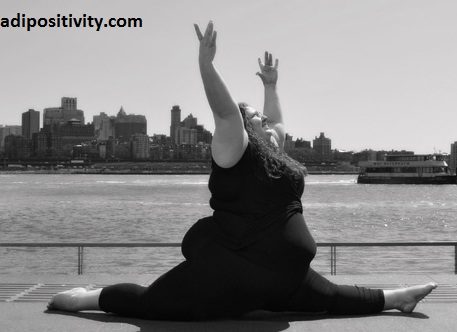
This whole “Good Fatty/Bad Fatty” thing has to die. I do athletic things because I enjoy them (or at least because I want to do them), not because I am under any illusion that I should have to “perform” as an athlete to deserve basic human respect. Fat people are allowed to be athletes and we are allowed to talk about it and be proud of our achievements but being a fathlete is no more laudable than if we knit awesome sweaters or if we can quote every word of Eddie Izzard’s Dressed to Kill.
I/we/fat people don’t “need to do” anything. Paternalism is running rampant right now, crushing fat people in its stampede to judge somebody else and tell them how to live their lives (and do it fast before someone looks at you!)
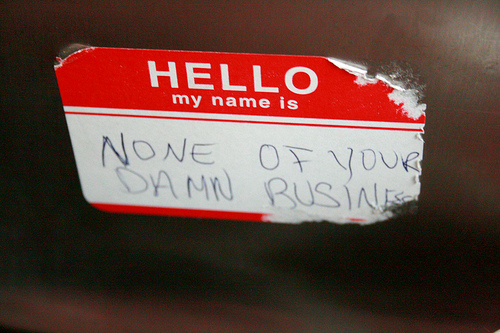
If I washed down a macaroni and cheese casserole with 2 liters of Mountain Dew and a couple gallons of ice cream and that was just breakfast, and I haven’t exercised since 1985, it STILL wouldn’t be anybody else’s business, and it still wouldn’t be their place to tell me what I “need” to do. Because I’m allowed to live that way if I want. Just like people are allowed to get pass-out drunk every weekend, or jump out of a helicopter onto a super steep mountain wearing skis, or be a cast member of Jackass. We don’t lose our right to chose how highly to prioritize our health, or what hobbies we choose because of our body size.
If you’re still here I’ll break it way down for you:
If you’re looking for your beeswax, you won’t find it on my ass.
My body size, my level of health, my diet, are none of anybody else’s business unless I choose to make it their business.. Just like theirs are none of mine. We live in such a “judge-or-be-judged” culture that people always seem to be looking for some way (any way!) that they are better than someone else. They have more money, they have more style, they have more friends on Facebook. So I think that when they see a fat person they heave a sigh of relief because they are obviously better.
This is not helpful. This is not useful. This is not getting us anywhere. I would suggest that those who are feeling the need to help strangers be healthier work on making sure that everyone has access to the foods they would choose to eat, safe movement options (both physically safe and psychologically safe – free from shame/stigma/bullying etc.) and good, affordable, evidence based healthcare. Or they can worry about their own health. But seriously, mine is none of their business and I don’t “need” to do anything to be afforded basic human respect and my rights to life, liberty and the pursuit of happiness, and neither does anyone else.
Like my blog? Looking for some holiday support or gifts? Here’s more of my stuff!
The Book: Fat: The Owner’s Manual The E-Book is Name Your Own Price!Click here for details
Dance Classes: Buy the Dance Class DVDs or download individual classes – Every Body Dance Now! Click here for details
Become a member: For just ten bucks a month you can keep this blog ad-free, support the activism work I do, and get deals from cool businesses Click here for details
This is also how you can tell if someone walked a marathon.
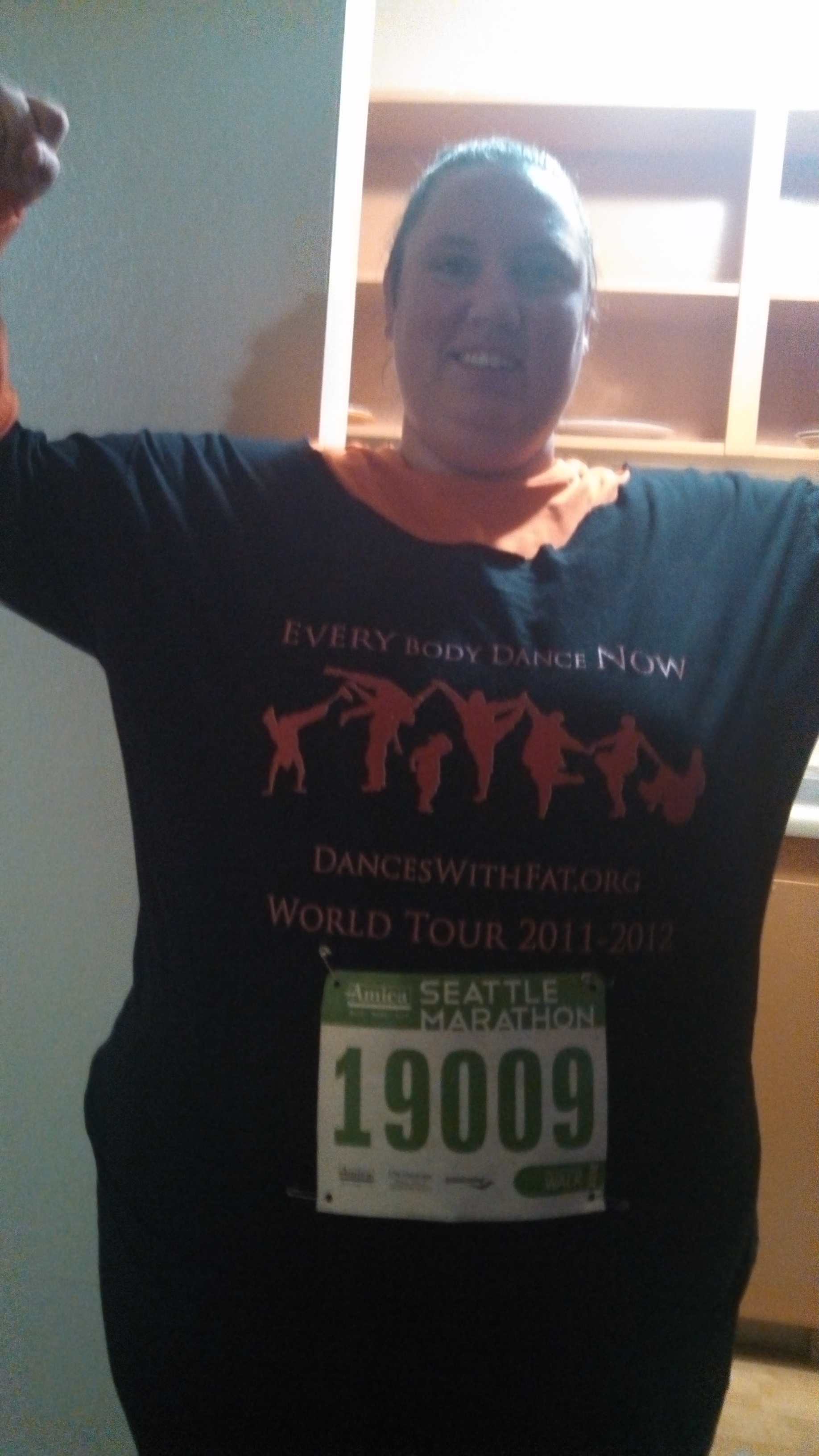
About twenty weeks ago I decided to train to do the Seattle Marathon. I had registered as a walker and Sunday was the Seattle Marathon. When I woke up at 5am I told my partner Julianne “It’s going to be a long day.” I was not wrong. I’ve been training for the last 20 weeks, 370 training miles in all, for an 8.5 hour marathon. That is not how it worked out.
I did the marathon with Kelrick – my best friend who, 20 weeks ago, took less than a minute to answer my “do you want to do a marathon” e-mail with “I’m in”. The course is billed as rolling with hilly sections. I thought I had trained for the hills, but I was wrong – Seattle’s hills are something else – the hills kicked my ass, as did the 9mph to 20mph headwinds that we experienced. After 4 miles I felt like I normally feel after 10 miles, not a great sign. After taking 25 minutes for a desperately needed bathroom break (and thanks to all those sending hatemail who are so very concerned about my gastrointestinal health, but this was mostly waiting in line to pee and then peeing) at mile 2, and dealing with the hills through mile 5 it became clear that my 8.5 hour marathon was not to be. We deemed ourselves Team Dead Last and prepared for a very long day.
The other runners were incredibly supportive, yelling encouragement, saying that I was their hero, giving me high fives, shouting to keep going, not to quit. It was awesome. Runners at the very front of the pack used precious energy to encourage me. For all of that I’m incredibly grateful, not just for the encouragement but because participating in a sport that I suck at and being encouraged by those who excel reminded me that actual athletes don’t spend their time being asses on the internet, they behave in ways that are honorable which includes being encouraging to beginners and those who aren’t elite.
Most of the encouragement came to me and not to Kelrick which he confirmed was really kind of crappy for him, though he noted that most of the crap came to me as well.
At mile 7 the woman driving the “sag wagon” (the vehicle charged with staying with the people in last place) asked incredulously if I was doing the marathon (yes) if I was a runner or walker (are you kidding me with this question? Note that I was in last place, wearing a bib that was green – the walker color – that said “walk” in big block letters, if someone knows this and still thinks I registered as a runner I have some concerns), and if I had started at the proper time (yup, one of the first out of the gate, the walkers started first in this particular marathon).
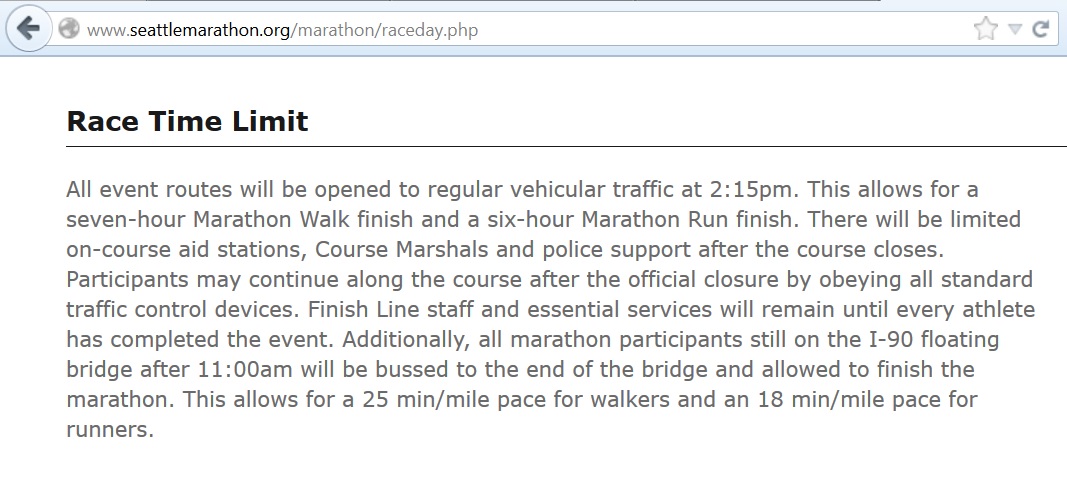
A few moments later she tried to talk me into quitting by telling me that it was later than it was, that I was going slower than I was, and saying that at this pace I’d never make it and I’d need to be picked up in the afternoon so I might as well quit now. I don’t remember exactly what I said to her but it started with “That’s enough.” and ended with “I chose this marathon because it said that it quote ‘stays open until every athlete finishes’ if I need to be picked up I’ll let you know.” We made it off the bridge with 30 minutes to spare before the cut-off time (and note that the rules stated that even if we missed the cut-off time we would be bussed off the bridge and allowed to continue.)
When we stopped to treat Kel’s blister at mile 10 and I used the restroom, she sent someone to bang on the door and ask if I was ok (yes, except I’m having trouble peeing while you bang on the door) and told a member of the medical staff to try to talk me into quitting when I came back. Kel overheard and thankfully put a stop to that. As we left she then got another member of the medical staff to come with us and try to talk us out of it. I mentioned that I thought that this woman just wanted to go home as early as possible and asked if there was there any way that we could let her do that, since this was hard enough without her constant discouragement. The medic suggested that we officially drop out but finish anyway. Um, no. I was participating based on the rules of the marathon. I would not have entered a marathon with a time limit and then ask that they accommodate me, I picked this marathon because their rules specifically accommodated my slow time. This woman was just going to have deal with it.
At mile 11 they closed the aid stations and opened the roads and from then on we were told that there would be no more mile markers, no more water and gatorade stations, no more port-a-potties, and since there weren’t sidewalks in a lot of places we had to walk on trails and lawns (which meant that, according to our GPS, we walked about a mile extra.) At mile 14 she sent a member of the medical personnel out, telling her that I was limping (I wasn’t) and that she should convince us to drop out. The young woman said that we looked great but told us that they were closing all of the medical stations. She gave us a bunch of supplies and wished us luck.
At mile 14 the sag wagon lady pulled beside me and said “You can quit now and still get a medal for finishing a half marathon.” I explained to her that I set out to complete a marathon, not a half marathon, and that if I didn’t complete this one I would have to do another one which I did not want to do. I leaned into the car and said “I. Will. Not. Quit.”
At mile 18 the sag wagon lady told us that they were tearing down and there would be no finish line.
It’s hard to explain why that news was so devastating – except to say that I realized that the moment I had trained for, that I had fantasized about for 370 training miles and that had kept me going for 18 miles that day wasn’t going to happen. We were 8 miles from the finish line and I was in a lot of pain – the uphills made me tired but the steep downhills had put pressure on a new part of my food and I had developed some serious blisters on the balls of each foot that hurt with every step and now I would start limping except that both feet were killing me, I had been dealing with a weird pain in my calf since around mile 11, and if I was able to suffer through 8 more miles, there would be no finish line to cross and I would have to accept my medal from a woman who spent the day trying to get me to quit. Through my tears I looked at Kel and he looked at me and we both said “the only thing to do is finish” and we set off again.
It was at this point that she experienced an attitude adjustment. She started crying saying that it wasn’t fair and I deserved to cross a finish line and that she was going to do the best she could to give us our medals with ceremony, and from then on she was really supportive. She and another gentleman in a separate car began to guide us in – she would go ahead to mark the path, he would stay behind us to light it.
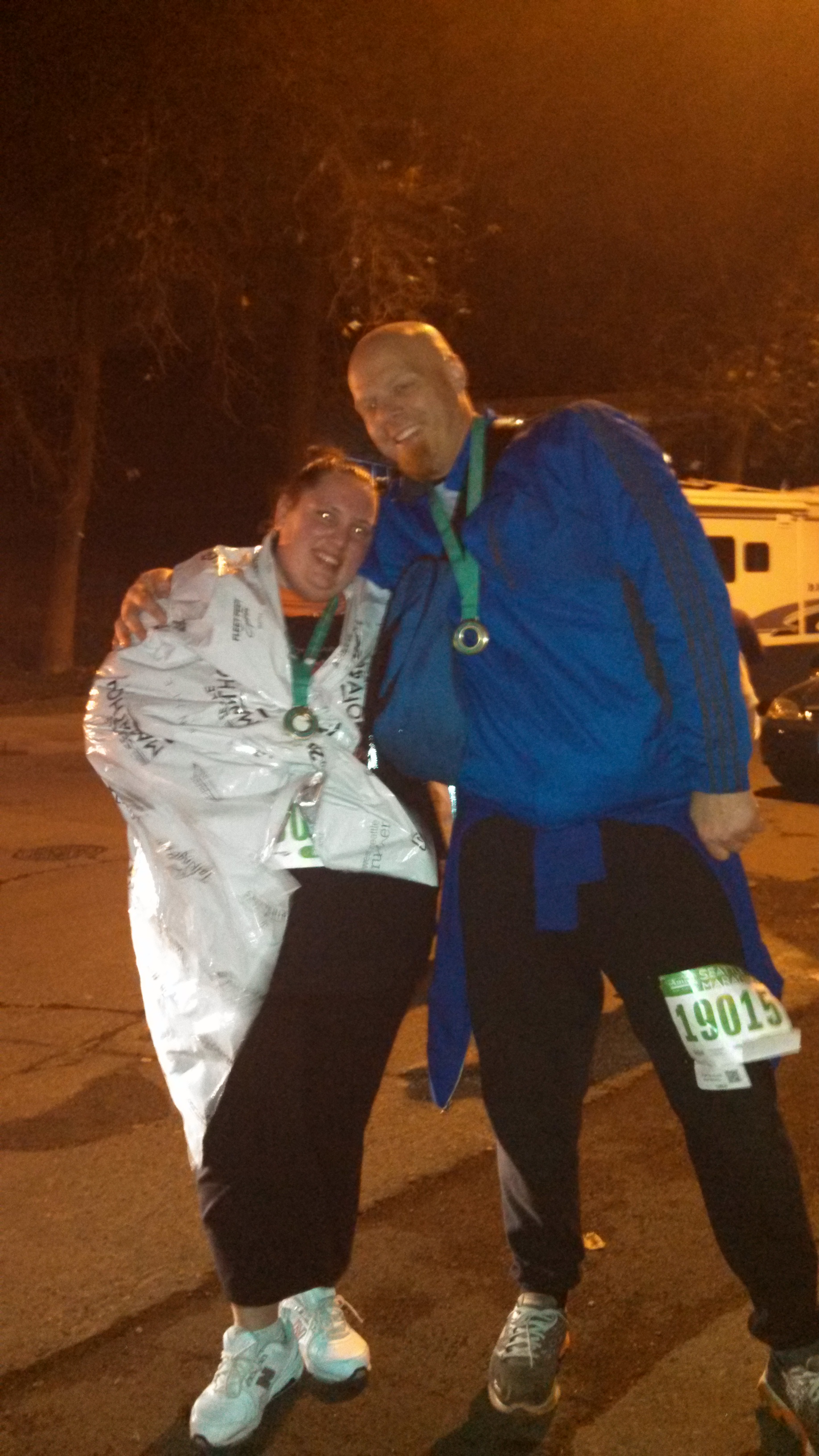
The next 8 miles are a blur of hills, pain, and suffering. As we turned the corner to the stadium we saw Julianne, our support crew, and a couple of guys from the race staff in a group of people cheering (I would later find out that one person came to cheer for me but wanted me to be able to rest so she didn’t introduce herself,) one was someone important with the race but I can’t for the life of me remember his title. I jogged the last little bit and accepted my medal – which, for reasons I may never understand, actually seemed (and still seems) worth all the work and pain and suffering. Kel and I got the same finishing time though he was perfectly willing to finish last so I would be second to last because that’s just the kind of best friend he is.
I planned to be on the course for no more than 9 hours. Team Dead Last took 12 hours and 20 minutes to complete the marathon. When the woman from the sag wagon hugged me she teared up and told me she was proud of me and apologized for us “getting off to a rough start.” I accepted her apology, thanked her, smiled and said what I had been waiting 19.2 miles to say – “I told you at mile 7 that I wasn’t going to quit.”
For more than half the marathon we did it with no water or gatorade stops, no medical support, no cheering crowds, no road closures, on muddy trails dodging tree roots, and with the people who were supposed to support us trying to convince us to quit. Earlier in the year I mentioned that I wanted to do more things that I’m not good at and this certainly qualifies – of over 10,000 people I was the absolute hands-down worst. I’m not sure it’s the hardest thing I’ve ever done in my life, but it is the thing that I most wanted to quit, and I mean it is the thing that I both most often, and most aggressively wanted to quit. We did it the hard way, but we did it.
One runner who wanted to encourage me told me not to quit because if I could finish I would believe that I could do anything. I smiled and gave her a high five, knowing that the truth is that I already believe that I can do anything which is why I was in the marathon.
Answers to frequent statements and questions:
It doesn’t seem like Health at Every Size to put your body through something like this.
Health at Every Size says that people of all sizes can engage in healthy behaviors and that our best chance for our healthiest body (knowing that there are no guarantees or obligations) is practicing health behaviors rather than trying to achieve health through the manipulation of our body size. It does not say that to practice HAES, everything I do has to prioritize my health or comfort. This goal wasn’t about health (though I certainly hit my movement goal for the week!), it was about achieving something totally outside my comfort zone, doing something that I’m not good at, and though I wouldn’t recommend it to anyone, I’m really happy that I did it.
If you don’t run a marathon in [insert random number of hours] then it shouldn’t count.
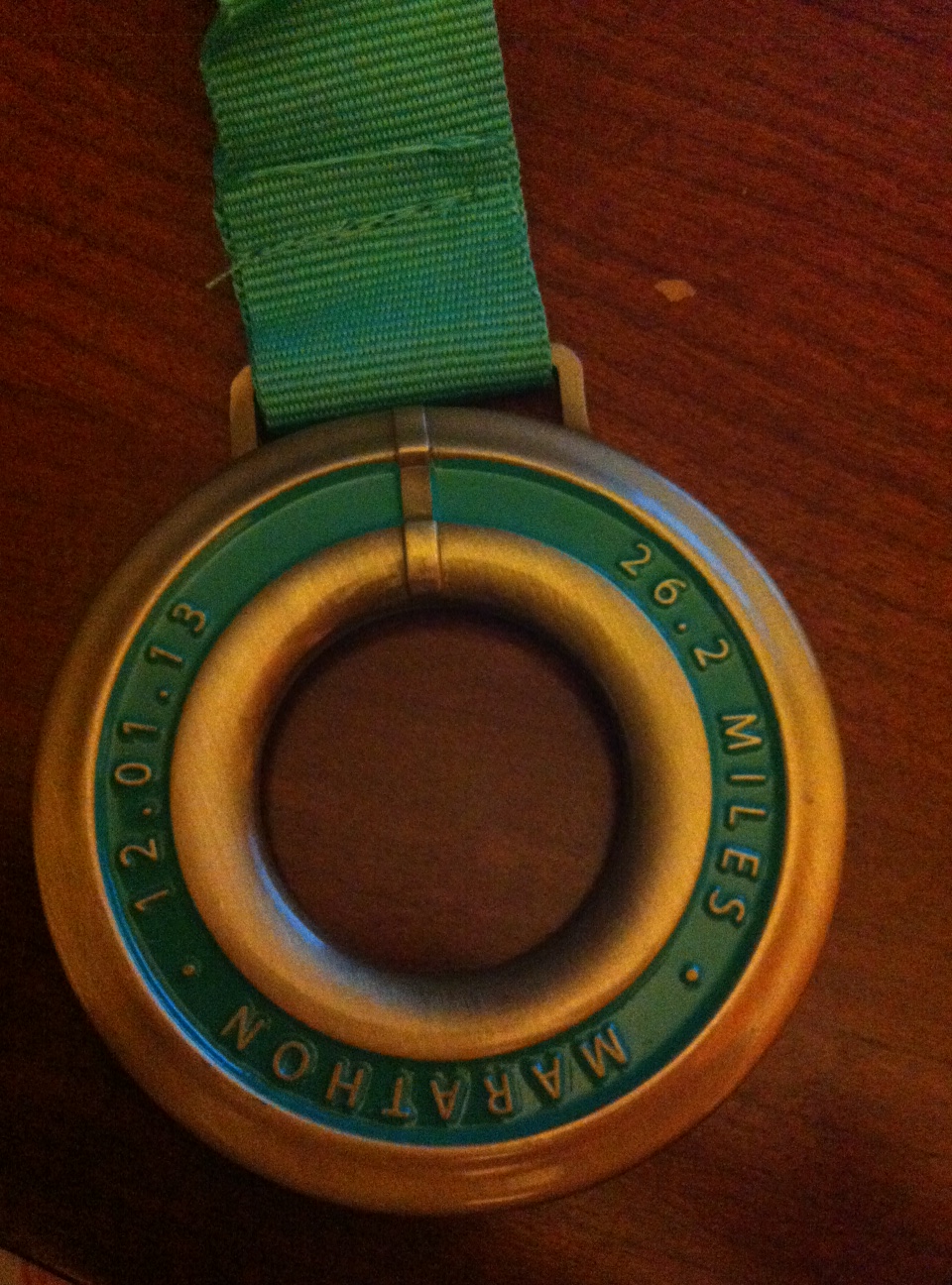
The Seattle Marathon specifically has no time limit. My medal says “26.2 miles. Marathon.” I finished, it counts. Don’t like it? You can do whatever you want but if you’re looking for a suggestion, feel very free to bite me.
Anybody can walk a marathon in 12 hours, it’s not that big a deal.
Plenty of people who registered to walk the marathon, and trained to walk the marathon, dropped out of the marathon. One of the guys at the finish line was telling my partner than he has done 55 marathons and that if he had done the Seattle Marathon as his first one he wouldn’t have finished. But at the end of the day it doesn’t matter – there is no shame in trying and quitting a marathon, there’s no shame in not trying a marathon, and there’s no shame in taking 12 hours and 20 minutes to complete it. I will never understand people who say that they love a sport but then don’t want to open it up to the largest possible group of people. People who want to insist that their sport is only for some people, or isn’t for those who look a certain way, or want to belittle or devalue other people’s achievements seem to me to be simply screaming “I’M INSECURE!!!!!!” at the top of their lungs.
When is your next marathon?
Never. Never ever. Team Dead Last is also known as Team Never Again. I’m trying to decide what my next thing will be. I’m thinking tap dancing, traditional Irish Dance, or competitive figure skating. I’ll let you know! Edit: Oops, my next marathon is LA in March, 2015. Wish me luck!
Thank you, in no particular order:
To all of my blog readers, twitter followers and Facebook friends who offered me support, encouragement, and congratulations, from the start of training to the egg throwing incident, thank you.
To Julianne for supporting me, making sure I had food after my long training walks, getting things for me when I was too sore and tired to walk, and listening to me complain about this for 20 weeks.
To Kelrick for suffering through this journey with me. He didn’t really train, he was hurting, and yet he refused to leave my side, best Best Friend EVER.
To Kenny (Kelrick’s husband) for giving us a ride to the marathon ridiculously early in the morning, and surprising me by spending all day yesterday making delicious homemade pho because it’s my favorite post long walk meal.
To Mom for her constant support of us.
To the runner who yelled “I love your blog!” You made my day.
To the reader who waited at the finish line to cheer me in.
To all the participants, spectators, and passersby who offered encouragement, especially those who included Kelrick.
To the race staff and volunteers who made the whole thing possible.
To Caroline who found us on mile 21 and insisted on giving us her headlamp because the next section was dark and offered to bring us anything from gatorade to socks, you are awesome!
To our support team, they had a very long day. To the gentleman who joined us around mile 15 and lit the way for us. And to the sag wagon woman for making me to want to gut it out every time she tried to get me to quit and for the support she offered after her change of heart.
Pictures:
Me the morning of the marathon. What the hell was I so happy about?Our course took us over this bridge…and back!We did it!26.2 miles Marathon It was all worth it in the end!Screen shot of the race rules
Like my blog? Looking for some holiday support or gifts? Here’s more of my stuff!
The Book: Fat: The Owner’s Manual The E-Book is Name Your Own Price!Click here for details
Dance Classes: Buy the Dance Class DVDs or download individual classes – Every Body Dance Now! Click here for details
Become a member: For just ten bucks a month you can keep this blog ad-free, support the activism work I do, and get deals from cool businesses Click here for details
Often during talks when I show evidence that habits are a better indicator of future health than body size, I get challenged by someone who tells a story of how someone they knew lost weight and got healthier. I ask if the person changed their behaviors prior to the weight loss and the answer is always say yes. So why, I ask, do we credit the weight loss for the change in health rather than the behavior change. (And let’s remember that health is not entirely within our control, is not an obligation, and is not a barometer of worthiness.)
It seems to me that the health change and the weight change both follow the behavior change so I don’t understand why, inexplicably, we ignore the behavior changes and credit the weight loss with improving the health. In reality, I think that the research indicates that the weight loss is a possible, and likely temporary, side effect of the behavior change.
Often when I deal with a doctor who is prescribing “lose weight feel great” for whatever I’ve come in for (sprained wrist, strep throat, severed limb, whatever) and I start discussing the evidence – that there is not a single study that shows that more than a tiny fraction of people succeed at long term weight loss and that there is not a single study that shows that even the tiny minority who maintain the weight loss have health benefits, and that the majority of people who attempt weight loss end up heavier than when they started – the doctors wholeheartedly agree with me. Then insist that it’s still worth trying. Inexplicably, doctors are constantly prescribing an intervention that has almost no chance of working and, the vast majority of the time, ends in the exact opposite of the intended effect. They are saying that I’m unhealthy because I’m fat, and then prescribing an intervention that is most likely to end in me being fatter.
Inexplicably, when discussing fat people and how we might be made thin, doctors, the government, and anyone who is not fat can suspend all concepts of research and logic, declare themselves an expert, and implement ideas created by rectal pull with absolutely no evidence to suggest that the implementation will work, or even that it won’t harm us. Experiment on children, ignore mountains of evidence, ignore good research methods, make bigotry sound reasonable, suspension of disbelief nothing is too much then we’re talking about making fat people thin.
One thing that fat people can do is stand up and demand that we be treated better than this. Call it out when it’s happening. Refuse to be the unwilling subjects of experimental medicine. Quit being pawns in a game that makes diet companies rich beyond belief and fat people the victims of shame, stigma and oppression. Decide that if they want a war on obesity, we’ll give them one. Enough is enough.
Like my blog? Looking for some holiday support or gifts? Here’s more of my stuff!
The Book: Fat: The Owner’s Manual The E-Book is Name Your Own Price!Click here for details
Dance Classes: Buy the Dance Class DVDs or download individual classes – Every Body Dance Now! Click here for details
Become a member: For just ten bucks a month you can keep this blog ad-free, support the activism work I do, and get deals from cool businesses Click here for details
If you are celebrating holidays in the next couple months then I wish you a season of celebration full of awesomeness and devoid of food policing and unwanted drama. Just in case that’s not how it works out for you, I offer you some quick reminders:
What you eat, what you weigh, and the prioritization and path to health that you have chosen are nobody else’s damn business unless you want them to be their business. Period.
You are allowed to do whatever you choose to get through difficult situations. You can educate, ignore, start screaming, leave, get along quietly, or something else. All of these are valid choices.
People who police other people’s food choices and bodies are messed up. You are fine. If you want more tips on dealing with the food police and holiday drama, check out my column in Ms. Fit Magazine: http://msfitmag.com/do-you-need-to-eat-that/ If you find yourself needing support you are welcome to e-mail me at ragen at danceswithfat dot org and I’ll help however I can.
PS: I’ll be in Seattle for the marathon on Sunday. All wishes of luck, good vibes, and no blisters energy are very welcome! A reader has started a finish line team on Sunday evening, and we are doing a meet-up at a restaurant on Tuesday night. If you want details, e-mail me at ragen at danceswithfat dot org
Like my blog? Looking for some holiday support or gifts? Here’s more of my stuff!
The Book: Fat: The Owner’s Manual The E-Book is Name Your Own Price!Click here for details
Dance Classes: Buy the Dance Class DVDs or download individual classes – Every Body Dance Now! Click here for details
Become a member: For just ten bucks a month you can keep this blog ad-free, support the activism work I do, and get deals from cool businesses Click here for details
I’m obsessed with the Sara Bareilles song Brave (video and full lyrics both below.) I think my favorite lyrics are
Let your words be
Anything but empty
Why don’t you tell them the truth?
Say what you wanna say
And let the words fall out
Honestly I wanna see you be brave
In the past week I’ve received a bunch of awesome e-mails from readers who have been brave. One reader finally asked her doctor for a surgery that she wanted to help with pain, and the doctor said yes. Another reader told her doctor that he needed to stop fat shaming her, presented evidence, and he agreed. Another asked her favorite local Chinese place to get some armless chairs, and they did. My inbox has been joyfully filled with incidences of people standing up and asking for what they deserve and it makes me so happy.
When we think of activism we often think of protests and petitions. These are all fine examples of activism but they take a lot of coordination and they aren’t always happening. A lot of the power of activism is in thousands and thousands of people being brave, taking a risk, and taking individual action in the face of stigma, shaming, bullying, and oppression.
It can be setting boundaries at that family holiday dinner, asking your doctor’s office to get some armless chairs, refusing to participate in a body snarking conversation, sending an e-mail to HR questioning the company’s Biggest Loser competition. For me, activism makes my world better just by participating in it, it’s a way that I push back against the tremendous amount of bullshit that I face as a fat person. Every time I engage in some activism, however big or small, I feel better about myself regardless of the action or the outcome because I’m taking back a tiny bit of power from those who try to keep it from me through an inappropriate use of their power and privilege.
I set a goal this year of doing at least 200 acts of small personal activism each week (besides my writing, speaking, and other larger projects). Whether it’s e-mailing a company that doesn’t make things in my size, asking out loud for a table with armless chairs at a restaurant, posting an activism opportunity to my Facebook, e-mailing Sara Bareilles to thank her for the fabulous fat dancers in her video etc. I do at least 200 each week. Now, I totally get that I am able to do that because I do this work full time and have flexible hours (like I’m blogging right now at 2:30 in the morning!) and I have blog members, to whom I am incredibly grateful, whose membership gives me the financial ability to spend so much time doing activism. Which is all to say that I understand that I am privileged to be able to do this and that my goal is not realistic for everyone, but what do you think about making a goal that is realistic for you – 1 a week, 1 a month? If 1,000 people each did 1 bit of activism a week, that would be 52,000 incidences of activism in a year.
Nobody is obligated to do activism, and I’m not trying to tell anyone how to live. What I am saying is that I’m an activist because I want a different world, a better world, and the only way I know how to do that is to take action and be just a little bit brave.
Here’s the video and lyrics [Annoying warning – the advert at the beginning is on a rotation and, according to readers, one of them is the KIA commercial with the hamsters who are trying to lose weight. Time for me to shoot an e-mail to KIA.)
You can be amazing
You can turn a phrase into a weapon or a drug
You can be the outcast
Or be the backlash of somebody’s lack of love
Or you can start speaking up
Nothing’s gonna hurt you the way that words do
When they settle ‘neath your skin
Kept on the inside and no sunlight
Sometimes a shadow wins
But I wonder what would happen if you
Say what you wanna say
And let the words fall out
Honestly I wanna see you be brave
With what you want to say
And let the words fall out
Honestly I wanna see you be brave
I just wanna see you
I just wanna see you
I just wanna see you
I wanna see you be brave
I just wanna see you
I just wanna see you
I just wanna see you
I wanna see you be brave
Everybody’s been there,
Everybody’s been stared down by the enemy
Fallen for the fear
And done some disappearing,
Bow down to the mighty
Don’t run, stop holding your tongue
Maybe there’s a way out of the cage where you live
Maybe one of these days you can let the light in
Show me how big your brave is
Say what you wanna say
And let the words fall out
Honestly I wanna see you be brave
With what you want to say
And let the words fall out
Honestly I wanna see you be brave
And since your history of silence
Won’t do you any good,
Did you think it would?
Let your words be anything but empty
Why don’t you tell them the truth?
Say what you wanna say
And let the words fall out
Honestly I wanna see you be brave
With what you want to say
And let the words fall out
Honestly I wanna see you be brave
I just wanna see you
I just wanna see you
I just wanna see you
I wanna see you be brave
Like my blog? Here’s more of my stuff!
The Book: Fat: The Owner’s Manual The E-Book is Name Your Own Price!Click here for details
Become a member: For just ten bucks a month you can keep this blog ad-free, support the activism work I do, and get deals from cool businesses Click here for details
I think that the diet industry actually tries to subtly (or perhaps not-so-subtly) sell us immortality. So much of our thin obsession – dieting repeatedly despite horrible odds and experiences, stomach amputation and banding, etc. are purportedly done under the guise of health. But I think that in many cases it might be more honest to say that it’s done because of a fear of death. We’re sold this idea that being thin will ensure a long life, that a long life is the most important thing, and that the diet industry is our ticket to it. So much of my hatemail says something about the fact that I’m going to die, as if the person writing the comment isn’t.
We’re sold the idea of “healthy weight” as if there is some magical weight that we can achieve that will allow us to be immortal unless we get hit by a truck or something. We know it’s not true – nothing will guarantee immortality or even a long life- people of every size die young and people of every size live to old age. Health and weight are two separate things, there is no such thing as a healthy weight. There are also no guarantees around this except that I’m going to die eventually and I don’t know when.
A lot of what I like about the Health at Every Size concept is that it supports my desire to have the best life possible between now and then. I spent a lot of my life being obsessed with being thin. Counting calories in and calories out and just waiting for weigh-in day to see if I was “healthy” and “successful”. It turns out that whether I had lost or gained weight I was neither – obsession with thinness was ruining my mental health, my physical health, and that wasn’t working out at all.
Now I roll healthy habits into my life and I can repurpose all the brain power and time and energy that I used to spend obsessing about being thin and counting calories to do things that I love. That is working out. Of course that’s just my experience, your mileage may vary.
I no longer believe that the diet industry will do anything except make money for themselves. Immortality would be nice, so would an invisibility cloak and the super-suit from Greatest American Hero (although preferably with the instruction manual), but since none of those are really likely to happen, I’m focusing on the living the happiest possible life between now and then, which includes spending zero physical or mental energy on being thin, and spending lots of physical and mental energy on things that I love.
Like my blog? Here’s more of my stuff!
The Book: Fat: The Owner’s Manual The E-Book is Name Your Own Price!Click here for details
Become a member: For just ten bucks a month you can keep this blog ad-free, support the activism work I do, and get deals from cool businesses Click here for details
It’s the holidays and I’m being hit with a ton of requests asking me to buy subscriptions to fashion and so-called fitness magazines – for myself, as gifts for my family and friends etc. I’m absolutely not going to do that, and here is why.
I was standing in line at the grocery store irritated about all of the magazine covers that showed diets, just like the month before that and the month before that. It hit me suddenly just how ridiculous it is to believe that these diets work if there is a new one (or three) on the cover of almost every women’s magazine every month. I started to wonder just how many weight loss messages I would have received if (heavens forfend) I actually subscribed to one of these magazines for a year.
I chose Self magazine and a quick trip to Googleland got me all of the covers for 2010. (I was going to post the covers here but they just irritated me way too much so I’m not.) Here’s what I could have accomplished in 2010 according to the cover of Self Magazine [trigger warning – you can skip the list to skip the triggering language.]
Peeled off major pounds with the food lovers diet
Become slimmer every day with the no gym workout
firmed up for free with 6 at-home tips
Learned to eat like Carrie Underwood
Achieved a sexy stomach
Learned to eat like Hayden Panetteire
Lost weight in 3 easy ways
Been happy and healthy at any size (this is on the same cover as “lose weight 3 easy ways and “firm up for free”)
Slimmed down for spring
Achieved a flat stomach with their proven plan (Hmmm, this word – proven- I do not think it means what you think it means)
Eaten the superfood that slenderizes while I snack
Learned 20 best foods for weight loss
Achieved flat abs, lean legs and amazing arms between April 1st and May 1st
Learned the 50 best foods for beating sneaky pounds (apparently too sneaky for the 20 best foods for weight loss)
Learned 15 delicious food that fight fat (apparently different that the best foods for weight loss or the 50 best foods for beating sneaky pounds)
Achieved flat abs and lost 9 pounds by revving my body’s natural fat burning ability. (9 pounds. not 8, not 10, 9.)
Learned what to eat to get a flat belly
Dropped 400 calories without noticing
Learned the fastest shape up ever – burning 10 calories in 10 minutes
Learned 242 ways to be slim, gorgeous and healthy
Achieved flat abs in 4 minutes
Learned the super market cheat sheet to just shop, eat and lose weight
learned the sexy body secret to a flatter tummy
Learned the single best workout (which makes me wonder why they keep publishing more workouts)
Lose 8 pounds in thirty days (8 pounds. not 7, not 9, 8.)
Burn 200 calories without working out
Learned the #1 way to burn fat (which makes me wonder why they keep publishing more ways to burn fat)
Become a happy healthy eater
Achieved leaner legs and a tighter tush in 6 like-magic moves
Learned 231 tips for a sexier, fitter me
Learned the simplest slim down (makes me wonder why they keep publishing other ways to slim down
Learned to Eat up, Lose Weight like 6 other women
Lose weight without trying with my weight loss grocery list (apparently different from the 25, 50, 15 food and the super market cheat sheet)
Stay slim all winter
This is ridiculous. They’ve been publishing these same types of stories once per month since January 1979. Based on the numbers from 2010 my year they would have published about 1152 ways to be skinny, and they are just one of many magazines doing this. They are selling millions of magazines by playing to the omgdeathfatiscomingforusanditwillgiveuscankles terror, and since Self claims a circulation of 5,5 million readers, according to its corporate media kit, the marketing appears to be working (never mind that the diets are not.)
My little project led me to three main conclusions:
If this stuff actually worked then they would be out of the business of selling magazines. Would you buy a magazine if it told you every month that it had a new and exciting way to teach you to be 6 inches taller, knowing that it had been giving that same advice without success for 32 years? How many times can the find “The Single Best Workout” and if they have, why bother publishing more workouts, just keep posting that one, as it is the single best.
I think that it is highly unethical to tell people to try intentional weight loss without being clear that it fails 95% of the time. I think that telling people that intentional weight loss is “easy” should probably be punishable by death.
I think it’s time to demand a little more from our reading material than superlatives, hyperbole and bullshit, with a heaping helping of advertising meant to convince us to hand over our self-esteem so that someone can cheapen it and sell it back to us at a profit (with a nod to CJ Legare who is the first person I heard put it like that.)
Activism Opportunity: Refuse to subscribe to these magazines, don’t give them as gifts, cancel the subscriptions that you have until these magazines provide us with something other than tired, recycled diet advice, ads that make us feel like crap, and a never ending Photo Shop of Horrors.
Reminder: the awesome Golda Poretsky is doing a 30 day “HAES for the Holidays” e-course. I’ve done workshops with Golda and she is really a fabulous teacher, you can find out about it here (Full disclosure – Golda offers an affiliate program so if you register for the class you support yourself, Golda, and me!)
Like my blog? Here’s more of my stuff!
The Book: Fat: The Owner’s Manual The E-Book is Name Your Own Price!Click here for details
Become a member: For just ten bucks a month you can keep this blog ad-free, support the activism work I do, and get deals from cool businesses Click here for details
The American Heart Association, the American College of Cardiology, and the Obesity Society released new guidelines urging doctors to be “more aggressive” in urging fat patients to lose weight. I don’t know what doctors other people go to, but the doctors who I see couldn’t get any more aggressive unless they started threatening me with a weapon.
But what do they mean by “aggressive?” The guidelines are [trigger warning]:
At least once year, calculate patients’ BMI, measure their waists and tell them if they are overweight or obese.
Develop a weight-loss plan that includes exercise and moderate calorie-cutting.
Consider recommending weight-loss surgery for patients with a BMI of 40 or for those with a BMI of 35 who also have two other risk factors for heart disease such as diabetes or high blood pressure.
Refer overweight and obese patients who are headed for heart problems to weight-loss programs. Specifically, discuss enrolling them in at least 14 face-to-face counseling sessions over six months with a registered dietitian, psychologist or other professional with training in weight management.
First of all, BMI and waist circumference are not measures of health at all, the suggestion that doctors should recommend any intervention based on these numbers is highly problematic, especially with so many studies that show that habits, not body size are the best determinant of health.
Even if weight loss was a health intervention (and I don’t believe it is), there is not a single study where more than a tiny fraction of people have maintained long term weight loss. Weight loss simply does not meet the requirements for evidence based medicine doctors attempting to “develop a weight-loss plan that includes exercise and moderate calorie-cutting” will be repeating an intervention that has been nearly completely unsuccessful in every study that exists. Most people will lose weight in the short term and, when their body adjusts, they will gain the weight back and many will gain back more than they lost. Prescribing something that a mountain of research has told us almost never works, and telling people that everyone who tries hard enough succeeds, absolutely defies medical ethics.
Weight loss surgery is dangerous including horrific life-changing complications, and a seriuosly increased chance of death and the evidence for efficacy is dubious at best: “most comprehensive independent review of bariatric surgery, conducted by the Emergency Care Research Institute, a nonprofit health services research agency, examined evidence from seventy studies. The investigators reported that while significant weight loss occurred, patients still remain obese. However, they noted that the evidence demonstrating that associated diseases improved was weak, and it was not evident that surgery resolved heart disease or extended life span. They report that claims of improved “quality of life and long-term health impacts are less conclusive.”
You all know that I do not ever want to tell you how to live or what to do (unless I’m telling you not to try to steal other people’s civil rights by an inappropriate use of power and privilege). That said, I want to implore you to please speak up against this if you in a position to be able to. This is not our fault but it becomes our problem and in my experience the way to change things is for those of us who can speak up against it, to speak up against it.
When the doctor suggests counseling or a diet intervention, we can demand the evidence that it will 1. lead to long term weight loss of the amount that they suggest you need to lose and 2. that the weight loss will cause the health improvements that they are suggesting. They will not be able to provide us with this because it does not exist. There is no study showing that even the tiny fraction of people who manage to maintain weight loss actually have improved health because of it.
If the doctor suggests weight loss surgery ask about the increased mortality rate,or if they can guarantee that you will not experience horrific side effects, or just tell them that you refuse to be have your vital organs mutilated or amputated for a surgery that brings no guarantees of long term weight loss or improved health, and often results in the opposite.
Demand health interventions (not body size interventions) for health problems, ask if thin people get this health problem (Pro-tip: they do), ask what they prescribe to thin people, insist on that intervention. Yes, even if the problem is with your joints.
We have the right to refuse to be the subjects of experimental medicine. We have the right to demand evidence-based medicine and the evidence basis for interventions the doctor prescribes. We have the right to be treated as individual patients and not ratios of weight and height.
If you want more information on how to talk to your doctor, including some practice, I’m teaching an online class this Saturday the 23rd from 12-2pm Pacific. The class will include scripting to use with your doctor, a discussion of patient rights, the research on weight and health, and optional chances to practice, ask questions, and role play. You can join by audio, or video and participate or just listen in. There are only 8 slots, and the class is $35 ($15 for danceswithfat members). You can sign up here. If there on no spots left just shoot me an e-mail at ragen@danceswithfat.org and I’ll get you on the list for first dibs on the next class.
Like my blog? Here’s more of my stuff!
The Book: Fat: The Owner’s Manual The E-Book is Name Your Own Price!Click here for details
Become a member: For just ten bucks a month you can keep this blog ad-free, support the activism work I do, and get deals from cool businesses Click here for details
I’ve had several readers ask about how to deal with diet talk – especially its uptick during the holiday season. There is no doubt that whether it’s donuts in the break room from a vendor, an appetizer buffet at a party, or your family holiday dinner, the more food options present themselves the more chances there are for you to be subjected to other people’s triggering talk about exactly what they are and aren’t eating and why.
I think that diet talk is a product both of a culture that insists that women apologize for and/or justify our every action, a diet culture that diet companies have very profitably perpetuated, and the hormonal shifts that occur when someone diets that can lead to them being hungry all the time and perhaps thus unable to shut the freaking hell up about their diet.
Regardless, I don’t know about you but I don’t give a crap why my co-worker is or isn’t eating something, what morality they’ve assigned to that choice or why. Much the same way that I don’t want to know if the cream that their doctor prescribed is making that rash any better. Boundaries people, boundaries. Can you imagine if we talked about every personal decision the way we talk about food choices “I have to poo but I don’t like to do it in public so I’m hoping to make it home before I really have to go.” Why are you telling me this? What can I do to make you stop?
People can participate in diet talk for a variety of reasons. Sometimes they do it to reinforce their own behaviors – someone has told them that talking about this out loud will help them stick to their diet, but failed to tell them that it may annoy the ever loving crap out of the people around them. There are some who do it for approval – diet talk, pat head, good dieter. Sometimes people do it out of habit and without any thought at all. Finally, it’s not your imagination, some people do it as a way to passively aggressively comment on your eating behavior (or their perception of it.)
Our society is screwed up around food and eating, and diet talk is one of the byproducts. Knowing that, when I deal with this I try to keep in mind that, unless I have reason to believe otherwise, this person probably isn’t trying to be the champion of triggering overshare, even if that’s how I’m hearing it. Regardless of why people do it, I think that there are four basic choices in how to deal with it:
1. Ignore It
Just act like it didn’t happen, continue the conversation or start another conversation.
Example:
They say: No cake for me, I’m being good.
You say: So I told him that if we don’t get that copier fixed I’m never going to get the shareholders report done in time for the meeting.
2. Return in kind
Talk about your Health at Every Size/Mindful Eating/Intuitive Eating Practice the way that other people talk about their diets.
Example:
They say: Do you think there is there any fiber in these brownies, I have to calculate the points.
You say: Sorry, I have no idea, I eat based my bodies internal cues and my enjoyment.
3. Ask them to stop
Let someone know that it’s upsetting to you and ask if they can refrain from doing it.
They say: Blah blah blah diet blah blah blah
You say: I’m working on getting to a healthy place around food and that kind of diet talk makes it much harder for me. Would you mind if we both refrained from talking about our food choices and talked about something else instead?
3. Snarky (not actually recommended but fun for me to think about)
Example:
They say: I am starting [insert intentional weight loss attempt name here] and I’m making it my New Year’s Resolution to lose 20 pounds.
You say: I’m resolving to do something that’s more likely to succeed, like play the lottery.
or
They say: I can’t eat that, I’m on the [whatever] diet.
You say: I’m planning to try laser surgery for my toe fungus. Sorry, I thought that we were over-sharing.
Feel free to leave other ideas in the comments. If you’re wondering how to deal with people policing your food choices, asking you “do you need to eat that” or giving you unhelpful, unsolicited advice at the holidays check out my first official Ms. Fit column here. (I’m super excited about this, hence all the linking – may I recommend that you poke around the site – lots of really cool articles.)
Like my blog? Here’s more of my stuff!
The Book: Fat: The Owner’s Manual The E-Book is Name Your Own Price!Click here for details
Become a member: For just ten bucks a month you can keep this blog ad-free, support the activism work I do, and get deals from cool businesses Click here for details
In what I believe are well meaning efforts to create public health messaging, there have been what I consider some very serious missteps. Though on the face it can seem like a simple concept “Encouraging people to exercise is good because exercise has been shown to lead to better health.” If we want to increase public health without running roughshod over groups of people who are often ignored or under-represented we have to acknowledge that it is, in fact, much more complicated.
Many people are excited about these types of interventions, often touting them as a way to prevent or decrease obesity, or help people get more exercise. But at what cost?
I’ll start with the premise that “Do No Harm” should apply to public health messaging, such that efforts to increase public health should, at the very least, not decrease public health. To me that means that public health messages and interventions don’t create or add to shame, stigma or oppression.
Based on that premise, there are a number of issues with this. First of all, the suggestion that bodies of a certain size should be prevented or eradicated is seriously problematic. Telling thin people that they should exercise so that they don’t look like fat people adds to the stigma and shame that fat people already face. Peter Muennig’s research from Columbia found that most of the health problems that are correlated with obesity are also correlated with being under a high degree of stress for a long period of time (for example, the stress of constant shaming and stigma). Therefore, public health messages that add to the shame and stigma that fat people face may actually decrease health in fat people.
Muennig also found that women who were concerned about their size experienced more physical and mental illness than those who were ok with their size, regardless of their size. So public health messages that make fat people concerned about their body size can also have the opposite of the intended effect.
But it’s more than that. Because of fatphobia (which anti-obesity messages can create and reinforce,) fat people exercising in public can be subject to shaming. If they choose not to do public exercise they can be shamed for not exercising. I notice that people in the Moscow subway station are casually recording people with their cell phones, not to mention the video that we are watching. As a fat person I often see, and have been personally subjected to, fat people being held up for public shaming for nothing more than existing in public, for exercising in public, and for the assumption that we don’t exercise enough. This makes situations like the squats and stairs a lose-lose for us.
There’s also the issue of ableism. When we set up a situation where doing squats or taking the stairs is considered better than paying for a ticket or taking the elevator, we do a disservice to people who can’t do those things. That includes people who utilize mobility aids like wheelchairs, scooters, and crutches, and it also includes people with invisible disabilities or injuries that make squats or stairs or whatever is being suggested difficult or contraindicated. Not to mention people who have injuries, congenital issues etc. that make squatting or taking the stairs a bad idea (the form that some of the people in the squat video are using is likely to lead to injury if they do many more squats.) People with disabilities, including fat people with disabilities, are often subjected to truly atrocious behavior and I think that public health messaging should do everything in its power to avoid making this worse.
There is also the issue of eating disorders. For people with a propensity for, dealing with, or recovering from, an eating disorder these messages can be very triggering. Considering the fact that anorexia is the most deadly of all mental illnesses, it seems to me that we’ll want to avoid triggering that if possible.
Reading the comments on articles about these things I see people bring up these issues and get shouted down and told that these groups don’t matter because the messages are good for most people. I think it’s interesting that they aren’t self-reflective enough to understand how privileged they are to be able to dismiss all of these people experiences and feelings without having any effect on themselves. I also wonder – shouldn’t public health be first and foremost interested in helping those who are the most underrepresented, oppressed, stigmatized and bullied?
Let me be clear that I think most of the people doing public health work (certainly those who I’ve been lucky enough to meet and work with ) are good people, often overworked and underpaid, with excellent intentions. What I’m talking about here is a paradigm shift and that’s certainly not an easy thing to wrap your head around yet alone do.
I think that a lot of the problem is that members of populations like fat people, people with disabilities, and people dealing with ED are not typically involved in the creation of the public health interventions that are either intended for them, or leave them out completely. I think a great first step is for people in public health to proactively reach out to those communities, as well as looking for any subconcious biases that they may have that are seeping into heir work.
After that, I suggest the following:
1. Make eradicating stigma, shame, and bullying a primary public health goal. Appreciating our bodies and believing that we are worthy of good care is a much better platform to make decisions for ourselves, and is much easier to do if we don’t have to fight through a ton of shame, stigma and oppression to get there.
2. Provide options. Work to make sure that everyone has access to the food that they want to eat, and access to safe movement options – that means not just physically safe but also psychologically safe, if everyone isn’t able to go to the pool in a bathing suit without fear of stigma or shaming for example, then we still have work to do. Widely distribute true, neutral, information about the things that people can do to support their health.
3. Make the message empowerment – acknowledge that, knowing that health is not entirely in our control, how highly we prioritize our health and the path that we take to get there are intensely personal choices. Empower people to make choices for themselves rather than treating them like they won’t make “the right” choice unless they are shamed or bullied into it.
4. Make the message additive. Instead of making health about “either/or” or giving things up, create campaigns around the variety of things that we can add to our lives to support our health. A serving a vegetables or piece of fruit, a little fun movement, a little more sleep, a little less stress, enjoying our food, appreciating our bodies.
5. Make messaging shame free, blame free, positive, and future oriented (as suggested by research from Yale University.)
6. Make sure that public health isn’t about making the individual’s health the public’s business, but about making health options available and accessible to the public, including and especially those who are often left out.
Like my blog? Here’s more of my stuff!
The Book: Fat: The Owner’s Manual The E-Book is Name Your Own Price!Click here for details
Become a member: For just ten bucks a month you can keep this blog ad-free, support the activism work I do, and get deals from cool businesses Click here for details
 First of all, thank you so much to everyone who offered congratulations on the marathon (did I mention that I completed a marathon?) There has been some confusion about my desire to do the marathon and what it means to have done it and I want to try to clear that up. This is from an e-mail that I received today:




 Dances With Fat