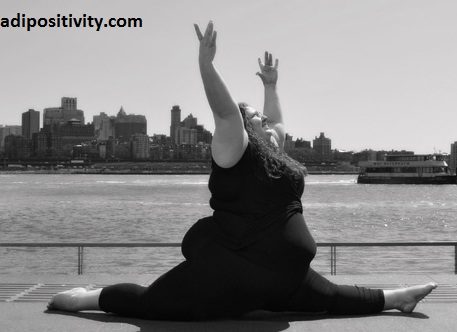
 There’s a lot of confusion about Size Acceptance, Health at Every Size® (HAES), and those of us who promote one or both. Here is my understanding:
What Size Acceptance Says
Size Acceptance says that body size should not be used as a barometer for a person’s value. It states that people’s body size is their business and that it’s nobody’s job, and is in fact inappropriate, to judge people or discriminate against them based on size. It’s not a health practice, it’s a civil rights/anti-discrimination movement.
What Health at Every Size Says
Health at Every Size says that weight shouldn’t be used as a proxy for health, and that weight loss shouldn’t be used as a proxy for healthy behaviors. HAES acknowledges the fact that health is multi-dimensional, and includes not just our current and future behaviors, but also the effects of past behaviors as well as genetics, access, and stress. So HAES says that healthy habits offer us the best opportunity for the optimal amount of health that is possible for us in the body we have and the situation that we are in; and that health problems should be treated with health interventions and not body size interventions.
What Nobody Says
Nobody in either movement is suggesting that not taking care of your body is a likely path to health.
Nobody in either movement is suggesting that it’s ok to bash thin people (and if there are, those people are hypocritical idiots.)
Nobody is saying that being fat is inherently healthy or unhealthy. The point is that there are healthy fat people, there are unhealthy thin people, and everyone who wants to be healthy or healthier would benefit from healthy habits which may or may not lead to weight loss.
Of all the crazy hate mail and death threats I receive, the only thing that ever really upsets me is when someone says that I’m a bad role model. It’s upsetting because it means that in these people’s eyes, despite reaching a level of fitness that very few people ever reach, and having worked very, very hard to have success in my sport and life, I do not deserve to be seen in a positive light because those things have not made me thin. The most ridiculous of these arguments being that showing a fat person practicing healthy habits promotes obesity. I covered that in some detail here. I disagree, I get a tremendous amount of inspiration from seeing other fat people being athletic so if I can give that to someone else I’m going to do it.
But having this attitude means that these people think that fat kids and fat adults should never see anyone who looks like them shown in a positive light, and should never feel good about themselves, even for a minute, until they are thin. It means that there are people who believe that fat people should experience a ceaseless stream of societal stigma and self -hatred until we get thin (which 95% of us are statistically unlikely to ever do)
It’s antithetical. People don’t take good care of things that they hate. The message that we are getting is “your body is unhealthy, unattractive, and a problem that needs to be fixed, now go take good care of it”. You can either promote healthy habits or you can promote body hate but you can’t do both and make sense.
Here’s how the typical discussion goes:
Weight loss proponents: You need to lose weight!
Me: How should I do that?
W: Eat well and exercise.
M: I’ve done that for a long time and it doesn’t make me thin. Now what?
W: Um, do it better.
M: What? I told you, I’m practicing healthy habits.
W: Are you just lying about your habits?
M: No, and I’m healthy.
W: You’re going to get sick if you don’t lose weight!
M: Ok, what should I do?
W: Practice healthy habits!
M: Again, doing that already, still fat.
W: … … .. … um, You have to lose weight!
M: AAAARRRRRRGGGGGGHHHHH!
Promoting obesity isn’t real, but promoting thinness is, and it’s dangerous. It is incredibly irresponsible to send the message that healthy habits don’t matter unless they make you thin. When people don’t get thin from the habits (as 95% of them won’t) then you’ve told them that there is no reason to keep up those habits and that’s incorrect, and dangerous, and will lead to the exact opposite of what you want to promote.
We’ve got to get together on this – healthy habits are our best chance for a healthy body no matter how fat or thin we are. Telling fat people that their bodies are wrong, that you can tell that they are unhealthy by looking at them, that healthy habits won’t make them healthy unless they also make them thin, and making sure that they never see someone who looks like them being active and practicing healthy habits WILL NEVER HELP. The first thing that we need to exercise here is some some common sense.

 Dances With Fat
Very well said. I don’t think most people understand that. They have come from birth conditioned to think that thin always = healthy. I don’t feel like it’s an individual fault, but an environmental fault. It’s going to take a while to turn back those thoughts.
I got bigger by diet and exercise. I am 5’9″ and weigh an unfeminine 170 lbs. I struggle everyday with that number. But I play hard, I am strong and I am happy. I used to weigh about 120 (same height) but I was ill from trying to be what I thought I was supposed to be by others’ standards. These days I mostly avoid mirrors and try to forget that 50 pounds I’ve gained in my happiness. They just distract me from having fun.
Even by BMI, the “target” weight for a 5’9″ person is somewhere just under 165 lbs (and that’s after the ’95 down shift in scale). I’m 5’9″ myself (very large frame) and the skinniest I ever got to even while dieting was 182.
Be glad you found a happy life, rock the hell out of those mirrors and never ever feel guilt for refusing to starve yourself! *HUGS*
“It is incredibly irresponsible to send the message that healthy habits don’t matter unless they make you thin.”
This is the very problem that kept me from exercising regularly through most of my life (apart from the health problems keeping me down). Even in childhood, I was told that my Great Shining Ultimate Goal was to lose weight. When I didn’t lose it fast enough, or when I didn’t lose it at all (thanks, thyroid!), I gave up on exercise. Now that my attitude is that exercise makes me feel better, and that weight changes are a side effect, I’m doing much better–I go to the gym four to six days a week, and my fibromyalgia is greatly improved thanks to exercise. (Not this week, alas. Stupid fibro. Why does it have to flare so badly I can only do gentle yoga? :/)
When I was in The Eating Disorder Cult That Shall Not Be Named, the cult leader literally said “you can exercise if you want to, but I don’t. It just makes me more hungry. And the muscle will show up on the scale and be demoralizing.”
I avoided exercise for that reason too– it made me hungry. Now I am strong and eat well and feel much better 🙂
Sometimes I boggle at how much the endless pursuit of weight loss is a tool to keep women weak and distracted.
I wonder if part of the thing with HAES is that it’s more likely to acknowledge the sort of health concerns that aren’t included in conventional ideas of healthy living? HAES blogs are more likely to include people saying “I’m prioritizing being able to get regular food over eating stuff officially considered healthy” or “If eating frozen vegetables or pre-packaged meals results in you eating more vegetables, go for it instead of constantly trying and failing to eat homemade food with fresh vegetables!” HAES involves acknowledging that not everyone has the money to eat all-organic, the time and transportation access to continually buy fresh vegetables, the mental health to engage in food restriction without triggering eating disorders, or the energy to regularly cook. For people who aren’t used to acknowledging that poor people, disabled people, people with a history of eating disorders, people with mental health problems, people with other health issues, and anyone who lacks the ability to do everything on the “good” list, this is going to look like excuses.
I think a lot of people get stuck in this “This problem can be fixed by punishment! Punishment isn’t fixing it? Clearly, we’re not being punitive enough!” infinite loop. So they push a punitive approach to losing weight (any form of food or movement that is fun or satisfying is likely to be declared not good enough, and near-starvation calorie levels are considered good), and if it doesn’t work, the answer is to do it harder and be more punitive. This goes on forever, and has no limit, especially since fat people can be assumed to be lying regardless of what we actually do.
Why is “regular food” different from “good” food? I wonder about our lives that have generally become so fast paced and hectic that we resort to less valuable food-ish items rather than take the time to find enjoyment in food prep and eating and the community aspect of food. Maybe our priorities are skewed.
A lot of the “regular” versus “good” stuff comes from poor understandings of nutrition. All food contains some potentially beneficial nutrients, and what’s best for a person varies a lot on individual circumstances.
I think it’s great if society maximizes the opportunities for people to be able to enjoy food preparation and community aspects of food. I also know that there are people who (for example) have days when they are too depressed to do serious cooking, and having packaged crackers and yogurt and soups things around so they can get some nutrients by opening a packet or microwaving a bowl of something is much better than not being able to get anything. It seems like the smart thing would be to create better options that people can actually do before trying to get them to change their behavior, but society seems stuck on condemning people for doing the best they can under current circumstances, while not putting any real effort into helping them become more able to do better.
This is kind of privileged statement to make…. It’s not that priorities are “skewed” (whatever that means, since they’re an individual thing), it’s that things like socioeconomic factors limit getting any food at all, let alone “valuable*” food-ish items. When you have to make the choice between making a rent payment or having some fruits and veggies to prep- it’s not so simple as to chalk it up to a hectic life. And, seeing as (at least in the US), many people have to take multiple jobs just to be able to make any rent payments, I think actually having the time to prep that food really exists. *[And again, value is in the eye of the beholder- when I suffered through anxiety and depression on any given day having any food in me was valuable, even if that food was “junk food”, as it kept me from doing much worse self harm]
Twinkies do provide calories, calories are something that the body needs…however a Twinky is not a nutritionally dense food.
So in one way you are providing your body what it needs in the form of calories, but to say that it is nourishing, is quite misguided.
So what is Health If there are no healthy foods, and health is different for everyone and a healthy habit can mean doing your dishes right when you put them in the sink?
If you practice the healthy habit of getting your oil changed every 3,000 miles, but you can’t figure out why you are sick several times per year, are you practicing Health?at every size?
I think this is the comment equivalent of those TV commercials that show someone whacking eggs with a hammer whilst proclaiming, “Cooking is hard!” Yeah, the example presented is tooth-grindingly bad, but the majority of people have a better handle on things.
Did my comment end up in the right place? The TV commercial thing was meant in response to the idea of changing one’s oil being healthy.
Yes it did. Replier x is just grasping at straws. 😛
I think “Eat Twinkies all the time; they’re the best thing for you ever” is another one of those things that nobody’s saying. *However* Twinkies can absolutely be part of a well-rounded and healthy diet (assuming you like them and nothing in them makes you sick.)
Not every bite of food must be full of vitamins or calcium or antioxidants. If you eat a wide variety of foods, you are likely to get the nutrients you need.
Also, if you are craving a Twinkie, there is frequently a reason for it. Maybe you missed lunch and are now *REALLY HUNGRY* so of course sweet fatty foods sound good. Maybe you’re stressed out and it would be comforting. Or maybe it just sounds tasty.
One thing I’ve noticed about “junk” food is that if I eat it when I want it, I crave it less. When I was dieting, I thought I was a bottomless pit of sugar cravings. Now there are plenty of times I eat half a donut and don’t want the rest of it or have no interest in a second cookie. So if we turn Twinkies into forbidden fruit, unless you have iron willpower, you may actually eat more of them than you would if you just gave yourself permission.
Oh, and all that stuff about changing your oil and washing your dishes and thinking those have anything to do with health is just strawmanning. It’s another of those things nobody’s saying.
That typical conversation sounds similar to one I had with my younger sister over the summer. I kept trying to tell her that I do practice healthy habits but all she said was ‘well something has got to change’, she obviously thought I wasn’t telling the truth. Change what exactly? I refuse to start counting calories again and restrict myself to a set amount of calories each day. I refuse to exercise til I drop. Then she started to monitor what I put in my mouth, ‘don’t drink soda’, ‘order a salad’, blah, blah, blah. Ugh! I don’t understand why I didn’t just tell her to mind her own business. When it comes to family it seems like all my self-esteem just goes out the window. She’s coming over for Thanksgiving and if she starts with me again, I am going to tell her that it is none of her business and the topic is off subject!
I’m so sorry that happened to you. I don’t know why people feel the need to deputize themselves into the food police! This is actually going to be the subject of my blog today. Good luck on Thanksgiving – good for you for having a plan ahead of time!
~Ragen
Re: dealing with family at Thanksgiving, Golda Poretsky is having a teleseminar next week:
http://www.bodylovewellness.com/2011/11/02/haes-for-the-holidays-how-to-navigate-food-family-fatness-better-this-holiday-season/
Thanks Nadira, I signed up!
Thanks for the explanations, Ragen! I think you are a great role model.
Thanks Elizabeth!
“showing a fat person practicing healthy habits promotes obesity”
The thing is that to a certain extent this is true, in the sense that a few fat people may actually *gasp* realize that it’s possible to be fat and healthy, accept their “obesity” and stop doing things like starving themselves, going on crazy diets, or having their stomachs mutilated. This is the terrible outcome that I think they’re imagining when they fling that accusation. They are horrified at the thought of a random size 28 person who will act as if they have just as much of a right as a size 4 person to have 3 decent meals a day, go into a restaurant and order anything off the menu that strikes their fancy, and feel fine and happy with their body.
I think “obesity” does need to be promoted. Using it as an argument against you to label you a bad role model is crazy circular logic that only works in the context of the current public discourse where everyone unquestionably KNOWS that fat=unhealthy and obesity is a terrible plague on the public that needs to be eradicated. If one were to use actual logic and scientific evidence this argument doesn’t hold since there’s nothing wrong with promoting “obesity”.
I have a really tough time with my feelings about a person I saw yesterday while we were waiting for a bus. He was tremendously obese, and he was drinking a sugared soda and munching on (alternately) potato chips and candies. He had a bagful of cupcakes, candy and chips from the dollar store. Maybe he spends the majority of his time at they gym, I don’t know, but as someone who has to watch my intake of fats and salt and carbs for health reasons (I had a heart attack at age 68) it really bothers me. I don’t know his emotional or physical issues, but IT BOTHERS ME! I don’t like to be judgmental, but find myself being so, and have to keep reminding myself that it’s okay for someone to be the way s/he is. I guess reminding myself is okay, just wish it come easier.
Hi Betsy,
First of all, thank you for realizing that it’s not your place to be judgmental and reminding yourself that everyone gets to make their own choices.. Each person gets to choose how high to prioritize their health. You’ve chosen a priority and path for yourself and the gentlemen who you saw at the bus stop is choosing his. In this situation I typically recommend that someone ask themselves if they would have felt so bothered if the man was thin but eating the same way, and why someone else’s choices, which don’t affect them, bother them so much? What I am certain of is that adding further shame and stigma will not contribute to this person’s health, and judging him won’t help him or you. It certainly makes sense that you would have to remind yourself in a world where we are all but encouraged to judge and shame people who don’t meet, and/or aren’t trying to meet, a specific size and shape.
~Ragen
Ok so as a fat girl and size acceptance advocate I have to make a confession even I sometimes have these thoughts – not so much caring about what someone eats but how fat people can act – take for instance at Sams club the other day I was sharing a pretzel with my baby and I saw a women walk over to get a fork and her tummy swiped about ten packets of mustard off the counter and on to the floor, then she looked down at them realizing she had done it but then WALKED AWAY. I was like get your cute fat behind over there and pick them up. I just didn’t like the thought of all the people looking at what she did and judging other fat people to be as rude or lazy.
But yes to the previous poster – my adopted brother ate like that but was 130 pounds on his heaviest day. And on the flip side do you have warm fuzzy thoughts when a fat person eats an organic salad with ice water and lemon?
Its hard to know what the emotional state of someone is, their education, background etc. Or what their habits are. But even if he did eat all the crap you could imagine he still deserves respect and dignity.
I just hate the thought of people judging my plate when I am out or my grocery cart. I don’t care about taking up more space in the world but being under the food police eye is daunting even when I have to fight the tendency to do it myself.
I like the “would you feel the same way if he were thin” question.
ugh. I hate re-reading my own commments – like “how fat people act – like ugh that sounds so stupid and lumping people together and I’m one of them.
but yes I’d be just as irritated if it was a thin person…
One thing that might help with the judgmental thoughts is to remember that you don’t know if this is a typical day for him or one day in a million. Imagine your worst, most stressed-out day and picture someone judging your whole life by that day. Like, if you snapped at your kids or grandkids (if you have them) once at the grocery store, someone might think you’re “that mean mom” when really that’s the exception. Or if you’re eating a ginormous sundae to celebrate your birthday or a promotion, people might think that’s an everyday occurrence.
You also don’t know whether he has the same issues with salt and fat that you do. Some people react to salt and some don’t.
Betsy Day, it’s very possible that the man you saw has a binge-eating disorder. But trust me on this: if he does, he’s not any happier about it than you are. And if people with BED could be cured by pressuring them to not eat, slim down, etc., they’d all be cured by now. EDs are notoriously intractable, and if you’re too poor to afford intensive therapy for them, they’re even more intractable.
Years ago, the gym where I worked out hired a bigger girl. I thought of two things. The first was that I have friends who have done everything they’re supposed to do but they are still considered obese. The second thought was that the gym would not hire somebody who couldn’t lead the class.
In the course of an hour, I basically had my butt handed to me by this instructor who was moving with a finesse and ability that I – with my decade of running, other physical activity and size six frame – could not match.
So, rock on. Size really isn’t an indicator of health or fitness.
I love that your gym hired a bigger girl—I’d be thrilled to take aerobics or yoga classes from someone who isn’t skinny and would feel a whole lot more welcomed at a gym that could accept than thin and fit aren’t the same.
I keep seeing more “War On Obesity!!!1!” stuff on npr.org and am wondering if you’ve thought about sharing your insights with them — this blog post has a link soliciting “If obesity has touched your life, share your story with NPR and the Public Insight Network.”
http://www.npr.org/blogs/health/2011/11/14/142255024/why-doctors-and-patients-talk-around-our-growing-waistlines#more