You may have heard that the US Senate called Dr. Oz to Capital Hill for a spanking, because he has made it a habit to sell snake oil under the guise of being a medical professional.
“Thanks to brand new scientific research, I can tell you about a revolutionary fat buster, It’s called Garcinia cambogia.” he said in front of a huge screen with the words “No Exercise. No Diet. No Effort” written on it.
The chairwoman of the Subcommittee on Consumer Protection, Product Safety and Insurance, Sen. Claire McCaskill, said “The scientific community is almost monolithic against you in terms of the efficacy of the three products you called ‘miracles’, I don’t get why you need to say this stuff when you know it’s not true..”
Dr. Oz responded “My job, I feel, on the show is to be a cheerleader for the audience, and when they don’t think they have hope, when they don’t think they can make it happen, I want to look, and I do look everywhere, including in alternative healing traditions, for any evidence that might be supportive to them.”
Kind of makes me wonder what else he’s willing to lie about so that he can put being a cheerleader for what people want over being a competent medical professional promoting evidence-based medicine. Also, let’s be clear that he’s not willing to look everywhere, even if it’s literally right in front of his face.
A few years ago Dr. Glenn Gaesser successfully campaigned to get on Dr. Oz’s show to talk about how wrong Dr. Oz is about weight and health. I did a video discussing the fact that Dr. Oz, who makes millions of dollars selling weight loss in one form or another, was “flabbergasted” to find out that there is research that disagrees with his medical opinion cheerleading.
If he was really going to “look everywhere” he would look into the studies that find that habits are a much better predictor of future health than body size (knowing of course that health isn’t an obligation, a barometer of worthiness, guaranteed regardless habits, or entirely within our control.) But where’s the profit in that? He is a scam artist and he can’t be trusted -the sooner everyone realizes this the sooner he goes off the air and we can replace him with a show that has more integrity, like Real World Bachelor Jackass Millionaires (with 10 points to readers who get the song reference.)
Oh Mehmet, can I call you Mehmet?, you’re an embarrassment to your profession and a danger to your listeners, how about you just shut it down and go on home now.
Like this blog? Consider supporting my work with a donation or by becoming a member! For ten bucks a month you can support size diversity activism, help keep the blog ad free, and get deals from size positive businesses as a thank you. I get paid for some of my speaking and writing (and do both on a sliding scale to keep it affordable), but a lot of the work I do (like answering hundreds of request for help and support every day) isn’t paid so member support makes it possible ( THANK YOU to my members, I couldn’t do this without you and I really can’t tell you how much I appreciate your support!) Click here for details
Here’s more cool stuff:
My Book: Fat: The Owner’s Manual The E-Book is Name Your Own Price!Click here for detail
Dance Classes: Buy the Dance Class DVDs or download individual classes – Every Body Dance Now! Click here for details
If you are uncomfortable with my selling things on this site, you are invited to check out this post
Recently I re-posted my blog about being comfortable in a swimsuit to Facebook in response to a day in which I had been barraged both by ads for diets that counted on my being terrified of wearing a swimsuit, and companies trying to sell me bathing suits by suggesting that I would look less like me if I wear them (though who, precisely, I would be trying to fool with a suit that makes me “look 10 pounds slimmer” is difficult to say.) It got a lot of views (hi new readers!) and many people re-posted it to Facebook (thanks y’all!) One of the common responses to the post was something like “Body acceptance is ok, but we can’t ignore the health dangers of being obeblah blah blah blah concern troll blah blah blah.”
I think this idea – that we can’t say anything in appreciation of fat bodies without someone making an unsolicited comment about our health – is deeply problematic. There’s often a predictable trifecta of concern trolling – VFHT (vague future health threats), erroneously conflating body size with health, and confusing body size with behaviors/eating disorders (ie: I would be just as upset if you were glorifying anorexia…)
Peter Muennig from Columbia University did research around weight and stigma and found that women who were “concerned about their weight” had more physical and mental illness than women who were fine with their size”, regardless of their size. He also found that the stress of the stigma that fat people face was correlated with the same diseases with which being fat is correlated.
So this hand-wringing, wailing insistence that fat people never be allowed, even for a moment – even for a single facebook post – to appreciate or be happy with our bodies without unsolicited opinions about our health may not just be incredibly irritating and indicative of a person with boundary issues, it may be actively harming us.
Studies of weight and health that take behaviors into account (Wei et. al, Matheson et. al, Cooper Institute Longitudinal studies etc) have found that habits are a far better predictor of future health than body size, and that people with similar habits had similar risk of all cause mortality and health hazard ratio regardless of their body size.
Meanwhile researchers are finally being honest about that fact that there is not a single study for which weight loss worked for more than a tiny fraction of people (which means that it doesn’t meet the requirements of evidence-based medicine) and that even among those who did lose weight there was no correlation to better health that could be credited to the weight loss independent of behavior changes (Mann and Tomiyama 2013) Sometimes when people change their behaviors, their health improves and sometimes they also lose weight. We often erroneously credit the weight loss, rather than the behavior, for the health changes but the above research shows that healthy habits, not the manipulation of body size, are what are likely to support health (though of course healthy habits are not an obligation, barometer of worthiness, or a guarantee.)
Body size is not health, it’s not behavior, and it’s not a diagnosis of any illness – physical or mental. To paraphrase Marilyn Wann the only things you can tell from someone’s body size are the size of their body, and your particular prejudices and preconceived notions about their body.
But even if all of that wasn’t true, even if the concern trolls were right about whatever they believe about our health – and setting aside the questionable idea that if they convince us to hate our bodies we’ll somehow take better care of them – we still have every right to refuse to put up with concern trolling. Because our bodies and our health are our business, and so is who gets to comment on them. Contrary to some people’s beliefs, public health should be about making information and options available to the public, not making the individual’s body the public’s business. We don’t have to allow anyone to comment on our health, not even if they are well meaning.
We each get to deal with this in any way that we want. We can let people say what they are going to say and just let it go in one ear and out the other, we can try to educate them, we can tell them to drink a big steaming mug of shut the hell up. Regardless, I think it’s important to be clear that our fat bodies are not the problem, the problem is people who insist that we shouldn’t have a moment of peace living in them.
Like this blog? Consider supporting my work with a donation or by becoming a member! For ten bucks a month you can support size diversity activism, help keep the blog ad free, and get deals from size positive businesses as a thank you. I get paid for some of my speaking and writing (and do both on a sliding scale to keep it affordable), but a lot of the work I do (like answering hundreds of request for help and support every day) isn’t paid so member support makes it possible ( THANK YOU to my members, I couldn’t do this without you and I really can’t tell you how much I appreciate your support!) Click here for details
Here’s more cool stuff:
My Book: Fat: The Owner’s Manual The E-Book is Name Your Own Price!Click here for detail
Dance Classes: Buy the Dance Class DVDs or download individual classes – Every Body Dance Now! Click here for details
If you are uncomfortable with my selling things on this site, you are invited to check out this post
Being a slow runner/walker comes with its own set of unique circumstances and challenges, it’s not better or worse, just different.
Time on the Course
People who win marathons complete them in just over 2 hours. They are averaging sub 5 minute miles. It took me almost 13 hours to walk my marathon, that means almost 30 minute miles. Even if my marathon hadn’t been an unmitigated disaster, my training was for an 8.5 hour marathon – so about 19.5 minutes per mile. Now I’m training to run/walk a marathon in 8 hours. Slower runners spend a lot more time on the course: in the elements (sun, wind, rain whatever), on our feet, which equals a lot more impacts over the course of a long event, and in the what, at least for me, is the relative boredom of running a long time to end up where I started just more sweaty and probably with blisters.. I’m not arguing that it’s harder than running faster, just that it’s a different type of event with its own challenges.
Time Out of Your Life
Training for a marathon requires logging some serious miles. When you do those miles at 20 minutes per mile rather than, say 10 minutes per mile, that’s a lot of extra time. If you’re logging 20 miles in a week (a conservative number), the 10 minutes per mile person is spending a little over 3 hours putting one foot in front of the other each week. The 20 minutes per mile person is spending over 6.5 hours away from home. Over a year of marathon training that’s about 165 extra hours of running that have to be carved out of a busy scheduled.
The Joy of Passing
When you are a slow runner you spend lots of your time being passed by people, so there is a particular sense of joy – perhaps not the most mature joy – when you become the passer instead of the pass-ee. This has nothing whatsoever do to with the person you are passing – no doubt they are a fellow slow runner with whom you have slow runner solidarity which includes an understanding that being faster than someone, whether in a particular moment of a particular run or in general, doesn’t make you better than them – it’s purely about the experience of passing someone.
Nutrition is a Serious Thing
This one goes hand in hand with the time on the course. Exercising for two hours fueled by some water and Gatorade is one thing.. Exercising for 8 hours fueled by some water and Gatorade can lead to a hitting of the wall that is truly spectacular. Also, many of the “walker friendly” marathons leave the course open for 8 or 9 hours but close the aid stations on a much faster pace – for example a rolling 6 hours. That means that at some point in the race the water and Gatorade that the faster runners glibly grabbed on their way by the aid station aren’t available to you and if you want a drink of Gatorade you better be packing some Gatorade.
Jerks Who Think They Are the Decider of Running
These are sad people who aren’t able to be happy with their own path in running and choose to put someone else down to feel good about themselves, instead of dealing with their issues. These people typically choose a time – though, of course, a time that’s slower than what they run – that is “too slow.” So if they run a 6 hour marathon, they will likely say that anyone who takes 7 hours or more shouldn’t get to run or shouldn’t get to call themselves a marathoner or whatever, never mind the fact that a marathon is a distance, not a time, or that they are comfortable with taking three times longer than the people at the front of the marathon to finish and still calling themselves a marathoner.
Nobody has any obligation to run (or to engage in any kind of movement) but I think that everyone who wants to should have every option open to them and be welcomed with wide open arms.
Like this blog? Consider supporting my work with a donation or by becoming a member! For ten bucks a month you can support size diversity activism, help keep the blog ad free, and get deals from size positive businesses as a thank you. I get paid for some of my speaking and writing (and do both on a sliding scale to keep it affordable), but a lot of the work I do (like answering hundreds of request for help and support every day) isn’t paid so member support makes it possible ( THANK YOU to my members, I couldn’t do this without you and I really can’t tell you how much I appreciate your support!) Click here for details
Here’s more cool stuff:
My Book: Fat: The Owner’s Manual The E-Book is Name Your Own Price!Click here for detail
Dance Classes: Buy the Dance Class DVDs or download individual classes – Every Body Dance Now! Click here for details
If you are uncomfortable with my selling things on this site, you are invited to check out this post
There is an amazing piece over on Shakesville that tells the truth about what it’s like to be a woman who does advocacy – from the unbelievable amount of abuse and hatred that we deal with, to the people who tell us that we shouldn’t talk about the abuse, or that we’ll never make a difference with the haters anyway. I hope everyone who sees this post goes and reads every word of that one.
and today I want to share a little battle with haters that I’ve won. The Fat People Hate Tumblr has generated plenty of hatemail to me (including after they changed their name to Fat People Love) but it looks like that’s all over now – I’ve beaten them. A reader made me aware of a recent post. It seems they did one last ranting raving name calling diatribe and then they said:
Outwit, outplay and outlast. Done, done and done. It’s over, I win. I get so much hatemail everyday that I created a special page for it, but no more from fatpeoplelove – they give up and I’m still going strong. Don’t let the door hit you on the way out y’all.
I believe in celebrating every victory, I believe that we can make a difference, and I believe that we need to talk about it.
Like this blog? Consider supporting my work with a donation or by becoming a member! For ten bucks a month you can support size diversity activism, help keep the blog ad free, and get deals from size positive businesses as a thank you. I get paid for some of my speaking and writing (and do both on a sliding scale to keep it affordable), but a lot of the work I do (like answering hundreds of request for help and support every day) isn’t paid so member support makes it possible ( THANK YOU to my members, I couldn’t do this without you and I really can’t tell you how much I appreciate your support!) Click here for details
Here’s more cool stuff:
My Book: Fat: The Owner’s Manual The E-Book is Name Your Own Price!Click here for detail
Dance Classes: Buy the Dance Class DVDs or download individual classes – Every Body Dance Now! Click here for details
If you are uncomfortable with my selling things on this site, you are invited to check out this post
This is a re-post because there always seems to be a lot of confusion understanding the difference between Health at Every Size and Size Acceptance, or suggesting that Health at Every Size should be required for Size Acceptance if a person is fat. Most recently, I saw a comment on Facebook that said “It’s time to stop stigmatizing us healthy fatties.” Um, no.
I believe that Health at Every Size and Size Acceptance are two separate things with separate, though sometimes overlapping, goals. That’s because I do not think we should involve the concept of health in the fight for fat civil rights, including the end to weight-based bullying, stigma, and oppression.
Let’s start with HAES. There are lots of different ideas about what it means to practice HAES. There are people who think there are things you have to do for your lifestyle to be considered “HAES” – some say you have to do intuitive eating, some say you have to exercise in a specific way, or that you aren’t allowed to do any kind of food measurement etc. I think the definition of HAES should be any personal health practice that is behavior-centered and weight neutral. So health is pursued through behaviors and without an attempt to manipulate body size. People’s prioritization of their health and the path they take to get there is up to them and any health care providers they choose to consult, and it cannot be said often enough that health is not an obligation, barometer of worthiness, or entirely within our control.
I think there is activism to be done around HAES, especially as it relates to access. Nobody is required to practice HAES or any other health practice, but if you want to practice habits that you believe will support your health then there shouldn’t be barriers to that – you should have access to the foods you choose, movement options that you enjoy that are both physically and psychologically safe (so that you can, for example, go swimming at your gym’s pool without any fear of being shamed), and affordable evidence-based healthcare (so your doctor listens to you and gives you interventions proven to help your symptoms and does not bring up weight other than if there are unexplained gains or losses, or to prescribe a proper dose of medication.) There is tons of work and activism to be done around access and it’s really important work.
I don’t think that we should use HAES as a platform to do Size Acceptance activism because I think that we should avoid even the intimation that some level of health or healthy habits is required for access to basic human respect and the rights to life, liberty and the pursuit of happiness. There is absolutely NO health requirement to demand your civil rights. Nobody owes anybody else “health” or “healthy habits” by any definition. You do deserve, and have the right to demand, respect and the rights to life, liberty and the pursuit of happiness in the body you have right this minute – whatever your size, health, habits and dis/ability.
I am both a SA and HAES activist, but I approach my activism very differently. I am a Size Acceptance Advocate – everybody deserves basic human respect and civil rights and that should never be up to show of hands or vote of any kind. Fat people have a right to exist, there are no other valid opinions about that. Our rights to life, liberty and the pursuit of happiness are not someone else’s to give, they are inalienable. SA activism is not about asking someone to confer rights upon us but rather demanding that they stop trying to keep them from us through an inappropriate use of power.
I am a Health at Every Size Practitioner. I practice HAES and talk about it publicly because there are so many people who aren’t even aware that a weight-neutral approach to health exists. I leave room for the fact that others choose different paths to health, and I respect those decisions as I want my decisions respected. I put my fat body on display (and therefore myself up for criticism) because I am a fathlete and I get to exist and tell my story; and because so many fat people tell me that they wanted to be athletic but didn’t think they could until they saw someone else doing it, because the message they received from society again and again is that it’s not possible. Fat fitness professional Jeanette DePatie, and I created the Fit Fatties Forum (which now has more than 2,500 members) so that people who want to can have a place to talk about fitness from a weight-neutral perspective. But if you read this blog regularly you know that I constantly point out that nobody has to do what I do and that doing what I do doesn’t guarantee that another person will have the same results that I have, or that I will always be healthy and athletic. Nor does it make me better or worse than anyone else. Health is not a moral high ground, it is multi-dimensional, never fully within our control, and our prioritization and health path are personal.
As always, I can only speak for me and this is what I think. There are a lot people who disagree about this, many of whom I hold in the highest esteem. I think it’s a good conversation to be having and I think that we can continue to do the activism work even as we have an ongoing discussion to clarify our beliefs around it, that is the nature of the stage of civil rights activism that our community is in. EDIT: Reader Annie just made me aware of this perspective on the same subject from The Fat Word
Like the blog? Consider supporting my work with a donation or by becoming a member! For ten bucks a month you can support size diversity activism, help keep the blog ad free, and get deals from size positive businesses as a thank you. I get paid for some of my speaking and writing (and do both on a sliding scale to keep it affordable), but a lot of the work I do (like answering hundreds of request for help and support every day) isn’t paid so member support makes it possible ( THANK YOU to my members, I couldn’t do this without you and I really can’t tell you how much I appreciate your support!) Click here for details
Here’s more cool stuff:
My Book: Fat: The Owner’s Manual The E-Book is Name Your Own Price!Click here for detail
Dance Classes: Buy the Dance Class DVDs or download individual classes – Every Body Dance Now! Click here for details
If you are uncomfortable with my selling things on this site, you are invited to check out this post
Tank says “What the…” (He’s just a puppy, he doesn’t know the F-word yet.)
Abbott Laboratories, makers of Similac baby formula, recently announced that they are reducing the calories in their commonly used formulas by one calorie per ounce. The reason they are doing it shows us just how out of control, and how far away from any concept of science, the obesity epipanic has become.
Similac claims that the new formulation will make formula more like breast milk, based on the idea that breastmilk has a protective effect against lifelong “obesity.”
There is tons of controversy around the idea that breastmilk has an effect on longterm body size, but even if you believe that it does, the idea that the thing that makes the difference is one calorie per ounce is a large leap over a deep chasm. In fact, research suggests that, much like everyone who ate Snackwell’s cookies in the 90’s, babies just eat more formula when there are less calories in it. This is significant for families on a budget – unless Abbott Labs is going to reduce the cost along with the calories, buying enough diet formula to make up for the extra calories could cost families around $150 a year. So maybe this is just a profit driver for Abbot labs and they actually aren’t a “lab” full of idiots who don’t know the first adage of research – correlation never ever implies causation.
A lot of the interventionsexperiments being tried on babies and children are based on simple observational correlation by people who don’t seem to have done even a basic literature review. People say “babies who are breastfed are less likely to be “obese” or “babies who gain less weight at certain times tend to weight less as adults.” so people go about creating interventions based on that information.
This is deeply problematic – correlation means that two things happen at the same time enough of the time to be statistically interesting, but we still don’t know the nature of their relationship – does A cause B? Does B cause A? Does C cause A and B? Is it all just a coincidence? If you don’t know causation then creating interventions can be tricky.
Here’s a made up example: Often in August in the United States the rates of ice cream eaten and the rates of murder both go up. So ice cream eating and murder are correlated. So I, Polly Public Health Person, decide it’s obvious that ice cream eating leads to murder, and so I cry and wail and wring my hands and shout “won’t somebody think of the children” until I convince stores to pull ice cream off the shelves. I am triumphant, for behold I have created an intervention! And yet my joy is less than full, because the rate of murders skyrockets. What the hell? It turns out that the problem is actually heat – when the heat increases people get irritable and they either eat some ice cream or they commit murder. By removing ice cream from the shelves, I created a situation in which people who would have eaten ice cream didn’t have access to it, so they ran around murdering people. Oops, sorry y’all, that’s my bad. Sincerely, Polly
That’s why having understanding of causation, which we can perhaps achieve through research, is important before we go and implement interventions like turning that Mommy and Me class into a Baby Weight Watchers Meeting. In a real life example that I first heard about in my first research class, thousands of kids died early deaths from cancer because of interventions based on correlation, this is serious stuff.
I was recently part of a panel discussion about childhood “obesity” at the Chicago School of Professional Psychology. The other people on the panel were all involved in interventions for childhood obesity and I made the point that they didn’t have any research to back up those recommendations. One of the panelists, a pediatrician who now specializes in research, said “Well it’s not like you can try to make kids fat, that’s unethical” but we’re absolutely fine with trying to make them thin and see no ethical issues there.
One of my statistics teachers used to tell us that for every correlation you find, there is a causal explanation that makes total sense, and is totally wrong. I’ll bet she’ll be explaining this to classes someday using this baby formula example.
Last Day for Your Flying Rhino’s T-shirt (and last day that this will be on the blog!)
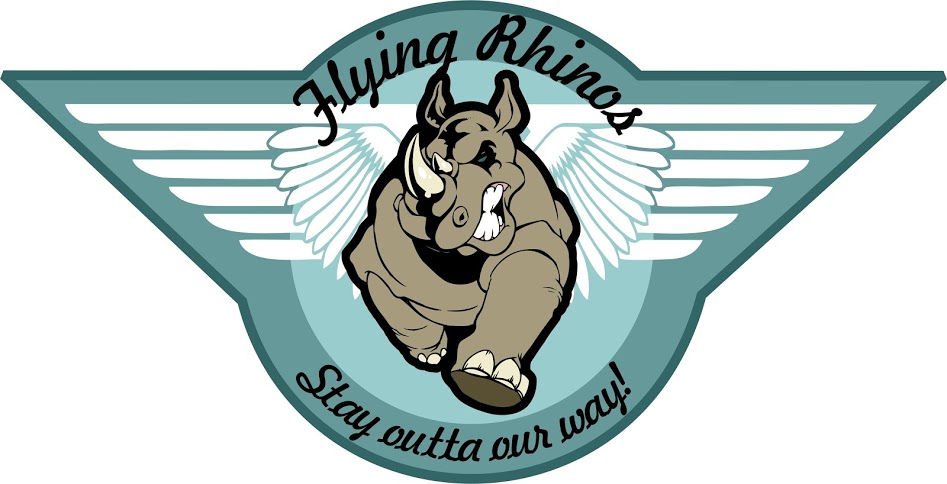
Wednesday is the last day to get your order in for the inaugural Flying Rhinos t-shirt. Regardless of whether or not you get a t-shirt, you can participate in the Flying Rhinos group at http://fitfatties.ning.com/group/flying-rhinos
Wanna Be a Flying Rhino?
I am so very, very excited about this! The Flying Rhinos are a way for people of all sizes who want to carve out space and obtain visibility and respect for fat people in the fitness world to be public about our involvement, show our pride and solidarity, and recognize each other when we’re out and about.
What Do the Rhinos do?
We live our mission out loud, wearing our official Flying Rhinos shirts in everything from our own movement activities and classes, to organized races, sports, and events. We have our own group on the Fit Fatties Forum to discuss our training, get support, swap stories and race reports, talk about events we’re in and plan meet-ups offline to do events together and/or just hang out.
Our shirts help us show our pride and recognize each other. If you want to order a shirt either for you individually, or for your team (whether it’s for an organized sport, a 5k, a charity event or whatever) just e-mail me at ragen at danceswithfat dot org with the size(s) and I’ll get you the details. We are taking requests for the current order until Wednesday, June 11th, then we’ll get the best deal we can for the number of shirts we have and split the cost evenly among the people making the order (no upcharges for larger shirts and nobody is making any money off the deal except whoever we hire to make the shirts!)
Who Can be a Rhino?
Everyone, of every size, who participates in movement at any level and is committed to body positivity is welcome to become a member of the group, and wear the official shirt. Wear it to yoga, wear it to roll your wheelchair in a 5k, wear it at the pool, wear it to your Krav Maga class, wear it to Zumba, wear it going around your block or in a marathon, put together a softball team or a team for a charity race and we’ll get you some shirts. Roll with the Rhinos for a fun, supportive, body positive, rocking good time.
How did this come about?
It started as a discussion on Ragen’s Facebook page about ridiculous names that haters call us – landwhale, hamplanet, and that day’s offering – land blimp. Seriously, land blimp. People started coming up with their own ideas and Nora suggested “Flying Rhinos”. We had been thinking about starting a group like this and the name struck us as perfect. Nora agreed to let us use the name, Sara H. designed the amazing logo and The Flying Rhinos said “Hello World!” on May 30, 2014.
Of course this is totally optional – while fat people absolutely deserve to be able to participate in whatever movement we want without shame, stigma, bullying, oppression – and deserve to have spaces to talk about that – participating in fitness doesn’t make a fat person better or worse than anyone else – it’s not an obligation, a barometer of worthiness, or a reason to treat someone differently. The good fatty bad fatty dichotomy needs to die.
Like the blog? Consider becoming a member! For ten bucks a month you can support size diversity activism, help keep the blog ad free, and get deals from size positive businesses as a thank you. I get paid for some of my speaking and writing (and do both on a sliding scale to keep it affordable), but a lot of the work I do (like answering hundreds of request for help and support every day) isn’t paid so member support makes it possible ( THANK YOU to my members, I couldn’t do this without you and I really can’t tell you how much I appreciate your support!) Click here for details
This installment of my ongoing series – where I publish the conversations I have with people who ask me to write about their diet products – ends with one of the most ridiculous would-be-hilarious-if-it-wasn’t-horrible emails I have ever received.
Today’s conversation is with with the creator of “A deck of cards with one goal, to help you lose weight. ”
In his original e-mail he wrote:
My name is Mike, I’m launching [my weightloss product] on [fundraising site] next week, a truly unique (seriously!) way to lose weight without dieting or pills. It would be great for your audience to have another helpful article on the topic of weight loss (and casually mention the product). Of course, I could write it for you (if you like). I’m thinking something like:
-What if everything you knew about weight loss was wrong?
-Hey fatty, always hungry? Here’s why…
-How to eat more calories and weigh less
Let me know what you think!
Mike
p.s. I’d be happy to send you a freebie sample, just let me know your address and I’ll shoot one your way!
I checked out his fundraising website. It started with the usual call-a-body -size -an-epidemic obesipanic, then admitted that 90% of all diets fail. In the product description:
It’s a great way to lose weight, anytime and anywhere.
The durable 100% PVC plastic cards will ensure your cards will last as long as your weight loss does.
It’s for any age group
You won’t be starving yourself
It’s a fun way to lose weight by yourself or with others
Absolutely nothing extra is needed for you to lose weight. No meal plans, no pills, nothing.
Shoot, they’re less than $20, when was the last time a weight loss program was less than $20!?
NO hype, just an honest, easy and fun approach to weight loss
After I got control of my eye-roll reflex I replied:
I’m interested in publishing this, but since, as you also mentioned, 90% of diets fail, I’ll just need to see the evidence that your product has a better success rate.
Thanks!
~Ragen
Mike sent back:
Hi Ragen
Thanks for writing back, and your interest. I have 4 people undergoing an 8 week test. The 8 weeks will be completed tomorrow at midnight. Even though every participant lost weight, it’s impossible to compare this to the millions of people every year that try diets and fail. Would you like me to do a writ-up of the study that was done with the 4 participants?
Knowing, as I do, that almost everyone loses weight on almost every diet short term and almost everyone gains the weight back long term, I remained skeptical. I replied:
I apologize, I’m a bit confused. On your [fundraising page] it sounded to me that you are saying that your program will succeed where 90% of diets fail (the research showing that most people experience weight loss in the short term and gain it back between years 2-5) Am I misunderstanding your claim or is there another differentiator that I’m missing? Sorry for my confusion.
Thanks!
Mike sent back:
You are misunderstanding the claim, I’m not associating my product with diets at all
-mike
At this point I began to suspect that Mike subscribes to the MST (Magical Semantics Theory) The idea that if you call a diet something else (“fun way to lose weight”, “approach to weight loss”, “lifestyle change” etc.) then it will work better.
Gotcha, so then what differentiates this from a diet, and what makes it more likely to be successful?
Mike tries to help me understand:
Hi Ragen
On this page [that I will not be linking to] there is a video that will explain the cards a bit, but to answer your question, the intent of diets is to change your eating habits with the goal of losing weight. The intent of [my ridiculous weight loss product] is to change the behaviors that cause someone to make better weight loss decisions. So there are no calorie restricting diets. With [my ridiculous weight loss product] you get points for making good decisions that that contribute to weight loss, and you subtract points for making bad decisions. So the goal is to get more points this week than the prior week. If you consistently get more points week after week, you are changing those influential behaviors that cause weight gain.
I hope this answers your question.
Wow, that’s crystal clear in the way that is the exact opposite of crystal clear. Let’s try this a different way:
I understand, but I’m still coming back to my question about the evidence that this will actually lead to weight loss. How did you choose the behaviors to encourage that will lead to weight loss – is there some research on successful weight loss that you are basing this on that is different than what the diets and so-called lifestyle interventions that fail so often aren’t using? I’m trying to understand your angle.
And then there was this:
Well if you want evidence, I am concluding the small study which I told you about earlier. Where’s the evidence that Jesus turned water into wine? Where is the evidence that global warming exists? This is theory, & I never said in any of my writings that this is proof of weight loss. The premise is these cards teach you how to eat and behave better regarding weight loss decisions. The cards came from a lifetime of knowledge, consulting with a couple dietitian and nutritionist, and online research and reading scientific studies.
-mike
Let’s review:
Mike, a self-described “health and fitness expert” describes his product:
“It’s a great way to lose weight, anytime and anywhere.”
“Absolutely nothing extra is needed for you to lose weight.”
“It’s a fun way to lose weight by yourself or with others”
“NO hype, just an honest, easy and fun approach to weight loss”
Then, when asked to provide evidence for the weight loss he is promising, he says “I never said in any of my writings that this is proof of weight loss” and besides I don’t need evidence because Jesus, Global Warming, and four of my friends.
That actually happened, and people (to whom he only spouted his MST-based marketing and who never got to hear about how his project is related to Jesus and Global Warming) funded his project. This is where we’re at in our discourse around weight and health. Actual researchers are being honest that intentional weight loss almost never works, but Mike with his GlobalWarmingJesus It’sNotADietIt’sADiet hypothesis of weight loss can convince people that they should give him money. And that’s why the “Diet Companies Say the Darndest Things” feature exists on this blog – because it’s time to start telling the truth – when it comes to weight loss cards, you might as well be playing roulette.
Like the blog? Consider becoming a member! For ten bucks a month you can support size diversity activism, help keep the blog ad free, and get deals from size positive businesses as a thank you. I get paid for some of my speaking and writing (and do both on a sliding scale to keep it affordable), but a lot of the work I do (like answering hundreds of request for help and support every day) isn’t paid so member support makes it possible ( THANK YOU to my members, I couldn’t do this without you and I really can’t tell you how much I appreciate your support!) Click here for details
Friday night I did my weekly “long run,” this week it was a 6 mile run/walk combination. It wasn’t a great day but I’ve learned that there are good and bad days and that’s cool. So it wasn’t as fast as I wanted it to be, but it was faster than I did the same week of training last time so I’ll take it. Everything was fine until the last half mile of the run.
On my marathon route there is a church about a half mile from my starting point. When I started training for my marathon last year they were just starting renovations. By the time I was doing my marathon the renovations were done. Throughout the time the church was always packed with people often out in front of the church for fellowship with themselves and their minister. They would typically spill onto the sidewalk and I would always smile and say a general hello when I walked by.
Tonight they were in church when I walked out, but on the way back they were on the sidewalk. The minister stepped in front of me, and then this happened:
Minister: I’ve seen you walking out here for a long time.
Me: Open my mouth to explain that I’m training for a marathon (like every other marathoner I know, I’m always grateful for the chance to tell someone that I’m doing a marathon without having to work hard to get it into the conversation)
Minister: I know it hasn’t been working, but don’t quit, you will lose the weight.
Me: Open my mouth to explain my SA/HAES philosophy.
Minister: Puts his hands ON MY HEAD and says “Jesus, this girl works so hard, please heal her from her obesity, Amen.”
Me: Discover that my Catholic upbringing trumps my self-defense reflexes and I narrowly avoid punching a minister in a the face, I lock eyes with him and say with as much intensity as I can “Get. Your. Hands. Off. Me. How DARE you ask your god to change my body?! How DARE you suggest that my body needs changing?!”
This is a show stopper, the 20 or so people who are on the lawn have stopped what they are doing and are staring at us.
Minister: I was just trying to help.
Me: I don’t need or want your help.
I walked away before he could say anything else. Coincidentally, my column this month for Ms. Fit is about diets that are run by religious leaders who conflate body size with the success of one’s religious practice, but this is a whole other level. Honestly, I think I prefer it when they throw eggs. If it hadn’t been for the distraction from a combination of shock, and worrying about missing my time goal this might have ended very differently, since he could easily have activated my face punch and profanity-laced monolog reflexes.
I mentioned this on Facebook and people responded with an amazing outpouring of support and suggestions. They have commented and sent me e-mails suggesting that I do everything from charging him with assault to thanking him for his good intentions. We all get to choose how we deal with our oppression and both of those are fine choices, but they aren’t my choice. The first thing that I’m going to do is refuse to change my life for this person – I’m going to continue on my marathon route as I always have. And I’ll consider being ready to sacrifice my time goal if I have an opportunity for a teachable moment with him or any of his congregants. I’ll also continue to be open to receiving his heartfelt apology for his completely inappropriate behavior.
That was something crappy, here’s something awesome:
Wanna Be a Flying Rhino?
I am so very, very excited about this! The Flying Rhinos are a way for people of all sizes who want to carve out space and obtain visibility and respect for fat people in the fitness world to be public about our involvement, show our pride and solidarity, and recognize each other when we’re out and about.
What Do the Rhinos do?
We live our mission out loud, wearing our official Flying Rhinos shirts in everything from our own movement activities and classes, to organized races, sports, and events. We have our own group on the Fit Fatties Forum to discuss our training, get support, swap stories and race reports, talk about events we’re in and plan meet-ups offline to do events together and/or just hang out.
Our shirts help us show our pride and recognize each other. If you want to order a shirt either for you individually, or for your team (whether it’s for an organized sport, a 5k, a charity event or whatever) just e-mail me at ragen at danceswithfat dot org with the size(s) and I’ll get you the details. We are taking requests for the current order until Wednesday, June 11th, then we’ll get the best deal we can for the number of shirts we have and split the cost evenly among the people making the order (no upcharges for larger shirts and nobody is making any money off the deal except whoever we hire to make the shirts!)
Who Can be a Rhino?
Everyone, of every size, who participates in movement at any level and is committed to body positivity is welcome to become a member of the group, and wear the official shirt. Wear it to yoga, wear it to roll your wheelchair in a 5k, wear it at the pool, wear it to your Krav Maga class, wear it to Zumba, wear it going around your block or in a marathon, put together a softball team or a team for a charity race and we’ll get you some shirts. Roll with the Rhinos for a fun, supportive, body positive, rocking good time.
How did this come about?
It started as a discussion on Ragen’s Facebook page about ridiculous names that haters call us – landwhale, hamplanet, and that day’s offering – land blimp. Seriously, land blimp. People started coming up with their own ideas and Nora suggested “Flying Rhinos”. We had been thinking about starting a group like this and the name struck us as perfect. Nora agreed to let us use the name, Sara H. designed the amazing logo and The Flying Rhinos said “Hello World!” on May 30, 2014.
Of course this is totally optional – while fat people absolutely deserve to be able to participate in whatever movement we want without shame, stigma, bullying, oppression, or unwanted laying of hands- and deserve to have spaces to talk about that – participating in fitness doesn’t make a fat person better or worse than anyone else – it’s not an obligation, a barometer of worthiness, or a reason to treat someone differently. The good fatty bad fatty dichotomy needs to die.
Like the blog? Consider becoming a member! For ten bucks a month you can support size diversity activism, help keep the blog ad free, and get deals from size positive businesses as a thank you. I get paid for some of my speaking and writing (and do both on a sliding scale to keep it affordable), but a lot of the work I do (like answering hundreds of request for help and support every day) isn’t paid so member support makes it possible ( THANK YOU to my members, I couldn’t do this without you and I really can’t tell you how much I appreciate your support!) Click here for details
People in the Size Acceptance Community have been talking for a long time about the research around successful weight loss interventions – specifically how there isn’t any. More and more people in the media are now starting to tell the truth.
Before I get into this too far let me be very clear about this: Fat people have the right to exist, in fat bodies, without shame, stigma, bullying or oppression. It doesn’t matter why we’re fat, what being fat means, or if we could be thin by some means however easy or difficult. Even if every study of weight loss showed that every person who tried to lose weight was completely successful by whatever definition, fat people would still have the right to exist. My goal in discussing the research around weight loss is to correct the misinformation that it’s become very profitable for companies to spread about weight loss, it’s not to “justify” the right of fat people to exist.
Kelly Crowe, a medical sciences correspondent for CBC News, wrote a piece called “Obesity research confirms long-term weight loss almost impossible.” [Trigger Warning: Fatties without heads, anti-fat language etc.) The article explains that, per Traci Mann, who has spent 20 years running an eating lab at the University of Minnesota “It couldn’t be easier to see, long-term weight loss happens to only the smallest minority of people.” It goes on to explain:
We all think we know someone in that rare group. They become the legends — the friend of a friend, the brother-in-law, the neighbour — the ones who really did it.
But if we check back after five or 10 years, there’s a good chance they will have put the weight back on. Only about five per cent of people who try to lose weight ultimately succeed, according to the research. Those people are the outliers, but we cling to their stories as proof that losing weight is possible.
“Those kinds of stories really keep the myth alive,” says University of Alberta professor Tim Caulfield, who researches and writes about health misconceptions. “You have this confirmation bias going on where people point to these very specific examples as if it’s proof. But in fact those are really exceptions.”
So if this is what the research shows, why isn’t this information spreading far and wide? That’s where things get ridiculous. According to Caulfield:
“You go to these meetings and you talk to researchers, you get a sense there is almost a political correctness around it, that we don’t want this message to get out there,”You’ll be in a room with very knowledgeable individuals, and everyone in the room will know what the data says and still the message doesn’t seem to get out. You have to be careful about the stigmatizing nature of that kind of image. That’s one of the reasons why this myth of weight loss lives on.”
Wait, what? Who exactly are we worried about stigmatizing? I don’t know about you but I think blaming fat people for not doing something that almost nobody is successful at, and using that lack of success to justify shaming, stigmatizing, oppression, charging us more for the same services, not providing us with medical care, and generally making us second class citizens is WAY more stigmatizing than telling us that the truth is weight loss hardly ever works. It sounds like they are more worried about not stigmatizing doctors who have been ignoring the evidence and prescribing weight loss, or not stigmatizing the diet industry that makes $60 billion a year selling us something that they have no reason to believe will work, likely having the exact opposite of the intended effect.
If you read the comments on the article, which I don’t recommend, you’ll see that many people subscribe to the magical power of semantics. If you attempt intentional weight loss, but instead of dieting you call it a lifestyle change, they claim you won’t gain your weight back. This is the second to the last stop on the denial train, at the final stop people just close their eyes, stick their fingers in their ears, and scream LALALA! Studies have shown that when people diet, their bodies change biologically for the express purpose or regaining and maintaining weight, but it really doesn’t matter at this point why weight loss fails almost all the time. The fact that it does means that weight loss does not meet the criteria of evidence based medicine. If a prescription fails almost all the time, often having the exact opposite of the intended result, (and especially when that happens consistently for more than 50 years,) the solution is not to keep prescribing that intervention and tell people to try harder, or to call the pill by a different name.
The article points out that for those who are interested, healthy behaviors are still the best chance to support our health but apparently “Eating right to improve health alone isn’t a strong motivator. The research shows that most people are willing to exercise and limit caloric intake if it means they will look better. But if they find out their weight probably won’t change much, they tend to lose motivation.”
This is the world that diet culture built. Doctors, diet companies, internet commenters, people’s mamas and everyone else have been telling us that being thin is the only path to health and that if healthy habits don’t make us thinner than they won’t make us healthier. Society says that the only “good” body is a thin body. Now we find that if healthy habits don’t make us thinner we “tend to lose motivation.” I forget, what’s the word that means the opposite of “shocking”?
She mentions that weight loss surgery “can induce weight loss in the extremely obese, improving health and quality of life at the same time. But most people will still be obese after the surgery. Plus, there are risky side effects, and many will end up gaining some of that weight back.” And when she says side effects she means death, according to a great piece about this from Linda Bacon “By best estimates, bariatric surgeries likely increase the actual mortality risks for these patients by 7-fold in the first year and by 363% to 250% the first four years,” not to mention a host of other complications that are discussed in Linda’s piece.
The solution is to stop worrying if the truth is “stigmatizing” and start telling the truth early and often. Telling the truth with the same veracity that people post anti-fat, pro weightloss diatribes in the comment sections of every article that exists on the internet. Public health should be about making as much true information and as many options as possible available to the public, and then letting people make their own decisions. Health is not an obligation, a barometer of worthiness, or completely within our control. Each of us gets to choose how highly we prioritize our health and the path that we want to take to get there and those decisions can also be impacted by forces outside of our control.
The other part of the solution is to stop stigmatizing fat people. The article waxes tragic about the fact that fat people are unlikely to get thin, but the truth is we have no idea what our health would be like if fat people weren’t faced by constant stigma. We have no idea what our health would be like if fat people stopped feeding our bodies less fuel than they need to survive in the hopes that they will eat themselves and become smaller (aka weight loss). Since statistically the best way to gain weight is to diet, we don’t know what our society body size distribution would look like if we stopped doing it. Maybe if enough people refuse to perpetuate the lie of weight loss and start telling the truth, we can find out.
Continuing to promote and/or prescribe weight loss is irresponsible and unethical and it needs to stop, right now. For all the research that I discussed in this piece, check out this resource bank.
Like the blog? Consider becoming a member! For ten bucks a month you can support size diversity activism, help keep the blog ad free, and get deals from size positive businesses as a thank you. I get paid for some of my speaking and writing (and do both on a sliding scale to keep it affordable), but a lot of the work I do (like answering hundreds of request for help and support every day) isn’t paid so member support makes it possible ( THANK YOU to my members, I couldn’t do this without you and I really can’t tell you how much I appreciate your support!) Click here for details
Fabulous actress Melissa McCarthy is interviewed in the July issue of Redbook. She discussed why she is starting her own fashion line:
When I go shopping, most of the time I’m disappointed. Two Oscars ago, I couldn’t find anybody to do a dress for me. I asked five or six designers—very high-level ones who make lots of dresses for people—and they all said no.
I have expressed my frustration before at the justifications that people use for why the selection of clothes for fat people is so limited and how they believe that doesn’t constitute fat stigma. They are, of course, allowed to believe that but I disagree and Melissa’s experience brings my disagreement into sharp relief. These are designers who fight tooth and nail to get their dresses on actresses walking the red carpet at the Oscars. As long as those actresses aren’t fat, in which case they seem to have no interest in dressing them. (I really wish Melissa McCarthy would have said who the designers were so that we could do some activism.)
As a fat woman I deal with the lack of clothing that fits me all the time. As a fat athlete I deal with it on a whole other level when clothes for the activities in which I want to participate simply don’t exist in my size and have to be custom made.
Let me quickly tackle a couple of the common arguments I hear about this:
There’s nothing wrong with a designer having a target demographic!
Saying “we want to target our marketing” is not the same thing as saying “we want to make it impossible for all people who look a certain way to wear our clothing.” You can have a target market that is based on the aesthetic that the customer is looking for (what the customer wants to buy), rather than the aesthetic of the customer (what the customer looks like). So a store can make clothes in a wide variety of sizes and then market those clothes to people who are interested in a “preppy” look, or a “goth” look, more classic or more modern etc.
It’s not discrimination, it’s just a marketing decision, companies are allowed to decide what sizes to sell.
It’s a marketing decision to discriminate against everyone who shares a single physical characteristic. Some companies (like Lululemon and Abercrombie and Fitch) have taken this to the next level by using the fact that they don’t sell clothes for fat people as a selling point – suggesting that discriminating against fat people makes them more cool. Marketing decisions do not happen in a vacuum and the phrase “marketing decision” is not a get-out-of-discrimination free card.
But there are stores that only sell “plus sizes”, that’s discrimination too!
If considered technically and in a vacuum, I suppose it’s possible to make an argument. But based on the actual reality of the current culture, I think it’s a derailing and basically indefensible position to take. When you realize that a fat person can be in a huge mall and not find a single piece of clothing in our size, it seems ridiculous to begrudge us the few stores that do sell clothes that fit us Those stores aren’t discriminating because they don’t want thin people in their clothes, indeed most of their clothes mimic those already available in straight sizes, these stores fill a gap so that fat people don’t all have to learn to sew or make our lives into some sort of endless toga party.
I think that the fashion industry has long taken advantage of how easy it is to discriminate against fat people by simply not making clothes to fit us, and acting as if that’s simply an aesthetic choice and not a discriminatory one. I would love to see fashion become about personal expression rather than defining who is cool and who is not (are we seriously adults still trying to be the “cool kids”, could we maybe stop doing that?), or becoming a way to tear each other down (Who has that kind of free time? If I ever find myself with enough time to sit around and judge other people for their clothing choices, I will immediately volunteer somewhere.)
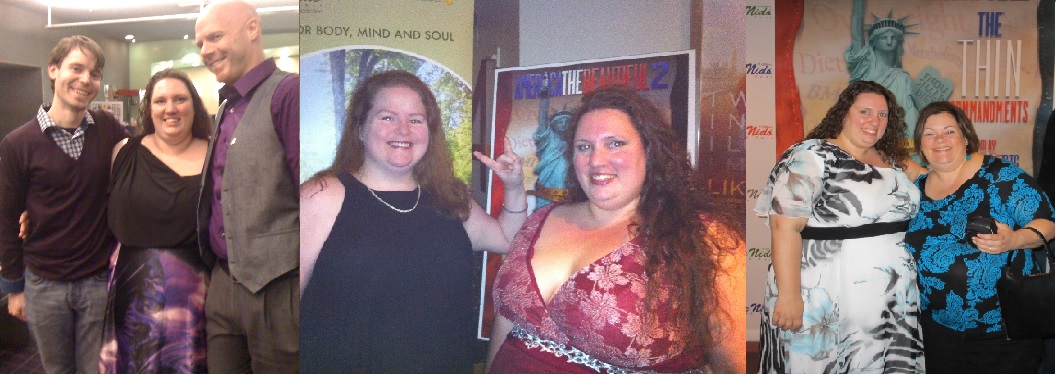
Some really cool experiences for me happened when I got to attend the New York, LA, and Chicago premieres of American the Beautiful 2 – The Thin Commandments, a documentary in which I’m interviewed (it’s available on Netflix!). One of the things that made the experiences really special was that I was dressed by Igigi by Yulia Raquel. They were amazing and the dresses were beautiful and fit me perfectly. (It was also a serious relief because I wasn’t sure where I was going to get a dress that I actually liked since my shopping prior to hearing from them uncovered a lot more “mother of the bride” than “red carpet.”)
Me at the NYC, Chicago, and LA premieres in my beautiful Igigi dresses with Kelrick and Kenny (my Best Friend and his husband), My friend Amy, and Jeanette DePatie aka The Fat Chick.
Yes it’s legal to refuse to make clothing for fat people, but the fact that something is legal does not make it right, or protect it from critique. I think that this has institutionalized and internalized fat stigma written all over this. Clothing designers and stores don’t want their clothing associated with us because of the stigma that is heaped on us, and many fat people don’t call them on that bullshit because we don’t believe we deserve the same shopping experience that thin people get, we’ve been encouraged to buy clothes that are too small as “motivation,” or to wait to buy good clothes until [insert body size manipulation goal here.] That’s bullshit, and it’s bullshit that we have every right to fight.
Like the blog? Consider becoming a member! For ten bucks a month you can support size diversity activism, help keep the blog ad free, and get deals from size positive businesses as a thank you.
What do member fees support? I get hundreds of requests a day (not including hatemail) from academic to deeply personal. I get paid for some of my speaking and writing (and do both on a sliding scale to keep it affordable), but a lot of the work I do isn’t paid so member support makes it possible (and let me just give a huge THANK YOU to my members, I really can’t tell you how much I appreciate your support!) Click here for details
 You may have heard that the US Senate called Dr. Oz to Capital Hill for a spanking, because he has made it a habit to sell snake oil under the guise of being a medical professional.





 Dances With Fat