The sun revolves around the Earth. Thalidomide is a great treatment for morning sickness. Heroin is a non-addictive substitute for morphine. Lysol is a fantastic douche. Everyone who tries hard enough can lose weight.
These are all things that science believed at one time. Three of them used to be the basis of healthcare advice. One of them still is. Sometimes science gets it wrong and there’s no crime in that – it’s the nature of science. The problem starts when science isn’t willing to admit that it’s gone really far down the wrong road.
That’s the situation that we find ourselves in when it comes to the “obesity epidemic.” A panic around fat people has been trotted out by the media to the multi-billion dollar profit of the diet and pharmaceutical industries. Now some researchers, including David B. Allison, director of the Nutrition Obesity Research Center at the University of Alabama at Birmingham, have come clean about the prevalence of myths that are floated by people in the field as fact.
Commenting on the article, Dr. Jeffrey M. Friedman, an obesity researcher from Rockefeller University said , “there is more misinformation pretending to be fact in this field than in any other I can think of.”
Some of the myths mentioned are :
Walking a mile a day can lead to a loss of more than 50 pounds in five years.
Diet and exercise habits in childhood set the stage for the rest of life.
Add lots of fruits and vegetables to your diet to lose weight or not gain as much.
People who snack gain weight and get fat.
If you add bike paths, jogging trails, sidewalks and parks, people will not be as fat.
It’s a good start in breaking down supposed “healthcare interventions” that make sweeping health generalizations based upon a single physical characteristic. But we’re not all the way there. They also includes some “facts” that I think warrant a closer look:
Weight loss is greater with programs that provide meals.
Some prescription drugs help with weight loss and maintenance.
Weight-loss surgery in appropriate patients can lead to long-term weight loss, less diabetes and a lower death rate.
Though weight loss may be greater with programs that provide meals in the short term, long-term weight loss does not go up – there is no study of any “lifestyle intervention” where more than a tiny fraction of participants maintained their weight loss for 5 years or more and many of those had weight loss from 2 to 5 pounds. Not for nothing, but I could exfoliate and lose 5 pounds in 5 years, and I wouldn’t have to eat highly processed food that comes in a baggy to be microwaved to do it.
As for drugs and surgery, there is no drug that has shown long-term success for weight loss, and some diet drugs have been taken of the market because they had a pesky habit of killing people so I’m not sure that this is a bandwagon on which fat people should be prepared to jump.
Weight loss surgery is nowhere near the panacea we’ve been promised. Whether it’s stomach binding or stomach amputation there are major risks, awful complications (anal leakage anyone?) and serious ethical questions. As Linda Bacon points out in her book: Dr. Edward Mason, who developed gastric bypass surgery said “For the vast majority of patients today, there is no operation that will control weight to a ‘normal’ level without introducing risks and side effects that over a lifetime may raise questions about its use for surgical treatment of obesity.”
Why does he say this? As Dr. Bacon explains, maybe it’s because almost 3% of the patients died after the first year, and 6.4% die at the end of the fourth year. Sandy Swarze a science blogger at Junkfood Science found that “By best estimates, bariatric surgeries likely increase the actual mortality risks for these patients by 7-fold in the first year and by 363% to 250% the first four years.” And among those who don’t die, many regain their weight. In the case of those who’ve had a bypass, they will never regain their ability to properly process nutrients since a surgeon has redesigned their innards to optimize weight loss over digestion.
Still, “everybody knows” is powerful and if you don’t believe me you can check out the comments on this article (provided you’ve been banking your Sanity Watchers points of course). Though these researchers are trying to explain that the sun does not revolve around the Earth, commenters help play out this modern-day Galileo story and would have them made to recant and put under house arrest if they could just for suggesting that what “everybody knows” isn’t true.
People of all sizes deserve evidence-based healthcare and the right to informed consent. Fat people have been the victims of experimental medicine pretending to be evidence based medicine for far too long. This confession is, despite its flaws, at least a step in the right direction.
Correction: I originally mis-identified Dr. Jeffrey M. Friedman as the author rather than just someone commenting on the article. Thanks to readers Deb, Atchka, and Pearlsong Press for pointing out the mistake!
Like the blog? Here’s more of my stuff:
The Book: Fat: The Owner’s Manual The E-Book is Name Your Own Price!Click here for details
The Dance Class DVDs: Buy the Dance Class DVDs (hint: Free shipping was supposed to end on Monday but I haven’t had a chance to make the changes to the pricing so there’s still free shipping until I get it done)!Click here for the details
Become a Member, Support My Projects, and Get Special Deals from Size Positive Businesses
I do size acceptance activism full time. I created a membership program so that people who read the blog and feel they get value out of it and want to support the work I do can become members for ten bucks a month To make that even cooler, I’ve now added a component called “DancesWithFat Deals” which are special deals to my members from size positive merchants. Once you are a member I send out an e-mail once a month with the various deals and how to redeem them – your contact info always stays completely private.
One of the ways that our healthcare system massively fails people is when healthcare providers presented with a patient who has a health issue focus on whether or not the issue is the patient’s fault. This is something that happens to a lot of fat people. Though thin people get all the same diseases as fat people, when a fat person goes to the doctor they can often expect to hear a lecture about how their health issue is all their fault, or how they would be easier to treat if they were thin – sometimes in lieu of actually receiving treatment for their health issue.
I think that the concept of “fault” is sometimes used to veil fat bigotry in healthcare. For example, when I go to the doctor now – no matter what my issue is – it is typically suggested that whatever the issue is, it comes from being fat and so it’s my fault since I ‘let myself get fat.” Interestingly, when I was thinner I had any number of injuries, all of which were “my fault” since nobody needs to do the jump splits, or play multiple sports, or train to run a 5k, or ski, or do anything athletic. But no doctor ever suggested that since my injury was my fault I didn’t deserve treatment.
Here’s the deal – unless your doctor is The Doctor and has mastered time travel during your appointment which takes place in a Tardis, then as far as I’m concerned it doesn’t matter why someone has a health issue, it matters what healthcare the doctor is planning to give the patient going forward.
Assigning blame and fault have no place in healthcare and serve only to increase bias, and negatively impact healthcare treatment for the people being speculated about.
I think healthcare providers should treat the patient in front of them for the healthcare issue that they have using evidence based medicine and informed consent . I would hope that healthcare providers who don’t have what they need to properly treat fat people would be on the forefront of activism to get the tools that they need to help their patients, not trying to hide their fat bigotry in talk about whose fault fat people’s healthcare issues are or how they could treat them if their bodies were smaller.
When you go to the doctor I suggest that you interrupt conversations about whose fault something is and instead ask that your doctor focus on providing you with evidence-based healthcare for the issue that you are presenting with. Some phrases that I find helpful at the doctor are:
Do thin people get this health issue? Can I get the treatment protocol that they get?
Can you help me understand how suggesting that I should be blamed for [my health issue] is part of your plant to help me get better? or I disagree that suggesting that I should be blamed for my health issue will help us to treat it so let’s please move on.
Can we please skip over who is to blame and focus on how we’re going to treat this issue?
Can you give me the name of a study of a weight loss intervention where the majority of people have lost the amount of weight that you are recommending that I lose and kept it off for the long term, as well as a study that shows that doing so would have long term positive effects on my health?
Studies from Yale have shown that over 50% of doctors have some prejudice against people of size – do you consider yourself part of that group of doctors?
Regardless, if you go for healthcare you deserve to get care for your health, not suggestions of fault and lectures.
Like the blog? Here’s more of my stuff:
The Book: Fat: The Owner’s Manual The E-Book is Name Your Own Price!Click here for details
The Dance Class DVDs: Buy the Dance Class DVDs (hint: Free shipping was supposed to end on Monday but I haven’t had a chance to make the changes to the pricing so there’s still free shipping until I get it done)!Click here for the details
Become a Member, Support My Projects, and Get Special Deals from Size Positive Businesses
I do size acceptance activism full time. I created a membership program so that people who read the blog and feel they get value out of it and want to support the work I do can become members for ten bucks a month To make that even cooler, I’ve now added a component called “DancesWithFat Deals” which are special deals to my members from size positive merchants. Once you are a member I send out an e-mail once a month with the various deals and how to redeem them – your contact info always stays completely private.
We’ve been receiving lots of diet books for the Size Diversity Task Force’s project to create a Guinness World Record paper mache sculpture. As we’ve been sorting books and counting pages I realized that I haven’t read a diet book in quite a while and in that time I forgot about the endless promises of “A New Me” and “A Perfect Me.”
I remember when I used to buy into that. My pursuit of thin was, at many times, based on these promises – every new weight loss attempt was the start of a “new me” on the way to being the “perfect me.”
Now that I’m removed from this it’s hard to believe that I bought into it. But then it seemed so natural to allow someone to sell me a product based on the idea that who I was needed to be changed – that I needed a new me. As my friend CJ Legare says, I let them take my self-esteem, cheapen it, and sell it back to me at a profit. Except their destined-for-failure product meant that I would have a hard time holding on even to my newly cheapened self-esteem.
Then there was the idea that being thinner would make me perfect – there was a time when I believed that this was true. That being skinny would mean that all my problems would go away, I wouldn’t have any more bad hair days, and I’d stop leaving cupboard doors open. So I wasn’t just waiting for another body to come along, I was waiting for the solution to everything to come along with my new body.
The diet industry has been very clever about its marketing – it’s pretty difficult to make more and more money with a product that almost never works without some very good marketing. The diet industry is happy to tell us anything we want to hear no matter how completely far-fetched. They say that being thin will make us new, perfect, practically immortally healthy. And then they tell us that their product will make us thin. Each claim is more ridiculous with less of an evidence basis than the last.
When I think of what we could do with the $60,000,000,000 that we give this industry every year in exchange for lying to us about anything and everything it makes me frustrated, but it also makes me hopeful. Sooner or later the world is going to call the diet industry on the fraud that they’ve committed and then we can start having actual evidence-based conversations about health, happiness, and how awesome the current, non-perfect us actually is.
Like the blog? Here’s more of my stuff:
The Book: Fat: The Owner’s Manual The E-Book is Name Your Own Price!Click here for details
The Dance Class DVDs: Buy the Dance Class DVDs (hint: Free shipping was supposed to end on Monday but I haven’t had a chance to make the changes to the pricing so there’s still free shipping until I get it done)!Click here for the details
Become a Member, Support My Projects, and Get Special Deals from Size Positive Businesses
I do size acceptance activism full time. I created a membership program so that people who read the blog and feel they get value out of it and want to support the work I do can become members for ten bucks a month To make that even cooler, I’ve now added a component called “DancesWithFat Deals” which are special deals to my members from size positive merchants. Once you are a member I send out an e-mail once a month with the various deals and how to redeem them – your contact info always stays completely private.
When I heard about Golda Poretsky’s new master class on body positive dating, I was really happy – I think it’s a subject that doesn’t get talked about enough and can be really tricky. I get reader questions about it from time to time but I’m the opposite of an expert when it comes to fat dating – I’ve managed to luck my way into an amazing relationship but it’s not because I have any game, or any expertise when it comes to dating.
For me the difficulty with dating fat was that it wasn’t just about my body acceptance and how I felt about myself. As a fat woman my potential partners live in a culture that tells them that my body is not just completely unattractive but in fact a moral failing and that to choose to date me is to open themselves up to the same social stigma with which I am currently .
That sucks, but it’s important to remember that there is a nothing “wrong” with our bodies that a little culture shift can’t fix (which is to say that there is nothing wrong with our bodies at all) – and that the cure for social stigma is ending social stigma and not weight loss. Still here we are, with a dating pool inundated with the message that fat=bad.
Social stigma related to dating has something in common with all social stigma related to being fat – it is highly profitable for the diet industry. The fear of not finding a mate sometimes means that people who might otherwise look at their abysmal success rate and take a pass instead go back again and again. I have definitely wondered how far this idea that you must be thin to get a mate sets the Health at Every Size movement back? I know people who have chosen to do what they consider to be unhealthy things to their bodies to be thin, even temporarily, in the hopes of finding a partner. (Knowing that if they succeed they may be setting themselves up for heartbreak in 2-5 years when they’ve gained the weight back ).
Then there are our own standards when we decide who we date. I’ll speak for myself on this one. I refused to date anyone who is interested in me in spite of my body. (I inadvertently did it once and it was a disaster.) I was also once part of a dating experiment that a grad student was doing and we self-selected into one of three groups. A group who made being fat the first thing that they talked about on their profile, a group who made it part of the profile but not the first thing, and a third group who avoided telling people that they were fat until it became unavoidable. In discussions that we had, the women in group three believed that their only chance was to get someone to fall in love with their personality enough to overlook their bodies.
If it works for them that’s completely cool, but I was committed that before I would date someone who felt that my body needed to be overlooked, I would get a bunch of rescue Great Danes and grow old as the weird dog lady. On the other hand I was not willing to date someone who only loved me for my body. With some regularity I get e-mails from guys (I’ve so far only received them from men) saying something to the effect of “I didn’t read the blog but I saw your picture and you are just so damn hot, let’s get it on”. Um, no.
Obviously dating is not necessarily a walk in the park at any size, I had to acknowledge that being fat may indeed have made dating more difficult. But looking at it logically my options were: to date someone who was willing to “overlook” my body, or to try something that fails 95% of the time in the hopes of attracting a mate who wouldn’t consider dating me as I am now, and then rolling the dice that they won’t leave me if I am one of the 95% who gains their weight back (As I had been so many times in the past), or to hold out for someone who was interested in all of me. I chose option three. I know I am extremely lucky to have found such a wonderful partner, but my choice also included an understanding that I agreed with the old adage “better alone than in bad company.”
If you’re in an awesome relationship then today might be a great day to leave a comment and tell us about it! Also, check out the Museum of Fat Love.If you’re dealing with dating, then you might want to check out Golda’s Body Positive Dating Masterclass.
February Speaking Schedule: If you are at Dartmouth, Mount Holyoke, Amherst, Smith, or UMass Amherst, I’ll be seeing you later this month – final schedules to be published soon. If you would like me to give a talk at your University or company just e-mail me at ragen at danceswithfat dot org. It’s totally ok if you’re not sure how to get it done, we can work through it together!
Like the blog? Here’s more of my stuff:
The Book: Fat: The Owner’s Manual The E-Book is Name Your Own Price!Click here for details
The Dance Class DVDs: Buy the Dance Class DVDs (hint: Free shipping was supposed to end on Monday but I haven’t had a chance to make the changes to the pricing so there’s still free shipping until I get it done)!Click here for the details
Become a Member, Support My Projects, and Get Special Deals from Size Positive Businesses
I do size acceptance activism full time. A lot what I do, like answering over 4,000 e-mails from readers each month, giving talks to groups who can’t afford to pay, and running projects like the Georgia Billboard Campaign etc. is unpaid, so I created a membership program so that people who read the blog and feel they get value out of it and want to support the work I do can become members for ten bucks a month To make that even cooler, I’ve now added a component called “DancesWithFat Deals” which are special deals to my members from size positive merchants. Once you are a member I send out an e-mail once a month with the various deals and how to redeem them – your contact info always stays completely private.
You may remember the Disney “Habit Heroes” debacle – a “ride” where bad habits were represented by fat people who kids defeated with the help of “Will Power” and “Callie Stenics” and the character played by the kids started out as a fat kid who got progressively skinnier as the game progressed. In short, it was an unmitigated disaster. The readers of this blog were part of a successful protest that lead to Disney closing the attraction for revamping.
The ride is now revamped and re-opened. The bad habits are now represented by cartoon icons – like flames to represent dehydration, Will and Callie are gone, as is the shrinking kid. Participants now work with Director Jin and her agents Fuel, Quench and Dynamo to fight bad habits with fruits and vegetables, activity, and water.
I see this as proof not only that activism works and that people are capable of hearing our message, but that it is possible to talk to kid’s about healthy habits in a way that makes it fun, and doesn’t shame kids for their bodies.
While I’m doing updates, people of all sizes, ages, and fitness levels have pooled their miles and minutes of activities and the Fit Fatties Across America effort has reached Parachute, Colorado. You can add your miles and or minutes of activity to help us get to Los Angeles…then see what happens next. Check it out at the Fit Fatties Forum!
The Size Diversity Task Force’s project to create a Guinness World Record paper mache sculpture entirely out of pages from diet books is off to a big start. Thanks to donations of books and money from around the world, including a big donation from Brenda Oelbaum, we have over 14,000 pages so far. If this project strikes your fancy, there are lots of ways to participate – even if you don’t have diet books to donate. (And hey – you can also join the Size Diversity Task Force – a member-run organization that advocates for equal rights and social justice for people of all sizes, weights, shapes, and abilities and believes that everyone has something to offer.) Check it all out at www.sizediversitytaskforce.org
Like the blog? Here’s more of my stuff:
The Book: Fat: The Owner’s Manual The E-Book is Name Your Own Price!Click here for details
The Dance Class DVDs: Buy the Dance Class DVDs (hint: Free shipping was supposed to end on Monday but I haven’t had a chance to make the changes to the pricing so there’s still free shipping until I get it done)!Click here for the details
Become a Member, Support My Projects, and Get Special Deals from Size Positive Businesses
I do size acceptance activism full time. A lot what I do, like answering over 4,000 e-mails from readers each month, giving talks to groups who can’t afford to pay, and running projects like the Georgia Billboard Campaign etc. is unpaid, so I created a membership program so that people who read the blog and feel they get value out of it and want to support the work I do can become members for ten bucks a month To make that even cooler, I’ve now added a component called “DancesWithFat Deals” which are special deals to my members from size positive merchants. Once you are a member I send out an e-mail once a month with the various deals and how to redeem them – your contact info always stays completely private.
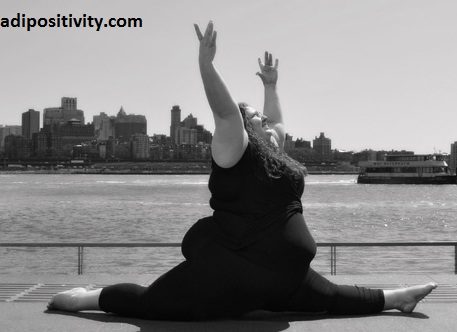
Ragen Chastain – superfat – picture by Substantia Jones for Adipositivity.com
I was forwarded an article from the Idea fitness website [with my strong trigger warning for fat shaming, stereotyping and bigotry]about modifying yoga for fat people that aptly demonstrates everything that typically goes catastrophically wrong when fitness professionals try to talk about how to modify exercise for fat people.
The article lists fat people by categories of fatness in a patently offensive section called “Know Your Plus Sizes”:The Athletic but Fat Person; The Soft, Large and Flexible Plus-Size Person; The Very Inactive, Inflexible, Unhealthy Person; The Supersized Person.
How many ways can one author go wrong? “The Athletic But Fat Person.” The word but should be removed completely – there is no but, this is not a paradox of any kind. Athletes come in all sizes (just ask the members of the Fit Fatties Forum)
“The Soft, Large and Flexible Plus-Size Person; The Very Inactive, Inflexible, Unhealthy Person” – It’s like adjectives in a blender. The only way that this makes sense is if the author accidentally published a section from the fat bigotry mad libs book that she was playing with while taking a break from trying to figure out how to make this article the most offensive of its kind ever published.
The Know Your Fatties categories are, perhaps unbelievably, the least offensive thing about the article. Each category gets a description in which declarative statements are used to let readers know that someone’s size tells you everything you need to know about them. From their attitude (the Athletic but Fat will “do everything he can to prove that he can keep up with your class, even though it may kill him for the first 2 weeks”) to their abilities (The Soft, Large and Flexible Plus-Size Person “is usually quite willing to begin an exercise program” – apparently Soft, Large and Flexible people couldn’t possibly have already started an exercise program), to their abilities (for Super Fat people – like me – “Simply lifting the arms can be a challenge. The supersized individual can’t get up and down off the floor or be on her feet for long periods. Embarrassed and humiliated by her weight and health, she spends a lot of time at home.”)
There’s a word for making judgments about people based on how they look…wait, it’s on the tip of my tongue…
It is highly problematic to make assumptions about student’s fitness or mental state based on their size. There are fit and unfit students at every size, flexible and inflexible students of every size, students of every size who have trouble getting up and down off the floor. Students should be accommodated for their level without shame or judgment, and when it comes to fat students, modifications should be used in order to make the poses work for a larger body, not because we make assumptions about someone’s fitness/flexibility/confidence based on how they look.
Next the author includes a section called “What Plus Size People Want You to Know” that has four unattributed quotes from people with fairly specific issues.The first of which is:
“I really don’t care and don’t want to know where my anterior deltoid is; I just want to relax my shoulders. Maybe later I will be open to learning anatomy, but for now I am here to learn how to relax, open and stretch my body in a way that won’t hurt me.”
There you have it…proof that fat people don’t care about anatomy – Maybe you could give us cues by pointing at a stick figure (drawn with an extra wide tip marker of course.) I cannot for the life of me figure out how this has anything to do with being fat. I’m sure that there are students of all sizes who don’t give a crap where their anterior deltoid is and that’s just fine. Do let’s try to remember that just because some fat person thinks something, that doesn’t mean that all fat people “want you to know” it.
Many fat people don’t pursue yoga because of the bigotry and discrimination we find in classes, and authors and teachers who make assumptions like this are part of that problem.
If you’re interested in yoga for fat bodies, check out Abby Lentz at www.heartfeltyoga.com, and Anna Guest-Jelly at www.curvyyoga.com both plus-sized yoga teachers who give actual modifications that work for plus-sized bodies without all the stereotyping and assumptions.
Fitness professionals can benefit from reading the article and then doing the exact opposite of what it advises. It is offensive to assume that students can’t do things because of their size. It is dangerous to assume that students can do things because of their size. Avoid stereotyping and stigma. Take each student as they come, respect their bodies, respect their boundaries and be enough of a professional to know how modify the work that you do to fit students of many sizes and abilities.
Like the blog? Here’s more of my stuff:
The Book: Fat: The Owner’s Manual The E-Book is Name Your Own Price!Click here for details
The Dance Class DVDs: Buy the Dance Class DVDs (hint: Free shipping was supposed to end on Monday but I haven’t had a chance to make the changes to the pricing so there’s still free shipping until I get it done)!Click here for the details
Become a Member, Support My Projects, and Get Special Deals from Size Positive Businesses
I do size acceptance activism full time. A lot what I do, like answering over 4,000 e-mails from readers each month, giving talks to groups who can’t afford to pay, and running projects like the Georgia Billboard Campaign etc. is unpaid, so I created a membership program so that people who read the blog and feel they get value out of it and want to support the work I do can become members for ten bucks a month To make that even cooler, I’ve now added a component called “DancesWithFat Deals” which are special deals to my members from size positive merchants. Once you are a member I send out an e-mail once a month with the various deals and how to redeem them – your contact info always stays completely private.
Several of my readers sent me articles about Daniel Callahan, a senior research scholar and president emeritus of The Hastings Center, who is suggesting that what fat people really need is more fat shaming. No, seriously. It turns out he quit smoking because of social shame around being a smoker and he feels that smoking and being fat are basically the same thing and that shame will make fat people thinner faster. He proposes things like public posters saying”“If you are overweight or obese, are you pleased with the way that you look?”
I’m Fatty McFatterson Mayor of Fatterworth and yes Dan (can I call you Dan?) I am pleased with the way I look. Meanwhile, I propose posters around The Hastings Center that say “If you are a bioethicist who can’t grasp the basic tenets of your field, are you pleased with your job performance?”
First of all, let’s be clear that smoking and being fat are not the same thing. Smoking is a specific behavior – every smoker smokes. Being fat is a body size and when it comes to habits and choices, fat people are as varied as any other group of people who share only a single physical characteristic.
I’m not promoting shaming smokers, but I want to be clear that shaming smokers shames people for something that they do. Shaming fat people shames people for who they are. If smokers want to continue their habit and avoid public shame, they can hide their smoking. Fat people would have to hide ourselves. Both of them may be wrong, but trying to get people to be ashamed of a specific habit is a very different than trying to get them to be ashamed of their bodies.
In an article about this [Trigger warning for fat shaming] Deb Burgard, one of my life heroes, said “For him to argue that we need more stigma, I don’t know what world he’s living in,” My sentiments exactly Deb! 386,170 negative messages about our bodies a year, but the secret to public thinness is more negative messages. Right. And yes, public thinness – let’s not fool ourselves that this is about public health. You can identify an evidence-based public health initiative because it is based on evidence and is focused on health. This is 0 for 2.
In fact, Peter Muennig’s research from Columbia found that most of the same health problems that are correlated with obesity are also correlated with being under a high degree of stress for a long period of time (for example, the stress of constant shaming and stigma). Muennig found that those who were concerned about their weight experienced more physical and mental illness than those who were ok with their size, regardless of their size. I guess being a bioethicist doesn’t include doing basic research to see if what you are recommending is likely to have the exact opposite of the intended effect?
I am lucky to know Dr. Tiffany Cvrkel, a brilliant bioethicist who works at UCLA so I immediately e-mailed her for her thoughts. She said:
I think Callahan is perhaps confused about the mission of bioethics. We are capable of doing many things to increase general public health. We can protect people from one of the leading causes of death and injury in very a straightforward way. All we have to do is forbid people from leaving their houses, for any reason. Maybe we should start a shame-based campaign?
Oh, wait. Just because we can do something doesn’t mean we should. It is the job of the bioethicist to be able to tell the difference. If Callahan thinks that shaming people for how they look is an efficient way to make them healthier — a claim that is simply empirically wrong, by the way — then he still needs an ethical argument for why that shaming is morally permissible. Simply saying “it’s for their own good” is not sufficient. I can forcibly prevent you from riding in automobiles for your own good, or from dating problematic people, or from voting for offensive political parties. Callahan is suggesting something equally ridiculous.
Suggesting that we should shame people for their own good until they hate themselves healthy thin offends me as a fat woman, as a human being, and as someone who appreciates logical, rational thought and evidence-based public health interventions. My hope is that this is the kind of thing that makes more fat people stand up and say that they’ve had enough – that the evils have finally become unsufferable, that this is not a tree and we are not kittens, that it’s time to stand up and fight back and that if they want a war on obesity, then we’ll give them one.
Like the blog? Here’s more of my stuff:
The Book: Fat: The Owner’s Manual The E-Book is Name Your Own Price!Click here for details
The Dance Class DVDs: Buy the Dance Class DVDs (hint: Free shipping was supposed to end on Monday but I haven’t had a chance to make the changes to the pricing so there’s still free shipping until I get it done)!Click here for the details
Become a Member, Support My Projects, and Get Special Deals from Size Positive Businesses
I do size acceptance activism full time. A lot what I do, like answering over 4,000 e-mails from readers each month, giving talks to groups who can’t afford to pay, and running projects like the Georgia Billboard Campaign etc. is unpaid, so I created a membership program so that people who read the blog and feel they get value out of it and want to support the work I do can become members for ten bucks a month To make that even cooler, I’ve now added a component called “DancesWithFat Deals” which are special deals to my members from size positive merchants. Once you are a member I send out an e-mail once a month with the various deals and how to redeem them – your contact info always stays completely private.
Earlier this year I was asked to give a super workshop at the NAAFA convention following up on the Georgia Billboard Project. I decided to use the talk to discuss ways that we can get people interested and involved in fat activism projects. If you have trouble with the audio, you can read the transcription below (thanks to the amazing Julianne who did the transcription).
If you’re in the San Jose area this Sunday, I’ll be giving a talk about options for health, happiness, and high self-esteem that honor the body you have now at Center for Creative Living at 1460 Koll Cir, San Jose, CA 95112 on Sunday, 1/27 from 1:00 to 3:00, cost is $20.
Video Transcription:
Harvey Milk is one of my great life heroes. My name is Ragen Chastain and I am here to recruit you. I am here to recruit you to fat activism and to leadership of fat activism. Some of you are already doing it and some of you don’t know that you are fat activist leaders yet. And I am here to help you.
They asked me to talk about the Georgia Billboard project, and I will. The project that in 8 days raised $21,000 to put up a media campaign in Georgia to counter a horrible anti-fat child-focused media campaign. What I realized when I started to think about the project and its success, was that what made it successful are the things that make everything successful. In my background I’ve consulted for Fortune 100 Companies. I’ve been a turn-around CEO for a multi-million dollar corporate conglomerate. I’ve been a part of a team that turned 200,000 votes in two weeks to win the No on 9 Campaign in Portland.
All of these things are built on really successful principles. So, I wanted to talk about that today so that when you go out if you become interested in leading fat activism and running your own projects – and I hope that you will – you will have all of the tools that you need.
There are many things that successful activism and activist organizations are built on. Leadership, People, Empowerment, and Fundamentals.
Let’s talk about Leadership and what really happened in Georgia. I can take almost no credit for this project. It wasn’t even my idea. I blogged about the campaign in Georgia by Children’s Healthcare in Atlanta. Well-Rounded Mama said “I wish we could have our own billboard.” I was like, “I wish we could have our own billboard, too.” So I posted on my blog and said, “Would you guys like to have our own billboard?” And they said, “Yes!” More of Me to Love came online and said we could have $5,000 and, “What do you want to do?” And we talked about it and we decided to do a matching grant, like a challenge grant, to get people involved. The Big, Fat Money Bomb was Shannon Russell’s idea – that we were going to do it all on one day. Get tons of publicity and then everybody donate today to get momentum going. Allen at Ad Out was our billboard representative. He called me one day and said, “I just spent a bunch of time reading about this project and I’m so excited!” Originally, we wanted to get one billboard and it was going to be $10,000. We ended up getting six billboards and ten bus shelters and it was $21,000. Allen made that happen for us. Allen was amazing. He was just some dude that I found on the internet who rep’d a billboard company. It was amazing. Marilyn Wann came on board and allowed us to use her “I Stand” project for the bus shelters and sponsored the project. Sabrina Wilson and Elizabeth Tamny were our Graphic Design Gurus. They came in and Sabrina did the original design for the billboard and Elizabeth did all of the” I Stand”s to spec in like 24 hours because we found out they weren’t going to look good. She was a hero. We had a thousand donors. We had tens of thousands of participants. Almost none of it was me.
The way that it works is this – this is my favorite quote about leadership – “With the best of leaders when the work is done, the people will say, “we have done it ourselves.” If you are leading a project, it is 100% not about you, your ego, or credit. Right? It’s about empowering people. This isn’t about making people believe that your ideas were their ideas. That’s not what it means. It means that when you leave, the people are empowered to go on without you. They don’t need you. You’ve empowered them. You’ve given them a gift by showing them their value – which they came to you already having. People come to you valuable, people come to you amazing, people come to you talented. But they don’t always know it. And it’s criminal, as a leader, to not show them, to not help them discover that, to not give them the option.
Proper leadership recruits and empowers group members. It makes people want to act. It makes people do things that maybe they thought they couldn’t do. It makes people excited. It makes people want to be involved.
Proper leadership identifies and develops new leaders. Always looking for the next person. Who’s next? Who’s after me? Who can I recruit? Who can I get to help? Who else is there? There are leaders everywhere and it’s our job, if we are coordinating projects – we have the opportunity to identify those people. And what a tragedy to not do that.
Proper leadership seeks out and elevates people who are smarter and better. Everybody on that list I just mentioned is smarter and better than me. At least at what they do and probably many things. Maybe all things. That’s my job as a leader. If you think you are the smartest, best person in your organization you are failing as a leader. You are actively failing. Surround yourself with people who are smarter than you. People who know other things. People that are better than you at what they do. That’s power. That’s how we gain momentum.
Credit kills campaigns. This was a sign in the first campaign office I ever worked in. I am sure you guys have heard the saying, “It’s amazing what you can accomplish if nobody cares who gets the credit.” It’s amazing what you can’t accomplish if someone does care who gets the credit. There is no room for credit in revolution. We don’t have room, we don’t have time. There’s no room for ego. We’ve got to get in a boat and we’ve got to row. And that’s how it goes. We are rowing that way. If you are also rowing that way, we welcome you in the boat. If you want to lead a team in the boat, that’s amazing. How can we help you and empower you to do that?
What happened in Georgia? The Georgia Campaign had 3 sponsors, had 1,010 donations, had tens of thousands of people who got the word out – and our policy was: “Everybody In!” We encouraged people to ask how they could help and when they asked, we gave them something to do. And that included people who had no money; that included people who had no internet; that included people who did not want to come out as fat activists in any way, shape, or form. We found a way for them to help – for them to make this their project. For them to become involved and want to become more involved and to take that next step. This is so important. Getting people involved. Showing them their value. Showing them that, maybe you don’t have money but you are valuable to this movement – you have something to give. We want to encourage that. It’s incredibly important.
I want to give an example of that. The NAAFA-LA chapter [now the Size Diversity Task Force] who are here in their red. Hi everybody. They spent this year fundraising, all year long, so that every single member of their chapter who wanted to come to Convention came to Convention. And that’s why they are more than a third of the people in this room. They got it done. And they empowered everybody to do it. Everybody was involved. Whether they were putting glitter on candles to sell or donating clothes for the Big, Fat Flea Market. Every single person got to be involved and got to feel valued. And here we all are. That’s amazing. That is activism! That’s how it works! And, people, understand – I was so inspired by this chapter that I changed where I lived! I want to be part of a community. I want to be involved with people like that. People who get it done. People who say, “Whatever your talent is, wherever you’re at, whatever you don’t have, we’ll make up for that. We can do that. We’re a group. You don’t have to be everything. Nobody can do everything but everybody can do something. Everybody who wants to.” And, I believe it’s our jobs to say, “What do you want to do? What are you good at? Let me help you. Let’s try some things.” Whatever it takes to get people involved and motivated and interested.
Because we are at a point in our activism where we want to tell the world, “This is what we want. This is what we deserve.” But, meanwhile, we have to turn around to our community of fat people, some of whom don’t identify as a part of the community at all, and say, “No, seriously. This is what you deserve.” So we’ve got this weird thing where we get it, we’re here, like we’ve got this gift of having discovered Health at Every Size and Size Acceptance. And that’s such a precious gift, we can’t hold onto that.
I get between 150-200 emails every day from people who read my blog. People who tell me their marriages are falling apart. People who tell me they are ready to commit suicide. People are suffering. People are dying. Every day, people are stigmatized, oppressed, and disenfranchised. And it is criminal, that we have discovered this, not to tell them about it – not to give them the option. I’m not about telling people how to live. Do whatever you want. You are the boss of your underpants. I’m the boss of mine. And there is no Underpants Overlord – and that’s how it goes. But if you want to get your underpants in the boat, I want you to know about the boat! There are people who don’t know that there is an option besides hating themselves. They don’t know! And that’s on us, because we know. We have got to tell people that. And we’ve got to get them involved and motivated and make them feel welcome and make them feel able and capable and smart – because they are – they don’t know it because the whole world tells them that they’re not.
So how did it work in the Georgia Campaign? Volunteer recruitment and management are the most important part of activism. No civil rights movement has ever succeeded because six people wanted to do something. Momentum of hundreds of people becomes a movement when they decide they have had enough. I’m ready to pick up a brick and throw it. There are consequences and I don’t care. “Risk is the currency of Revolution.” We have to take risks. So, getting people on board, giving them a way to get in – even if they aren’t all the way there. It’s not, “If they are not with us, they are against us.” It’s, “If they are not actively against us, maybe they’re with us. What can we do and how can we get them involved?”
Again, nobody can do everything, but everybody can do something. In fat activism, this is particularly important. We are told, as fat people, every day, from every direction, that we are worthless – that we are valueless – that we are lazy – and this just doesn’t count and it won’t count until we get thin. So, as leaders and fat activists, it is criminally negligent to perpetuate that. To make people feel that they are anything less than valuable and amazing. It is criminally negligent and to do it for the sake of your own ego is worse. We’ve got to start being active and getting people involved and getting them on board and letting them know that they are valuable. It’s one of the most important things we can do for fat activism.
Good volunteer management empowers. Again, you’re giving people the opportunity to find out something about themselves – to try something and fail spectacularly, and that’s okay, and that’s going to happen. Better to try and fail spectacularly and find somebody who wants to try again than to say, “No, I’ll just do it myself because I’m gonna do it better. It’s just too much of a pain to get you involved and teach you how. It’s too much of a pain. I don’t have time.” Better to get people involved. Even if they fail at their first shot.
Good volunteer management respects. Respects people’s time, respects people’s talent, respects people’s ideas. They are not going to come on board unless they know they are valuable. Good volunteer management uncovers value. Again, they come to you valuable, but they sometimes they don’t know it. And that is horrible. And that is something we can do something about!
Fundamentals. This is the last little bit I’ll talk about. So what happened in Georgia? We had clear goals. We had follow-through. We gave constant updates. We gave opportunities for input as well. Sabrina Wilson was a hero because she developed the billboard, that then thousands of people voted that they wanted to be the billboard for the campaign. She’s not just a hero for that. She’s a hero because she got on a phone call with six people and we made the billboard better together. She didn’t say, “This is my idea and it is perfect as it is and 4,000 people voted for it so it’s what we’re doing.” She said, “Who wants to help? How can I make it better? How can I get involved? How can I get other people involved?” Better, smarter people than me. Because that’s how we win, that’s when we’re powerful.
Transparency. We were clear the whole time. People could look at our financials and bank reports at any time. We were extremely clear about where we were.
Good organizations and campaigns respect people’s time. They begin and end meetings on time. They respect the amount of time people say they can put into the organization and give them something that matches that amount of time. They have good follow-through. They help people all the way through. Is that difficult? Yeah, sometimes it really is. Is it frustrating? I have a friend who says he can’t watch his kids clean the kitchen. Because it’s just too painful and he just can’t sit there and watch it. But they’ll never learn to clean the kitchen if he doesn’t let them try. So, try – feedback. Try – feedback. All the way through until they are kitchen cleaning experts. That’s the deal. That’s what leaders do.
Good organizations give opportunities for input and ideas from the group at every possible opportunity. Anytime they can get feedback and input and involve that and involve people and their ideas – they do it. Again, because we are a baby activist movement and people need to know that they are valuable and they’re welcome and there is a place for them for more than their money. We never want to make people think they are only valuable for what they can donate to our cause. Right? 1,000 people donated, but it took tens of thousands of people to get that done. And those people are just as, if not more, valuable than the people who were able to make a contribution. Because they got more people involved. Now 10,000 people consider themselves fat activists. There’s a really cool study where they went around with a picture of a really big, ugly billboard and they said, “Would you put this in your yard?” It was about community beautification. And 98% of the people said, “No, I will not do that.” Obviously. Except for one neighborhood where almost 80% of people agreed to put a big, ugly billboard in their yard. And the reason why is because two weeks previous, someone had come around and asked them to put a little sticker in their window that said that they believe in community beautification. And what they learned is that that tiny act changed the way people felt about themselves. They became people who cared about community beautification. Enough that they would put that billboard in their yard to talk about beautifying their community. It’s a little seed and it grows so fast. Because it changes how people see themselves, who they believe themselves to be. And that’s powerful.
Good organizations are transparent about their membership, their financials, their goals and projects. If you are leading a project and it turns into a bigger thing that’s going to go on for years and years and into an organization, it is time to call elections. There is no place for oligarchy in revolution. If you are a leader you want to be a leader because people ask you to be a leader. They said, “You’re the one. I pick you. I raise my hand. I want you out in front.” And if that happens to you and you become that person, it’s your job to find the next people and grow them – not to hold onto that leadership and hope that the people never, ever say that they don’t want you. You’ve already been chosen. Your time is there, it’s great, now it’s time to integrate new leadership. All the time.
So with the best of leaders, when the work is done, the fatties will know we have done it ourselves. They want a war on obesity? We will give them a war! And we will do it by empowering ourselves one at a time. By showing people that they are valuable and they deserve love and respect and that they can demand it. And so can we. We deserve the activist committee that will win. And we can create it for ourselves.
Thank You.
Like the blog? Here’s more of my stuff:
The Book: Fat: The Owner’s Manual The E-Book is Name Your Own Price!Click here for details
The Dance Class DVDs: Buy the Dance Class DVDs (hint: Free shipping was supposed to end on Monday but I haven’t had a chance to make the changes to the pricing so there’s still free shipping until I get it done)!Click here for the details
Become a Member, Support My Projects, and Get Special Deals from Size Positive Businesses
I do size acceptance activism full time. A lot what I do, like answering over 4,000 e-mails from readers each month, giving talks to groups who can’t afford to pay, and running projects like the Georgia Billboard Campaign etc. is unpaid, so I created a membership program so that people who read the blog and feel they get value out of it and want to support the work I do canbecome members for ten bucks a month To make that even cooler, I’ve now added a component called “DancesWithFat Deals” which are special deals to my members from size positive merchants. Once you are a member I send out an e-mail once a month with the various deals and how to redeem them – your contact info always stays completely private.
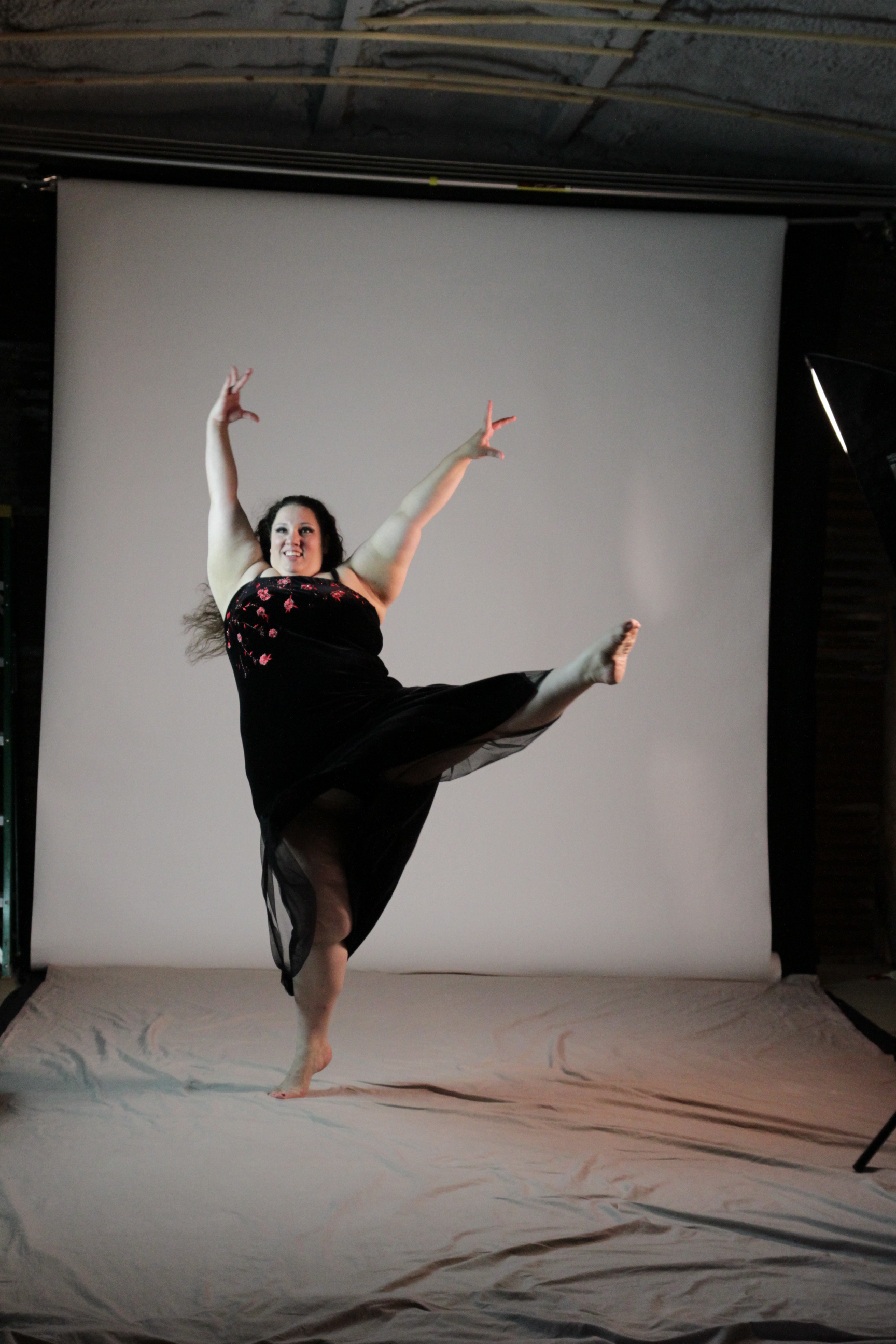
Ragen Chastain 5’4 284 pounds, wearing a dress that a judge once said she “couldn’t stand to look at me” in. photo by Richard Sabel
I’ve taken some time off of competitive dance and recently I’ve been considering getting back into it. I’ve had a number of conversations about it and in each of them the concept of “looking the part” has come up. Some people being very clear that, in their estimation, if I want to compete at the top levels there will be issues if I don’t “look the part” by being thin.
This is a pervasive idea – that only thin bodies “look right” for various activities. Dance is an area where fat people are often told that the idea that our bodies are “wrong” is not opinion, culture, or discrimination – but absolute fact. I am certain that is fiction.
Just as I am certain that it is fat bigotry that leads our culture to choose our singers, actors, and dancers not predominantly on their ability to sing, act, or dance, but on their ability to meet a culture stereotype of beauty. Models for plus size clothing often don’t “look the part” unless they are too small to fit into the clothes they are modeling. Studies have found that, in general hiring practices, “strong obesity discrimination was displayed across all job selection criteria, such as starting salary, leadership potential, and likelihood of selecting an obese candidate for the job.”
In our society “looking the part” is almost always about being thin – whether “the part” is a professional actress or an administrative assistant. This is size discrimination, plain and simple. Fat people are often advised to solve this discrimination by changing our bodies. I certainly don’t hold it against anybody who chooses this path, though I feel for them since the actual likelihood of permanent long term weight loss is so small and I imagine that the stigma people experience does not go down if they lose a bunch of weight and then gain it back. This illustrates one of the problems with trying to solve discrimination or social stigma with weight loss. We can try to stop the bullies by giving them our lunch money but that doesn’t guarantee the bully will leave us alone, especially if we have more lunch money next week.
We have the option to challenge what “Looking the Part” means. We have the option to become the best dancer, singer, actress, administrative assistant, plumber, HR specialist etc. that we can be in the body that we have now, and to relentlessly pursue our dreams and goals while refusing to change our bodies, even though the deck is stacked against us. Fat discrimination is real and these things do not change overnight so there’s no denying that this is a risk. As I said before, I harbor no ill will toward those who try to get thin in order to escape social stigma. It’s just not for me. I believe that risk is the currency of revolution. For things to change a lot of people are going to have to risk – I choose to be one of them. So I plan to return to competitive dance this year and see if I can expand what “the part” looks like.
Like the blog? Here’s more of my stuff:
The Book: Fat: The Owner’s Manual The E-Book is Name Your Own Price!Click here for details
The Dance Class DVDs: Buy the Dance Class DVDs (hint: Free shipping was supposed to end on Monday but I haven’t had a chance to make the changes to the pricing so there’s still free shipping until I get it done)!Click here for the details
Become a Member, Support My Projects, and Get Special Deals from Size Positive Businesses
I do size acceptance activism full time. A lot what I do, like answering over 4,000 e-mails from readers each month, giving talks to groups who can’t afford to pay, and running projects like the Georgia Billboard Campaign etc. is unpaid, so I created a membership program so that people who read the blog and feel they get value out of it and want to support the work I do can become members for ten bucks a month To make that even cooler, I’ve now added a component called “DancesWithFat Deals” which are special deals to my members from size positive merchants. Once you are a member I send out an e-mail once a month with the various deals and how to redeem them – your contact info always stays completely private.
First of all, you may have noticed that I skipped a few posts last week. Thank you to the readers who have sent e-mails and Facebook messages to check on me. I am fine, my partner however is not. She injured her knee and the healthcare debacle that has followed has been nothing short of shameful. I will probably blog about it eventually but for now greatly appreciate happy thoughts directed at her knee and our journey through the healthcare system. Thanks also to my friends in LA who have been so generous with support, rides, food (T, I’m looking at you) Seriously, thanks. Onward to the blog:
You may remember a while ago I was part of a panel on childhood obesity that included a bunch of self-identified childhood obesity experts who claimed that they didn’t need any evidence that their interventions work because they have common sense. Oh let’s entrust as many children’s lives as possible with these people – don’t you think?
Another concept was brought up after the cameras were off that I’ve been wanting to talk about for a while. One of the panelists claimed that calling ourselves fat was a source of the problem. He explained that if you call yourself fat then that’s what you become – much better, he claimed, to say that you “have fat.” I was barely able to control my eye-roll reflex when another panelists explained that in her book (which I will never, never name or link to) she explained that it’s not that people are physical fat, it’s that they are mentally fat. Uh huh.
These are both highly problematic in different ways. Let’s start with the idea of being “mentally fat”. I hate to spoil the ending, but she is just regurgitating the same tired stereotypes that fat people don’t plan, prepare, and portion their food correctly and don’t move their bodies enough while thin people do these things, despite the fact that the evidence shows that this isn’t the case. I imagine that it’s only her insistence that evidence isn’t necessary if she thinks something is common sense that allows her to sleep at night after taking money for this book.
Fat is not a “state of mind.” Fat is not a specific set of behaviors. Fat is a body with lots When it comes to diversity of habits and choices, fat people are just like thin people – only bigger. There are people who eat the exact same things and move the exact same amount and have various different body sizes. There are people who eat vastly different diets and move in drastically different amounts but have the same size bodies. Our society accepts the fact that there are very thin people who eat very poorly and never exercise but remain thin, yet insists that it is impossible for someone to be fat unless they eat their body weight in big macs everyday.
To be clear people get to make choices about what they eat and if someone wants to eat their body weight in big macs everyday they get to do that and it’s nobody else’s business. My point is that the persistent myth that fat people just need to learn portion control and go for a walk and then they’ll be thin (both physically and, apparently, mentally) is dangerously misleading, is insulting – at least to this fat person, and keeps people who are interested in health from pursuing evidence-based methods for improving health that don’t involve some “eat less move more” platitude that has been shown to be an utter failure in over 50 years of studies.
Which brings us to the idea that people shouldn’t identify as fat, but should consider themselves to be a thin person covered in (ostensibly undesirable) fat. Here’s why I think that’s bullshit. First of all, I am with my body 100% of the time and this suggests that I should look at my body as flawed and needing to be changed in order to be worthy, I don’t believe that is the case. Since all the studies suggest that most fat people will always be fat, this suggestion means that we spend our whole lives unsatisfied with our bodies. I spent a lot of years hating my body and it was awful and exhausting and it made me tired and sad and miserable but it did not make me thin. I have come to believe that fat people are no more thin people with extra fat than tall people are short people with extra leg. People come in lots of different sizes for lots of different reasons and none of us owe anybody an explanation for our size, and none of us should be expected to hate our bodies because they don’t look like somebody else’s body.
Finally, it ads another layer to the stigma and shame that fat people experience. Now it’s not just our bodies that are wrong, it’s also our minds. My fat is not a state of mind, I am not a thin woman covered in fat. I am a fat woman, and there is absolutely nothing wrong with that.
Don’t forget that the Lose the Diet Gain Yourself Telesummit starts today (January 21, 2013) I’m speaking at 2:30 Pacific Time – Truth, Lies, and Measuring Tape – What the Evidence Really Says About Weight and Health. You can listen live and ask questions or listen to the recordings at your convenience. Register here for free.
Like the blog? Here’s more of my stuff:
The Book: Fat: The Owner’s Manual The E-Book is Name Your Own Price!Click here for details
The Dance Class DVDs: Buy the Dance Class DVDs (hint: Free shipping was supposed to end on Monday but I haven’t had a chance to make the changes to the pricing so there’s still free shipping until I get it done)!Click here for the details
Become a Member, Support My Projects, and Get Special Deals from Size Positive Businesses
I do size acceptance activism full time. A lot what I do, like answering over 4,000 e-mails from readers each month, giving talks to groups who can’t afford to pay, and running projects like the Georgia Billboard Campaign etc. is unpaid, so I created a membership program so that people who read the blog and feel they get value out of it and want to support the work I do can become members for ten bucks a month To make that even cooler, I’ve now added a component called “DancesWithFat Deals” which are special deals to my members from size positive merchants. Once you are a member I send out an e-mail once a month with the various deals and how to redeem them – your contact info always stays completely private.
 The sun revolves around the Earth. Thalidomide is a great treatment for morning sickness. Heroin is a non-addictive substitute for morphine. Lysol is a fantastic douche. Everyone who tries hard enough can lose weight.




 Dances With Fat