Dealing with a Fat Shaming Massage Therapist

Say Something SundayI have found massage therapy to be amazing – most of the massage work I get is sports massage but I’ve also had the occasional relaxation massage.  It can be great, but it can also be a fraught situation – you’re lying on a table, vulnerable, while someone is touching you. It’s a terrible time to be fat shamed.  Recently, reader Lucinda had this experience. She shared her brilliant response with me and gave me permission to share it with you:

I’m a fat athlete too, and this last Saturday I ran my first Half Marathon. It was a great experience! Unfortunately, as maybe I should have expected, it was very hard for the world to let a fat woman run a half marathon without making sure I knew how unhealthy it was to be a fat woman and how much better my half marathon would have gone had I been thin.

Yesterday I had scheduled a recovery massage with my regular therapist, Joan. I’ve seen her about 5 times this year, as part of my preparation for the race, and also as part of my rehab for my knee (tendinitis). She has heard every story of preparation and planning for my half marathon, and has been a supporter of my efforts. I have felt a strong rapport and built trust with her.

During my massage, I told her about my half marathon experience. But instead of being supportive, this time her response was to give me unsolicited advice about how losing weight would really “fix” my running and then try to sell me some shake program that she’s been following and has lost weight on. So there I am, naked on her massage table, completely vulnerable, paying her $80 to work on my body, and she took that time to A, criticize my body, B, try to fix my “problem” which she, not me, has diagnosed and she admittedly is not an expert in, and C, then she tried to sell me something. It was such a violation, and ruined the massage for me, and left me feeling upset and angry all day.

Usually my response in these kinds of situations is to withdraw and just never go see that practitioner again. But yesterday was not like all those other times, because yesterday was the first time someone had said that kind of bullshit to Half Marathon Finisher Lucinda. All those other times, the woman they were criticizing was the woman who didn’t think she was capable, who believed that her body was an enemy she had to overcome, who thought she didn’t have what it took. Now I know, I have what it takes. I have surprised myself with how much I can do. I did not run that half marathon despite my fat body, I did it with my fat body. We are on the same team. And nobody disrespects the Team.

So I wrote her an e-mail.

Joan,

I wanted to circle back to our conversation about that shake program (isometrics?). Thanks for telling me about your own experience with weight loss on this program, I am glad you feel good about it. However, it made me uncomfortable to feel like you were selling me something during a massage, and that discomfort took me mentally out of the relaxation of the experience. Also, and this is more what I wanted to make sure I said, I did not appreciate you making a comment about my body, specifically that I needed to lose weight, while I was lying naked and vulnerable on your massage table. That felt like a violation of trust and also of your role. I had just finished telling you about what a victory running my half marathon was, and your response was to give me unsolicited advice about how weight loss would fix and improve my running, which does not need to either be fixed or improved, and which you yourself admit is not an expertise of yours. Both giving unsolicited and unresearched health advice, and making comments about a client’s physical body that reveal your negative opinion of that body, seem to me to be beyond the scope of your role as a massage therapist. My time on the massage table is time I dedicate to relaxation, self care, and recovery, and I pay a premium for it. It is not too much for me to expect that that time be free from criticism, bigotry, judgment, and condemnation of my perfectly normal, strong, healthy, and accomplished fat body.

Sincerely,

Lucinda

Now, as we’ve talked about before, with activism we can only give people the opportunity to question their behavior, we aren’t responsible for their reactions.  Happily, in this situation Joan took advantage of the opportunity that was generously given to her:

Oh Lucinda,

I am truly sorry that I made you so upset.  I hate that you had to take the time to write this note and may continue to carry anger.

First of all,  I can’t tell you how excited I am about your race and your success. I thought about the race many times during the weekend. It was an accomplishment that, as you said, changed the benchmark for you about what was possible.

I was very conflicted before sharing my weight loss experience and have been thinking about it ever since our massage.  You are absolutely correct the advice was unsolicited and unprofessional and I wish I could inhale the words back in. Lesson learned.

There is a check in the mail to refund the massage.

Run on!

I really appreciate Lucinda because not only did she advocate for herself, but who knows how many of Joan’s clients will be saved from similar negative experiences.  I think it’s also important to point out the power of the after-the-fact letter.  Sometimes we just don’t feel like speaking up at the moment and that’s ok, we have no obligation to engage in activism in the moment, or at all.  But sometimes we walk away from a situation and decide that we do want to say something and that’s when the letter or e-mail can come in really handy, and I want to really thank Lucinda for giving us a great example of how it’s done for Say Something Sunday.

Like this blog?  Here’s more cool stuff:

Like my work?  Want to help me keep doing it? Become a Member! For ten bucks a month you can support size diversity activism, help keep the blog ad free, and get deals from size positive businesses as a thank you.  Click here for details

Book and Dance Class Sale!  I’m on a journey to complete an IRONMAN triathlon, and I’m having a sale on all my books, DVDs, and digital downloads to help pay for it. You get books and dance classes, I get spandex clothes and bike parts. Everybody wins! If you want, you can check it out here!

Book Me!  I’d love to speak to your organization. You can get more information here or just e-mail me at ragen at danceswithfat dot org!
Nobody Tells This Woman How to Dress

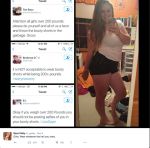
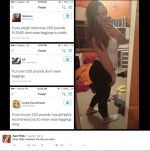
How messed up do you have to be to take to social media in order to try to tell people of a certain weight what they can and can’t wear? That’s a question that I don’t have a definitive answer to (“pretty messed up” is as close as I can get.)  When it comes to options for responding to this nonsense, Sara Petty has that part under control.

Sara is a blogger who is majoring in Public Relations at Bowling green University, and she decided to create a response to the size-shaming troll drivel she found in social media about what people should and shouldn’t wear.  In a statement to Huffington Post she said:

I also hope that girls are able to separate who they are from the number that shows up on the scale, and realize there is no number, high or low, that dictates if you’re worthy of feeling beautiful.

I think that this is a great project and I appreciate Sara putting herself out there.  I especially appreciate that the pictures are amateur, with just her room in the background etc.  While there’s nothing wrong with having beautiful, professional pictures taken of yourself, I also want people to know that activism doesn’t require a professional photographer, and that you can make a difference using whatever resources you happen to have.

But it’s the responses to her activism that I found particularly interesting, and that’s what I want to talk about:

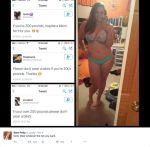
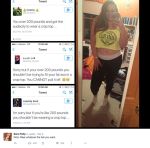
There is NO WAY that she could be 200 pounds

This one illustrates that people are terrible at judging weight, but excellent at missing the point of Size Acceptance. She is 5’11 and 219 pounds for the record, but that’s not really the point here.

She’s not fat!

This one is a bit tricky.  As a smaller fat person Sara has privilege since the mistreatment of fat people, as well as access to everything from clothing to transportation to compassionate evidence-based healthcare gets worse the more visibly fat one is (as well as intersectionally with things like disability, health, race, and other marginalized identities.) So some people are pointing out that, while she is taking a risk by putting herself out there, her risk is not as great as it would be if she were a size 26 with belly rolls and cellulite. And that’s true.

Still, as we’ve discussed before, this is something to be careful with because if someone is being shamed, stigmatized, bullied etc. for being fat, and we say “they aren’t fat” or “they aren’t even that fat”  in their defense, what we are also suggesting is that there is a size at which they would deserve that treatment, and that’s just not true. Which brings us to…

But she looks good at 200 pounds, I was talking about the other 200 pound people.

Because of her height and the distribution of her fat, Sara approximates the current stereotype of beauty more than people who are shorter, fatter, have different fat distribution etc.  That’s an important thing to note, and I was happy that Sara represented for women her size, and used her privilege to advocate for women of all sizes – specifically not doing the “at some point you’re too fat blah blah handwringing about our health blah blah” thing that can often happens in these situations.

At the end of the day, the most important thing to remember is that the suggestion that only people of a certain size/ weight/appearance are allowed to wear certain types of clothing is ALWAYS bullshit regardless of the parameters.  If people don’t like how fat people dress, they can avail themselves of one of these options.  In the meantime, here are Sara’s fabulous pictures, and you can check out her blog here!

Like this blog?  Here’s more cool stuff:

Like my work?  Want to help me keep doing it? Become a Member! For ten bucks a month you can support size diversity activism, help keep the blog ad free, and get deals from size positive businesses as a thank you.  Click here for details

Book and Dance Class Sale!  I’m on a journey to complete an IRONMAN triathlon, and I’m having a sale on all my books, DVDs, and digital downloads to help pay for it. You get books and dance classes, I get spandex clothes and bike parts. Everybody wins! If you want, you can check it out here!

Book Me!  I’d love to speak to your organization. You can get more information here or just e-mail me at ragen at danceswithfat dot org!


When Every Body But Yours is Beautiful

The world is messed up you are fineWe had our first call for the Body Love Obstacle Course tonight.  This subject came up so I decided to repost this.  One of the most common e-mails that I get is from blog readers who say that, while they completely understand size acceptance for everyone else, and they find bodies of all sizes beautiful and valuable and awesome, they just can’t get there for their own bodies.

For me, the thing that triggered the idea that I could ever be happy with my fat body was the realization that I didn’t feel about other fat bodies the way that I felt about my body at the time. I was trying to quit a terrible diet program, and when I told them I was quitting, they made me go into a little room with a poster about not quitting and a woman brought in a binder with pictures of fat women, and she started flipping through it silently.  She said “You might not know it, but this is what you look like and these women will die alone eating bon bons in front of the television and is that what you want for yourself…”

What I realized in that moment was that I didn’t find anything wrong with those women’s bodies, in fact I thought that they were beautiful.  I didn’t expect that they would never find love (and I didn’t know what bon bons were but that’s another thing.) So it occurred to me in a rush: if I thought that their bodies were beautiful… and if I looked like them…then maybe it was possible to think that my body was beautiful.

Of course that was the beginning of a long process.  I started that process by focusing on what my body does instead of how it looks.  I made a massive list of all the things that I appreciate about my body – I included things like blinking and breathing, I included standing, walking, reaching,  hugging and any other action I could think of.  I included that I love my curly hair and my eyes that change color.  I wrote down anything that I could think of that I liked about my body, or that my body did.

Then I committed to really paying attention to my thoughts and every time I had a negative thought about my body I would replace it with a positive thought from the list.  Every time it crossed my mind I would thank my body for doing anything that I could think of  – hey, thanks for breathing! I appreciate you reaching for that!  Way to climb the stairs!  Whatever I could think of.

More than any work that I have done, this started to shift the way that I felt about my body.

At the same time I made a point of noticing something beautiful about every body that I saw.  When something about someone caught my eye because it was outside the stereotype of beauty, I focused on what was amazing about it.  When I had negative thoughts I reminded myself that I had been spoon-fed these ideas by industries that profit from my thinking them; and that if they didn’t serve me or didn’t feel authentic, then I was free to replace those thoughts with thoughts that I came up with on my own that did serve me and felt authentic.

I stopped engaging in body snarking altogether and I started to interrupt it or walk away when other people did it.

I actively sought out pictures of people who were outside of the stereotype of beauty.  Some places I can recommend for this are below, feel free to leave other ideas of body positive places in the comments!

The Fit Fatties Forum Photo Gallery

The Adipositivity Project (NSFW)

The Flickr Athletes of Every Size group

Videos like this one from the Fit Fatties Forum:

I looked for similarities between the people I thought were beautiful and pictures of my own body, and I reminded myself that other people were looking at me and seeing the same beauty that I saw in those women.

And I had a lot of compassion for myself.  Changing thoughts and patterns that are ingrained, and sometimes reinforced by the culture around us is really hard work.  It takes time, there will often be backslides and mistakes, and the best ways to NOT succeed are not having compassion for the learning process, not having patience, and trying to rush it along. I know for me I decided that I was going to get there, and then I held that thought all the way through.  Patience, persistence, and belief that I would get there were the keys to my success.

Like this blog?  Here’s more cool stuff:

Like my work?  Want to help me keep doing it? Become a Member! For ten bucks a month you can support size diversity activism, help keep the blog ad free, and get deals from size positive businesses as a thank you.  Click here for details

Book and Dance Class Sale!  I’m on a journey to complete an IRONMAN triathlon, and I’m having a sale on all my books, DVDs, and digital downloads to help pay for it. You get books and dance classes, I get spandex clothes and bike parts. Everybody wins! If you want, you can check it out here!

Book Me!  I’d love to speak to your organization. You can get more information here or just e-mail me at ragen at danceswithfat dot org!
Good Fatty Bad Fatty BS

Angry FrustratedThe Good Fatty/Bad Fatty Dichotomy (originally named by the fabulous Kate Harding) happens when people try to divide fat people up into two categories, and suggest that one group deserves to be treated better than the other group. “Good Fatties” are seen as doing the “right” things by the people who think they have a right to judge – it may be what they are seen eating, how they dress, their current health/ability, whether or not they engage in movement, the type of movement they engage in etc.  “Bad Fatties” are those who are seen as doing the “wrong” things based on those same criteria.

The GFBFD creates privilege for some fat people. I am someone who is privileged by the GFBFD because I am a fat athlete. Like most privilege, I didn’t ask for it and I can’t give it away, but I can use my privilege to speak out against it and I try to do that whenever I can. The GFBFD blends multiple oppressions including sizeism, healthism, ableism, and racism among others, and it is always bullshit.  It’s also insidious and often perpetrated by people who have never really thought it through.  It’s been on my mind since I was interviewed recently for the Brave Endurance Podcast by Dr. James Kelley.

I had been recommended to him by Jon Robison (of the workplace culture firm Salveo Partners) who had been discussing the research around weight and health with James for a while. My primary goal in these types of interviews is always to tell/remind those listening that fat people have the right to exist in fat bodies without shame, stigma, bullying, or oppression, and that it doesn’t matter why we’re fat, what being fat means, or if we could (or even want to) become thin. That is a fact, it’s basic civil rights, and it’s non-negotiable – there’s no “agreeing to disagree” that we have the right to exist.

After that, I am happy to talk about what the research says about weight, weight loss and health, but always with the understanding that whether or not we agree about the research and regardless of a fat person’s health/ability/habits etc. fat people should be treated with respect. Being fat does not put you in a special category that requires you to meet some criteria to be treated with basic human respect.

The interview actually went pretty well. James didn’t necessarily agree with me on everything, but he asked reasonable questions and gave me the space to answer them, and considered my answers, which I appreciated. The first half of the interview is about me and my life, during the second half we transitioned to talk about Size Acceptance and Health at Every Size and my IRONMAN and that’s when the GFBFD came up.

I think a lot of people adopt this idea without thinking it through to realize that if you believe that fat people can be divided into “good” and “bad” based on some criteria (and treated “accordingly”), then you have to admit that you can divide any group of people into “good” and “bad” based on those same criteria.  There are two kinds of brunettes, two kinds of tall people, two kinds of green-eyed people etc. But we don’t hear anyone suggest that they’re only ok with tall people who “take care of themselves.”  Because, whether people realize or not, this isn’t actually about health, or anything else other than a crappy justification for engaging in sizeism (though not as crappy as the “fat people cost me tax dollars bullshit.)

There aren’t two kinds of fat people and suggesting that there are is simply sinking one’s self into a pool of stereotypes and bigotry and just soaking in it. Fat people are as varied as any group of people who share a single physical characteristic, and that is as it should be. The Good Fatty Bad Fatty Dichotomy needs to die, if you want to help kill it you can do things like not participating in it, and calling it out when you notice it.

You can check out my interview on the Brave Endurance Podcast (and leave comments please!) on iTunes, or on the Brave Endurance webpage.

Like this blog?  Here’s more cool stuff:

Like my work?  Want to help me keep doing it? Become a Member! For ten bucks a month you can support size diversity activism, help keep the blog ad free, and get deals from size positive businesses as a thank you.  Click here for details

Book and Dance Class Sale!  I’m on a journey to complete an IRONMAN triathlon, and I’m having a sale on all my books, DVDs, and digital downloads to help pay for it. You get books and dance classes, I get spandex clothes and bike parts. Everybody wins! If you want, you can check it out here!

Book Me!  I’d love to speak to your organization. You can get more information here or just e-mail me at ragen at danceswithfat dot org!
Best Response Ever to Thin Model Wearing Plus Size Clothes

I can’t go ten minutes without hearing about how 257% of the people in the world are fat Everybodypanicthisisacrisesdeathfatzarecomingtogetyou!

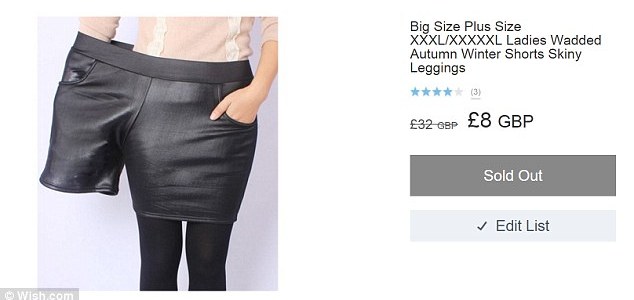
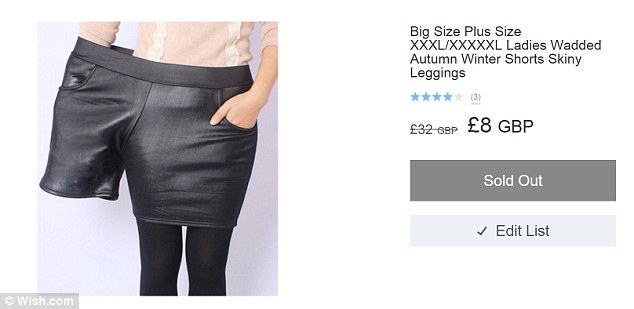
So imagine my surprise when internet sales company wish.com apparently couldn’t find a single 3x-5x model to show off their 3x – 5x shorts.  Instead, they had a thin thin model put both of her legs in one leg of the shorts, thusly:


wish

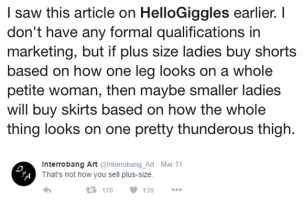
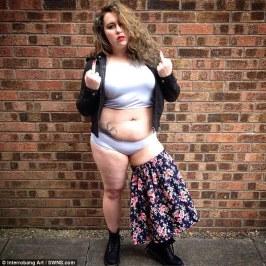
This is not the first time that this has happened. But this time, plus-size designer Christina Ashman was on the job. She responded with the following message and epic picture (possibly NSFW)

Christina Ashman 1

Christina Ashman

That. Is. Awesome.  I don’t have a ton to add to this, I wanted to blog about it mostly to boost the signal on Christina’s perfect response to such absolutely insulting advertising.

I do want to be clear that I’m not at all insulted that there are people who can fit both of their legs into one leg of my pants, because I celebrate the diversity of body sizes. I’m irritated that, while it’s difficult to tell what clothing will look like on me when I see it on a thin woman who is sealed into it by industrial sized clamps all down her back, it’s downright impossible to tell how shorts will look on me when a thin woman is wearing them as a skirt.  Companies that want my big fat money will have to do better than this.

Speaking of awesome companies that use models of diverse sizes, you can see (and buy) Christina’s fabulous designs here!

Like this blog?  Here’s more cool stuff:

Like my work?  Want to help me keep doing it? Become a Member! For ten bucks a month you can support size diversity activism, help keep the blog ad free, and get deals from size positive businesses as a thank you.  Click here for details

Book and Dance Class Sale!  I’m on a journey to complete an IRONMAN triathlon, and I’m having a sale on all my books, DVDs, and digital downloads to help pay for it. You get books and dance classes, I get spandex clothes and bike parts. Everybody wins! If you want, you can check it out here!

Book Me!  I’d love to speak to your organization. You can get more information here or just e-mail me at ragen at danceswithfat dot org!

Lane Bryant, Indecency, Sexiness, and Fat People

IMG_1851[1]
My Best Friend, Kelrick, got her for me at a little shop near his apartment in Astoria, I don’t know the artist
Recently Lane Bryant claimed that their ad has been rejected by major networks ABC and NBC for being “indecent” because they contained plus sized women, despite the fact that similar imagery of thin women is shown on those networks all the time. If these ads were rejected because their subjects are plus-sized then NBC’s rejection is particularly stinging because they are happy to show scantily clad fat people on The Biggest Loser (their abomination of a show in which they mentally and physically abuse fat people for profit,) but let fat people suggest that we have the right to love and celebrate our bodies and all of a sudden it’s indecent.

Of course immediately people jumped in to say that this is all a publicity stunt and that the rejection had nothing to do with the models being plus sized.  Lane Bryant released a statement:

The This Body campaign was meant to be a fun way for us to celebrate and honor women of all shapes and sizes. What is too much for some does not hold true for others. All women should be celebrated and feel empowered to express themselves as they see fit. We want her to know she can attract as much media attention, look just as striking as any woman, and decide what beautiful means to her. The This Body commercial holds nothing back. It is a true celebration of women of all sizes doing what makes THEM feel beautiful whether its breastfeeding their newborn, flaunting their bodies the way they see fit, breaking down barriers all around and simply being who they are or want to be!

Lane Bryant’s “Plus is Equal” and “This Body” campaigns have had some issues, as Virgie Tovar and Jes Baker have discussed.  But there are more layers to this. I recently had the honor of being on a panel for Harmony Eichsteadt’s Wild Women Wednesday. The subject was Wild Self Love and the panel included Jamia Wilson, April Weathers, Siobhan Barros-Limón, and me.  We talked about a lot of aspects of self love, including the ideas of sex, sexuality, and feeling sexy.  I talked about how, as a fat woman, this is a complicated discussion.

Fat people are often told that we are, by definition, not sexy.  So ads like this one by Lane Bryant, or declarations from fat people that we can be just as sexy as thin people can be really empowering, and helpful to fat people’s realization that the idea of “sexy” is a huge part of the oppressive idea of beauty that is used to convince us to hate ourselves so that we buy things from the beauty and diet industries. But let’s dig down a couple layers:

First, the ads focus on a specific type of fat body (hour glass, big boobs, smaller fat, no stretchmarks, athletic, femme, cis gender, etc.)  There is nothing wrong with bodies like this, and it’s progress, but when Lane Bryant describes it as representing “women of all shapes and sizes” at best they make a lot of us invisible or, at worst, they risk reinforcing the idea that only some fat bodies are good fat bodies. Sometimes including a side of good fatty/bad fatty dichotomy.

Then there is the issue of objectification. While I want all people to have the ability to feel sexy, and be empowered sexually, I don’t want anyone’s value hinging on whether or not we are seen as “sexy” based on the male gaze or some stereotype of beauty. So I think there are issues with trying to find empowerment through the idea that we, too, can satisfy the male gaze, or to suggest that we if we can approximate every aspect of stereotypical beauty besides thinness we can be considered sexy.

So it’s complicated, and there are so many layers to this and no easy answers.  For me it’s about celebrating progress while also always pushing for the next step, and part of that is calling out the double standard of suggesting that what is perfectly fine for thin people is somehow indecent for fat people.

In the meantime, I totally recommend watching the Wild Women Wednesday video!

Like this blog?  Here’s more cool stuff:

Like my work?  Want to help me keep doing it? Become a Member! For ten bucks a month you can support size diversity activism, help keep the blog ad free, and get deals from size positive businesses as a thank you.  Click here for details

Book and Dance Class Sale!  I’m on a journey to complete an IRONMAN triathlon, and I’m having a sale on all my books, DVDs, and digital downloads to help pay for it. You get books and dance classes, I get spandex clothes and bike parts. Everybody wins! If you want, you can check it out here!

Book Me!  I’d love to speak to your organization. You can get more information here or just e-mail me at ragen at danceswithfat dot org!

Flying Fat – You’re Right, It’s Not Fat Shaming

What a Load of CrapWhenever I speak out about the fact that people of all sizes should receive the same service when traveling by plane (specifically – travel from point A to point B in a seat that accommodates them) people on the internet lose it.  I want to address some of the common responses:
I’m not fat shaming you, it’s simple economics.

I agree, this isn’t fat shaming (although fat shaming shouldn’t happen) But it’s also not “simple economics.”  What it is, is discrimination – the idea that people should have to pay more for the same experience based on how they look. The idea that we should allow airlines, and those who make planes, to determine what size humans are “allowed” to be, and to charge anyone outside that size double for the exact same trip is not ok.

And it’s not an insignificant form of discrimination – it affects the ability of fat people to travel – to attend weddings and funerals, to go on vacation, to experience the world.  And it can limit career choices – if the best candidate for a job that includes travel is fat, the company would have to double their travel budget.  And if we’re talking about a fat singer, comic, speaker etc. then anyone who hired them would have to pay twice as much to bring them in as they would pay for a thin singer, comic, speaker etc. further keeping talented fat people from realizing their talents and being in the spotlight.

It’s your fault that you got fat because of your eating and exercise choices so you should pay double.

By that logic thin people who eat more and exercise less than fat people do should also be forced to pay double. People are lots of sizes for lots of reasons and if your business is transporting people from one place to another then you should not be allowed to discriminate based on size. (And by the way, Southwest Airlines is the only major airline to give a free extra seat and they’ve had 43 consecutive years of profitability – including record profitability last year – so it looks like airlines can be profitable without engaging in size discrimination.)

It costs more fuel to transport you.

This doesn’t hold up to even basic scrutiny – if it was about weight then the airlines would charge passengers by weight – but they don’t because we are people and not cargo.  But this isn’t about weight at all, it’s about size.

And a fairly arbitrary size since seats are different sizes on different planes making it very difficult to predict whether or not you’ll fit, and even if you go to the trouble to figure out that the seat will work for you, a last minute equipment change can blow your whole plan apart the morning of your flight. It’s also skewed against women since we tend to carry more weight in our hips, thighs, and asses than men do, and of course those are the body parts the airlines are concerned about – they never kick off people with broad shoulders that encroach on other passengers, I was recently asked to move from the aisle seat that I took great pains to book (I happen to fit into one seat, but the aisle allows me to be more comfortable) to a middle seat to help a tall passenger “be more comfortable.”

You pay for a seat, not the trip.  If you need more than one seat you should pay for more than one seat.

Nope, as I’ve already pointed out airlines should be in the business of  accommodating the sizes that people are, not dictating what size people are “allowed” to be. But let’s look at the “you pay for a seat, not a trip” argument, because that’s not what the airlines say. When a fat person wants the same travel experience as a thin person, the airline claims that they are in the business of selling specific seats. But when an airline bumps someone from a flight they tell them that they didn’t pay for the seat, they paid for the trip and that’s why they don’t give refunds.

I have to admit that even I’m a bit shocked by the sheer audacity of people who suggest that (of course) they deserve a seat that accommodates them while flying, but that fat people don’t deserve the same experience. Discrimination is wrong and even though airlines are currently getting away with it, there is no justification that will make it ok.

Like this blog?  Here’s more cool stuff:

Like my work?  Want to help me keep doing it? Become a Member! For ten bucks a month you can support size diversity activism, help keep the blog ad free, and get deals from size positive businesses as a thank you.  Click here for details

Book and Dance Class Sale!  I’m on a journey to complete an IRONMAN triathlon, and I’m having a sale on all my books, DVDs, and digital downloads to help pay for it. You get books and dance classes, I get spandex clothes and bike parts. Everybody wins! If you want, you can check it out here!

Book Me!  I’d love to speak to your organization. You can get more information here or just e-mail me at ragen at danceswithfat dot org!


So You’ve Been Inconvenienced by a Fat Person

You Forgot Your BullshitA couple of days ago I wrote a blog to remind people that equal access is not special access. What followed was a predictable flood of comments (that I will never publish) with stories (many of which strained credulity) from people who claimed to have been inconvenienced in some way by fat people who dared to exist. They were shocked – SHOCKED I tell you – to find that fat people thought that they deserved to exist in the world and get the same experiences as thin people. So I thought I’d create a nifty little guide to help these people process their experiences.
A fat person acted like an asshole

If you’ve been inconvenienced by a fat person who acted in a way that you would consider shitty regardless of the size of the person, then this has nothing to do with the person being fat and if you think it does, then you are combining their bad behavior with your size bias.  Assholes come in all sizes, if you focus on the size of the person and not on their bad behavior, then it’s you who is being an asshole.

I didn’t like the way a fat person looked (because they were fat, because of how they were dressed etc.) 

Here’s a little newsflash – nobody owes you aesthetically pleasing by any definition. If you don’t like the way a person looks (any person, of any size by the way) there are always at least three other cardinal directions in which you can focus your gaze.  The problem here isn’t the fat person, it’s your issues with fat people, and your choice to put them down instead of challenging your own biases or, at the absolute least, taking some advice from the band Chicago and look away, baby, look away.

A fat person encroached on my space

This was by far the most common and it often centered around seats on transportation, or public places and the idea that somehow fat people existing isn’t fair to thin people. (or, more specifically, isn’t fair to sizeist thin people.)  If your space was “encroached upon” by a fat person then your problem isn’t with the fat person, it’s with a space that doesn’t accommodate people of all sizes. If you are sitting in a seat that fits you, then your question shouldn’t be “why is this fat person crowding the seat that fits me,” but rather  “why isn’t this company providing everyone the same experience that I get?” (the experience, in this case, of a seat that accommodates you.) Otherwise what you are saying is “I deserve a seat/bed/space that accommodates me, but people who look differently than I do don’t deserve the same things that I get” and that’s super messed up.

If you are a fat person dealing with one of these scenarios, just remember that you are not the problem – the problem is a world that doesn’t accommodate you and the people who want to  blame you for that, or use that as an excuse to engage in sizeism. Unfortunately this may become your problem, but it shouldn’t be happening and it isn’t your fault.

Like this blog?  Here’s more cool stuff:

Like my work?  Want to help me keep doing it? Become a Member! For ten bucks a month you can support size diversity activism, help keep the blog ad free, and get deals from size positive businesses as a thank you.  Click here for details

Book and Dance Class Sale!  I’m on a journey to complete an IRONMAN triathlon, and I’m having a sale on all my books, DVDs, and digital downloads to help pay for it. You get books and dance classes, I get spandex clothes and bike parts. Everybody wins! If you want, you can check it out here!

Book Me!  I’d love to speak to your organization. You can get more information here or just e-mail me at ragen at danceswithfat dot org!

What To Call Fat People – Person First Language and Fat People

What Will you DefendI posted a piece called Person First Language and Ableism on my Facebook page.  It started an interesting conversation about language, including as it relates to fat people since this has been coming up recently.

First, a bit of background, Person (or People)  First Language started as a tool in disability community and is based on the idea that putting the “person” before their “illness or disability” helps to decrease stigma.  For example “A person with a disability” rather than “A disabled person.” There is a lot of controversy within that community about the use of PFL.

This became pertinent to fat people because of organizations like the Obesity Action Coalition. If you’re not familiar, the OAC is a nightmare of an organization that pretends to advocate for fat people when what they really do is act as a lobbying arm for the weight loss companies that donate hundreds of thousands of dollars to be on their “Chairman’s Council.”

The organizations who fund the OAC need obesity to be seen as a disease  because it is a first step to convincing insurance companies to pay for their expensive and dangerous treatments. So, under the guise of “eliminating stigma,” they are trying to advocate for Person First Language.  Using their own example (from a website I will NEVER link to)

“The woman was affected by obesity.” instead of “The woman was obese.”

The man with obesity was on the bus. instead of The man on the bus was very obese.”

As you can see here, as we did above, we’re no longer labeling an individual with their disease.

This is bullshit as far as I’m concerned.  First of all, body size is not a diagnosis.  And, as Amy Sequienza pointed out in her article, language like this actually increases stigma because PFL is never used to indicate a characteristic that is positive or neutral.  Nobody says “The woman was affected by brunetteness” or “The woman with shortness was on the bus.” Much like the suggestion that “we aren’t fat we have fat, like we have fingernails, we aren’t fingernails,” the use of PFL suggests that accurately describing a fat person’s body is stigmatizing, in a way that other descriptions are not (tall, blonde, etc.) thus reinforcing stigma around being fat.

There is no way to say “don’t call people fat” without stigmatizing fat people since we are, in fact, fat whether we call ourselves that or not. But remember that’s not what’s actually important to groups like the OAC – what’s important to them is the profits of the companies and organizations that allow them to exist through massive amounts of funding.

That leads to a question I got from Shelley on Facebook about what to call fat people:

I’m not fat so I usually use “people who live in larger bodies” when talking to general public or other personal trainers about not being assholes, is this ok?

This is a really good question.  I use fat for a lot of reasons but it’s definitely not for everyone. (I’m also conscious of the fact that thin people don’t do this because, for the most part, they get to understand their body size as a good thing so they aren’t triggered by the words that describe them.) When I’m looking for a neutral and non-controversial term I look for few criteria. First, it can’t pathologize body size (which means that “obese” and “overweight” are out.) Second, I typically try to avoid euphemisms (curvy, fluffy, etc.) because I think that euphemism can often suggest discomfort. So “people who live in larger bodies” would work for me, as do “people of size” and “larger bodied,” in some contexts I’ll use Plus Size but it’s not my favorite. If you have other examples I welcome you to include them in the comments.

This is made more difficult because fat people aren’t a monolith and so what some of us prefer to be called, others will loathe, and each person gets to decide which word/s we prefer for ourselves which is why using neutral descriptors like “people of size” or “larger bodied people” can help.  It can also help to remember that, regardless of what we call fat people, the only thing that will permanently end the stigma against fat people is to end weight stigma and fat shaming, and celebrate the diversity of body sizes including fat bodies, whatever we call them.

Like this blog?  Here’s more cool stuff:

Like my work?  Want to help me keep doing it? Become a Member! For ten bucks a month you can support size diversity activism, help keep the blog ad free, and get deals from size positive businesses as a thank you.  Click here for details

Book and Dance Class Sale!  I’m on a journey to complete an IRONMAN triathlon, and I’m having a sale on all my books, DVDs, and digital downloads to help pay for it. You get books and dance classes, I get spandex clothes and bike parts. Everybody wins! If you want, you can check it out here!

Book Me!  I’d love to speak to your organization. You can get more information here or just e-mail me at ragen at danceswithfat dot org!

Creating a Size Friendly Gym

IMG_1846[1]Nobody is ever obligated to go to the gym or work out.  But for fat people who want to go to the gym, it’s important to remember that it’s our gym too and we deserve for them to act like it.  Here are 5 things that they should already be doing

Asking about your goals and then training to them

If you work with a personal trainer at your gym, it is their job to either use their expertise to help you reach your stated goals, be honest that those goals are not realistic, and opt not to train you if necessary. That means that they should ask you for your goals, not make assumptions or impose their ideas on you.   If you ask to increase strength, stamina, and/or flexibility, and they talk about weight loss, they are out of line.  If they say that you have to lose weight before you can work on strength, stamina or flexibility, (this has happened to me) then they are either grossly incompetent or a liar. If they say that they can help you achieve long term weight loss, they are promising you something with no evidence to back it up.

Abolishing Fitness Myths

There is a ton of misinformation that floats around out there about fitness, your gym owes it to you to separate myth from fact.  There is no such things as lower abs.  You cannot spot reduce. You can’t “melt away” fat. Fitness and health are not the same as body size. You do not have to workout for hours and hours a day, or do things that you hate, to get health benefits. If your gym buys into any of these myths or perpetuates them through signage, workshops, classes, or any other messaging then they have some explaining to do.

Use Assessments and Measurements that are Helpul

Instead of putting people on a scale, calculating their BMI and selling them a cardio room and a bag of magic weight loss beans, your gym should be e offering to measure things other than weight.  Offering tests like VO2 Max scores, blood panel, strength, stamina, flexibility etc.  People should be able to choose the baseline tests they want at the beginning and then take them again three, six months in etc. to see if there are any changes.  They should also support those who aren’t into assessments and evaluations and just want to show up and work out. Regardless, people shouldn’t be misinformed to believe that the only “good” or “correct” outcome of going to the gym is manipulation of body size.

Hire People of All Sizes

When we only see one body type represented as “fit” at the gym, it perpetuates the myth that “fitness” looks a certain way or is the same thing as body size, and the gym owes it to their clients to show the true diversity of people who are involved in fitness.  People of all sizes deserve to see themselves represented in the staff at the gym. People at the gym should have the opportunity to take classes form instructors of all sizes.

Create an Environment Free From Stigma and Shame

It is inappropriate to try motivate some gym members by suggesting that they should workout to try to avoid looking like other gym members. That creates a situation wherein the gym is encouraging shaming and stigma.  There should be no messaging that one body size or body type is better than another. The gym’s focus should be on encouraging personal goals, not on trying to look or not look like other members, or trying to stigmatize or shame a group of paying customers for the way that they look.

It’s your gym too – you pay the same membership fee as everyone else.  You deserve an environment that makes you comfortable and honors you body and your goals.

Like this blog?  Here’s more cool stuff:

Like my work?  Want to help me keep doing it? Become a Member! For ten bucks a month you can support size diversity activism, help keep the blog ad free, and get deals from size positive businesses as a thank you.  Click here for details

Book and Dance Class Sale!  I’m on a journey to complete an IRONMAN triathlon, and I’m having a sale on all my books, DVDs, and digital downloads to help pay for it. You get books and dance classes, I get spandex clothes and bike parts. Everybody wins! If you want, you can check it out here!

Book Me!  I’d love to speak to your organization. You can get more information here or just e-mail me at ragen at danceswithfat dot org!