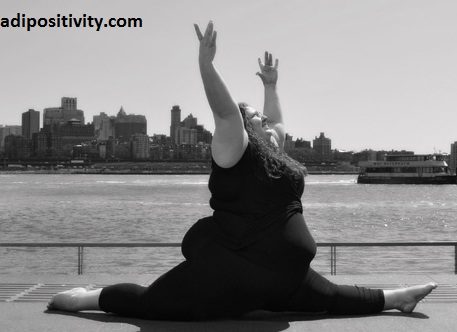
 Surprisingly often, people incorrectly assume (often out loud or in comments) that I “can’t climb a flight of stairs without being winded” because I’m fat. But, in the same breath, say that the only reason that I can leg press 1,000 pounds or do a standing heel stretch is because I’m fat. Huh?
Of course, this doesn’t make any sense – my strength, stamina and flexibility are the result of a combination of my genetics; my access to movement options, information and professional assistance; and my extremely hard work on strength, stamina and flexibility.
These statements are typically made by people being idiots and trying to diminish my accomplishments so that they can hold onto their stereotypes and sense of superiority at all costs. I don’t care so much about it when comes at me but I do worry that other people, who may have not had the opportunities to understand health that I have, will believe the oft-repeated false assertion that the only way to gain strength, stamina and flexibility is to lose weight.
We talk a lot on this blog about how intentional weight loss fails 95% of the time. Today I want to talk about the areas where movement succeeds:
“Groundbreaking work on fitness and weight has been done by [epidemiologist Steven] Blair and colleagues at the Cooper Institute. They have shown that the advantages of being fit are striking and that people can be fit even if they are fat … and thus have lowered risk of disease. A remarkable finding is that heavy people who are fit have lower risk than thin people who are unfit.”
-Dr. Kelly Brownell, Director of the Yale Center for Eating and Weight Disorders, 2003“We’ve studied this from many perspectives in women and in men and we get the same answer: It’s not the obesity—it’s the fitness.”
-Steven Blair, P.E.D., Cooper Institute for Aerobics Research, 2004“Active obese individuals actually have lower morbidity and mortality than normal weight individuals who are sedentary … the health risks of obesity are largely controlled if a person is physically active and physically fit.”
-The President’s Council on Physical Fitness and Sports, 2000“This prospective follow-up study among middle-aged and elderly men and women indicates that obesity (as assessed by increased BMI) is not related to an increased risk of all-cause and CVD mortality, but low-level LTPA [leisure time physical activity] and a low level of perceived physical fitness and functional capability are … In conclusion, in contrast with our initial hypothesis, obesity was not found to be an independent predictor of mortality among middle-aged and elderly men and women. However, low-level LTPA seemed to predict and a low level of perceived physical fitness and functional capability predicted an increased risk of all-cause and CVD mortality among both men and women.”
–International Journal of Obesity Related Metabolic Disorders, 2000See the rest of this list of quotes here. (Warning, the list of quotes is good but this site may be triggering for some).
Why do we not hear about the vast benefits of exercise? Maybe because it’s not proven to lead to weight loss. In fact, while the diet industry spends billions of dollars on marketing and funding “scientific” studies to mislead the public into believing that its solution works, there’s nobody pouring billions of dollars into the message that movement is likely to make you healthier even though it probably won’t make you thinner.
When studies came out saying that exercise did not lead to weight loss, a litany of “news” sources published reports that overlooked the benefits of exercise entirely and told people that they might be better off NOT exercising since it didn’t help lose weight. What with the who now? The most egregious to me was a Time Magazine article which lost any modicum of credibility as far as I’m concerned by writing: “after you work out hard enough to convert, say, 10 lb. of fat to muscle — a major achievement…” A major achievement indeed since it’s physically frickin impossible. I get that this is stated a lot and that many people believe it, but how does someone who wants us to trust him as a reporter make this mistake?
The ways in which this article gets science wrong are so numerous that they would require an entire blog post so I’ll just leave it for now with the thought that the reports all mention that study participants didn’t lose weight, but they fail to discuss what health benefits participants may have received. Based on all the research available, we would expect to see improvements in one or more of the following: blood glucose, blood pressure, triglycerides, insulin use by the body, cholesterol , strength, stamina, flexibility, and self-esteem. But I mean, if it’s not going to make my body smaller then why would I do it? (sarcasm meter is a 10 out of 10 here)
Back to the point of my first paragraph. Plenty of people who develop heroin habits lose weight but they don’t experience increases in their strength, stamina or flexibility as a result. I am ginormous but I have the strength, stamina and flexibility of a professional athlete. I think that if you want to be healthier, it couldn’t hurt and might help to find some form of movement that you enjoy and do a little more of that than you are currently doing. Garden, dance around your living room, take a walk, whatever. If you are going to work with a fitness professional, I highly recommend finding one who works from a Health at Every Size approach and who is not grossly incompetent.
Listen to your body. If you are somebody who thinks of you and your body as two separate things, then consider the radical idea that your body is a friend and supporter rather than a limitation to be overcome through mental toughness. Celebrate EVERY victory – did you switch from 10 to 12.5 pound weights? Were you able to lift your grand kid for the first time? Booty shaking happy dance time!
If you’re struggling with this, or even just with the word exercise which, because of the way it’s used in our society can be really triggering, you might check out this post for more specifics.
- Health and fitness are multi-dimensional and include things that are in our control and things that are out of our control
- Health and fitness are not moral or social obligations
- Your mileage may vary – bodies are different so what works for me, or anyone else, may not work for you
- Everyone deserves to be treated with respect


