Experimenting on Kids, Maybe Not So Good

Think of the childrenThe first thing to know is that all of the interventions being used for “childhood obesity” are experimental at best.  There is no long term data showing that these interventions lead to more “normal weight” kids/adults, or healthier kids/adults (remember that those are two different things.) The research simply doesn’t exist.

There is definitely evidence that trying to get children to be as weight-obsessed as their parents may not have been the best call:

Research from the University of Minnesota found that: None of the behaviors being used by adolescents for weight-control purposes predicted weight loss…Of greater concern were the negative outcomes associated with dieting and the use of unhealthful weight-control behaviors, including significant weight gain.

A Canadian study found that eating disorders were more prevalent than type 2 diabetes in kids.

The American Academy of Pediatrics reported that hospitalizations of children younger than 12 years for eating disorders rose by 119% from 1999 to 2006. (Children UNDER 12) There was a 15% increase in hospitalizations for eating disorders in all ages across the same time period.

A new study is looking at the effects of “school based healthy-living programs.”  Turns out that these programs are being instituted in lots of schools, despite the fact that, per the researchers,  there is little research on the effectiveness of these programs or any inadvertent harmful effects on children’s mental health.

This study found that these programs are actually triggering eating disorders in kids.  Dr. Leora Pinhas said “The programs present this idea that weight loss is good, that only thin is healthy…We live in a culture that stigmatizes fat people, and we’ve turned it into this kind of moralistic health thing.”

Well said Dr. Pinhas, well said.  But I would say that it goes beyond that.  Fat people have been the unwilling, un-consenting victims of experimental medicine for years.  Now we are moving the experiment to kids.

With her assertion that she is going to eradicate all the fat kids in a generation, despite having not a single intervention shown to lead to long-term weight loss in kids (or adults), Michelle Obama has helped to usher in an era wherein anyone who says that they have an idea for eradicating fat kids is taken as seriously as if they had actual research backing their idea.  Kids are being subjected to interventions that were created by rectal pull, no evidence necessary. So when someone said”It makes sense to me that if we have kids focus on their weight, count calories, and think of exercise as punishment for being fat, then they’ll all be thin” authorities, including health professionals, just went ahead and implemented that intervention in schools across the country.

The problem is that someone’s belief – no matter how sincere – does not an evidence-based public health intervention make.   When we consider dart-throwing and rectal pull to be appropriate methods of developing public health initiatives for kids, we open ourselves up to things like what the evidence is uncovering:   the interventions don’t work, they have the exact opposite of the intended effect, and they result in dangerous side effects.

We need to demand that kids not be subjected to a ceaseless barrage of experiments in an attempt to manipulate their body sizes in ways that we don’t have any proof is possible or helpful.  While we’re at it, we might demand the same standard for ourselves.

Like the blog?  Here’s more of my stuff:

Become a member: Keep this blog ad-free, support the activism work I do, and get deals from cool businesses Click here for details

The Book:  Fat:  The Owner’s Manual  The E-Book is Name Your Own Price! Click here for details

Dance Class DVDs:  Buy the Dance Class DVDs – Every Body Dance Now! Click here for details
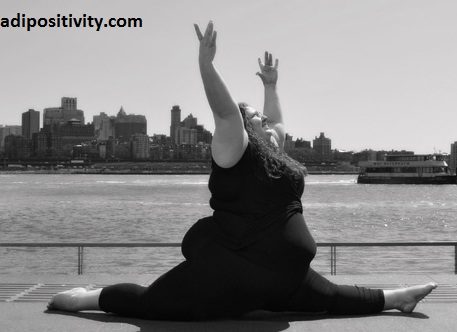
Myths and Stereotypes Are Ruining My Zumba Class!

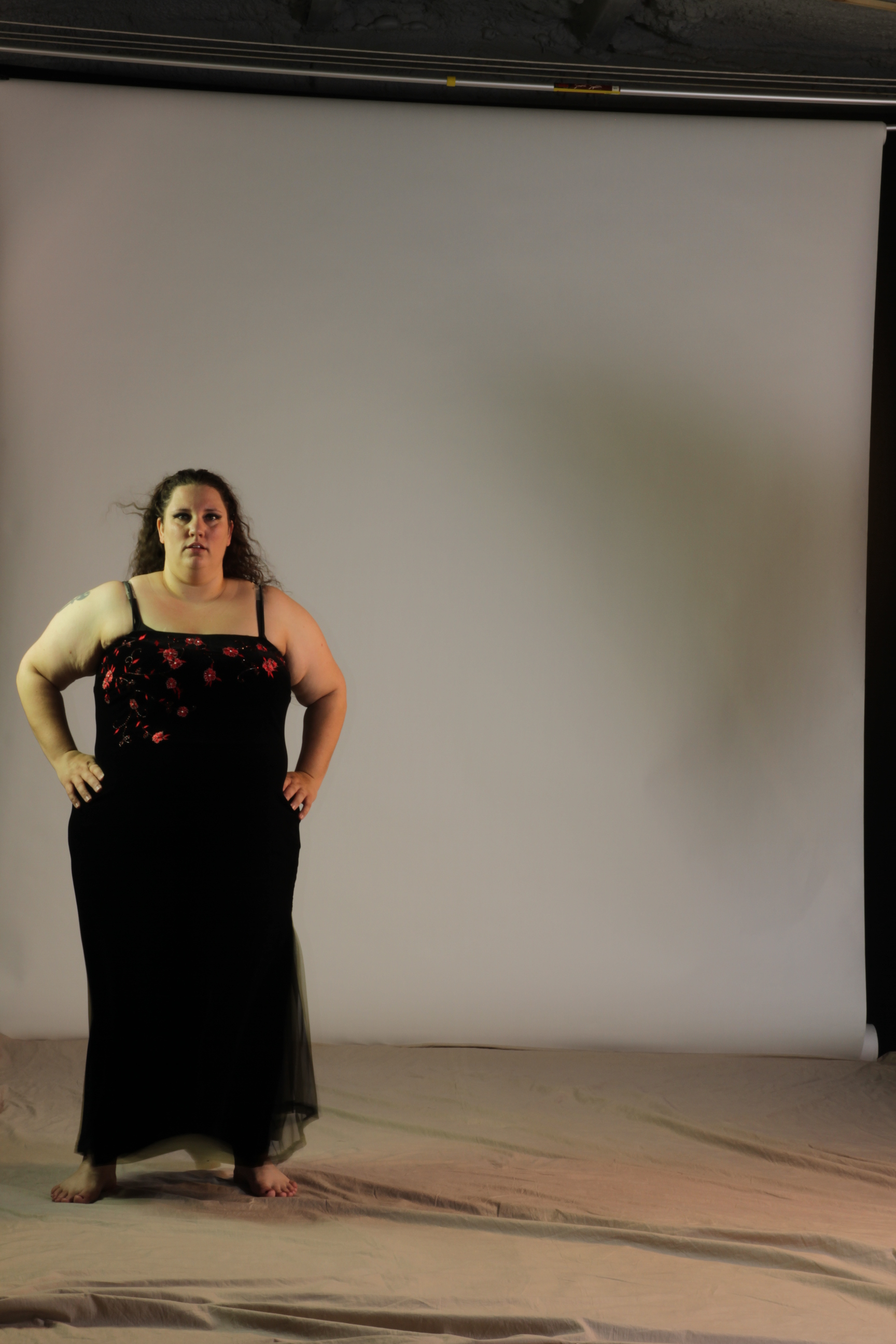
Photoshoot Outake.  Photo by Richard Sabel
Photoshoot Outake. Photo by Richard Sabel

My partner and I are members of our local YMCA.  One of the reasons we chose it is because there are way less fat-shaming messages and weight loss propaganda than at other gyms.  I started taking a Zumba class for a fun way to get in some movement, but it has been hampered by weight loss myths and fat stereotyping and so my j0y is less than full.

Nobody, of any size, has any obligation to do movement of any kind.  But everybody, of every size, should have the opportunity to do things that they want to do in a space that is physically and psychologically safe, with an instructor who is knowledgeable. If only…

The first time I took the class the teacher kept saying that we should move our hips to help “whittle our middle.”  Since we’ve known for many years that spot reducing is not actually possible, I went up to her afterwards and asked what made her say that. She looked at me and said “When you move your hips it heats up your waist area and the fat melts away.”  It happened so quickly that I was not able to control my “WTF Face.” I recovered and said “Sorry, do you mean that literally?  The fat melts away?”  She answered “Yes, the heat from the workout makes the fat melt.”  I explained that spot-reducing has been disproven in a number of ways (including a study where they measured the playing arm and the non-playing arm of tennis players and found that the had the same amount of fat despite one arm doing a ton more work).  She said that she didn’t understand what that had to do with it. As politely as possible I asked her  to consider doing her research, and not give any more workout advice until she does, since she is a fitness professional and people  will believe what she says.

My fun is also compromised by stupid myths from classmates.  Last night it was really warm in the room, there are fans on the wall and about 15 minutes in everyone turned on the fans for their row. As a couple of us moved to turn our fans on, one of the women in our row insisted that we leave them off because it would help us all lose more fat.  Ok, first of all let’s not assume that everyone on the row wants to lose fat.  Second, does she think that the fat is coming out of our pores? A little reality for you:  we’re not losing more fat, we’re just sweating our asses off. Turn on the damn fans.

Behind me were a girl (who mentioned being a college freshmen) and her mom. Halfway through the class I overheard her lamenting to her mom that she couldn’t keep up. Her mom tried to console her by saying “It’s your first time, you’re doing fine.”  I was thinking how awesome her mom was for reacting that way when the girl said “I’m not!  Even that fat girl [points at me] is doing better than me!”

Ok, dude, I am not the low bar (I can, however, simultaneously hear you and see you in the mirror so you might want to watch that.)  Seriously though, look around, I can say with humility and honesty that I’m doing better than just about everyone in the class – which is likely because I have, like, a hundred million hours of dance training and practice. I would suggest not comparing yourself to others at all, but assuming that the fattest person in the room is the worst at whatever you are doing is simply stereotyping and bigotry.

Then the cherry on top of the crap sundae – I was on my way out and a girl from the class said “You’re a great dancer, keep working and, I promise, you’ll get there!”  I responded, with absolute innocence, “Get where?”  She said “You know…reach your goals.”  I asked, with a smile “What goals?”  To her credit she then said “Well, you’re an amazing dancer.”  I smiled and said “Thanks!  See you next time!”

Despite all the crap, I will see her next time.  I’ll say it again – nobody, of any size, has any obligation to do movement of any kind.  But everybody, of every size, should have the opportunity to do so in a space that is physically and psychologically safe, with an instructor who is knowledgeable. Unfortunately not everyone has that, and for fat people it can mean that those who want to move or get involved in various activity don’t.  (If you haven’t ready Tiffany’s blog about Practicing Yoga While Fat  over on the More Cabaret Blog I recommend it.)   One of the ways that I try to do activism around that is to keep showing up fat.  Some days I have the energy and desire to challenge these myths and stereotypes directly and try to make things better. Other days, I just do single-single-double-cha-cha-cha, know that I’m doing something that my body likes, hope that by being the fattest person in the room I might have made life a little easier for someone who was worried about being the fattest person in the room, and knowing that,  just by being fat in that space, I’m giving some people the opportunity to challenge their stereotypes.  And on those days, that’s enough.

Like the blog?  Here’s more of my stuff:

Become a member: Keep this blog ad-free, support the activism work I do, and get deals from cool businesses Click here for details

The Book:  Fat:  The Owner’s Manual  The E-Book is Name Your Own Price! Click here for details

Dance Class DVDs:  Buy the Dance Class DVDs – Every Body Dance Now! Click here for details

Airline’s Pay by the Pound Policy is a Problem

facepalmSeveral readers let me know that Samoa Air has become the first airline to price tickets entirely by weight. According to NBC News “Depending on the flight, each kilogram (2.2 pounds) costs 93 cents to $1.06.”  The weight includes the passenger and their luggage.

I looked up the official policy and it says:

So how does ‘Pay-by-weight’ work?

Well, its simple really:

Step 1. Select ‘Make a Booking’, and choose your flight

Step 2. Enter your details, including your estimated weight(s) of passengers and baggage

Step 3. Your airfare is then calculated using your weight.

Step 4. You travel happy, knowing full well that you are only paying for exactly what you weigh… nothing more.

Still unsure? Read on…

Booking a flight with us is as easy as inputting your approximate weight into our online booking engine (don’t worry, we will weigh you again at the airport) – you then can prepay your ‘guesstimate’, guaranteeing you that much weight is allocated to you for that flight. Take as many or as few bags as you wish – and avoid the exorbitant excess baggage fee’s [sic]! With Samoa Air, you are the master of how much (or little!) you air ticket will cost.

I’m so glad they said that, I was totally worried that they weren’t going to weigh me again at the airport.  Holy crap.  This is such a bad idea that many people online thought it was an April Fool’s joke.  It is not. In fact, it has been touted as “the only fair way to price tickets.”  I disagree with that, and think it’s a bad idea on many other levels.

First of all, the idea that “You are the master of how much” your ticket costs is ridiculous and not just because dieting is shown to fail long-term for almost everyone.  This also penalizes people monetarily for being tall, or for being more genetically likely to put on muscle, for weight training, for being on life-saving medications that cause weight gain, for having health conditions that cause weight gain.  But I’m getting ahead of myself…

First of all, I think it would be great if the airlines would clarify the problem they are solving.  As Deb Burgard once pointed out to me, the airlines try to have it both ways: When they bump us from flights because they’ve sold more seats than they have, they tell us that they didn’t sell us a specific seat, they are only selling transportation from one place to another.  When we take up more than one seat, they tell us that they aren’t selling transportation from one place to another, they are selling us a specific seat. That’s mighty convenient. but it leaves me with some questions.

I’ve seen the CEO of Samoa air quoted as saying that this is about charging heavier people more because they require more fuel.  Let’s examine that situation.  Forbes writer Emily Stewart’s research found that it takes about a gallon of jet fuel to fly 100 pounds on a domestic flight.  The industry average is $3.05 per gallon.  So I cost $6.10 more to fly than a 100 pound person, but my ticket costs up to $96 more.  That’s quite the mark-up.

Also, the most common complaint I hear is that fat people should pay more because we take up more space. Instead of blaming the airlines for shoving more seats on smaller planes,  anonymous people take to the internet to wring their collective virtual hands at the thought of having to touch a fat person – omg the horror, THE HORROR! For now I’ll ignore the fact that I’ve only ever seen it suggested that fat people pay more –  not people whose wide shoulders or long legs cause them to encroach on other passengers.  I looked all over Samoa Air’s website and I could not find anywhere that this is addressed.  There is nothing explaining what I would get for paying 3 times as much as a 100 pound passenger.  Do I get three seats?  Am I paying 15 times more than a 20 pound child but getting the same amount of space that they do? If I pay three times as much as the person next to me (my six bucks in extra fuel plus an 89.90 markup) and I’m still crammed into a tiny seat and they are still bitching about sitting next to a fat person, I’m not going to be a happy camper.

Even if I get three seats, there are other problems with this.  First of all, Samoa Air is a tiny airline so maybe they have time to weigh everyone at the airport and adjust their fees, but can you imagine the kind of time this is going to add to major airlines?  I travel all the time and I routinely get stuck behind people who haven’t sussed out that keys are made of metal, and so have to go through the x-ray twice, how early am I going to have to get to the airport to deal with this bullshit?

Also, I often book trips months in advance and, while I’m an organized person, I don’t typically pack my bags months in advance and so don’t have a precise weight for them.  So let’s say that I want to be a good guy so I overestimate.  According to their website “In the event that a pre-estimated weight defined by the customer is greater then what travels on the day, it is at the sole descretion [sic] of Samoa Air as to whether a refund for the weight difference may be offered.”

Ok, so if I don’t want to take the chance at losing money because I am not a luggage psychic, I underestimate. Then maybe I don’t get on the plane – again according to their website “Pre-purchased weight is given priority over weight that is purchased at a later date (for example: Online, prior to day of travel vs. at the airport on the day of travel).”

Ok, so if I overestimate I might lose my money.  If I underestimate then I might not be able to get on the flight. I’m sure this system wasn’t created to get people to overestimate and give the airline more money.

What happens when someone has underestimated by more than the money they have available to pay?  Does the airline lose the entire fare? Do they keep the money but not allow the flyer onboard? What happens when someone overpaid and wants their money back?

Yeah, this definitely won’t cause a massive clusterfuck at check in.

What about people who need medical equipment?  Power wheelchairs can weight more than 400 pounds, do people who use those chairs have to pony up an extra two hundred bucks every time they fly?  Then there are people who are on medication that causes weight gain, and who have health conditions that cause weight gain? They are being asked to pay extra for what is clearly a medical condition.

What about people with eating disorders who are told not to weigh themselves because of how triggering it can be?

Many women retain water each month. Forget that ovulation calendar, we’ll have to track water retention so that we know how much to estimate for our airline ticket.

Doesn’t this set up a scenario where people may do unhealthy things to “make weight” for their airline ticket?

Also, of course I would never suspect them of anything shady but who is verifying that the scales are correct?  According to the Bureau of Transportation Statistics from 2012, about 1.75 million passengers fly every day.  If the airlines add just 2 pounds per person at $0.50 per pound that’s more than a half billion dollars in extra profits every year.

Meanwhile, Chris Langston, Chief Executive Office of Samoa is trying to get credit for “raising awareness of weight” because we know that the job of the airlines is to make our health their business, and absolutely nobody is talking about weight.  No wait, that’s wrong – people cannot shut up about weight and the job of the airline is to fly my ass safely from one place to another. Sorry, no extra credit for you Chris.

Even if this isn’t thinly veiled fat bigotry it’s still a horrible idea for all of these reasons and more. (For more on this topic, I recommend this blog by Jay Solomon.)

Like the blog?  Here’s more of my stuff:

Become a member: Keep this blog ad-free, support the activism work I do, and get deals from cool businesses Click here for details

The Book:  Fat:  The Owner’s Manual  The E-Book is Name Your Own Price! Click here for details

Dance Class DVDs:  Buy the Dance Class DVDs – Every Body Dance Now! Click here for details

My Hardcore Habit

Wrong RoadThere is a deodorant commercial airing right now where Lolo Jones, an Olympic track athlete, talks about how hard it is to be an Olympic track athlete and then says that she is now going to compete in Bobsled in the winter Olympics.  In another similar commercial Olympic Soccer player Alex Morgan explains that when she’s not playing soccer she does stand up paddle-boarding and that “if you’re not sweating, you’re not working hard enough.”  At the end both women say “I do more.”  and big block letters on the screen say “Do: More.”

The first time I saw the commercial I thought “That’s awesome!” and I thought back with pride to a couple weeks ago when  I had a video shoot to do to celebrate the success of Fit Fatties Across America.  I was sick and felt absolutely horrible but I took great pride in going to the shoot and acting like everything was mostly fine and that I “sounded better than I felt,” (holy crap was that a lie!).  I came home and got much sicker.

These two things have helped me realize that one of my old issues was trying to come back.  A big part of my eating disorder was compulsive exercise but I didn’t call it that – I called it “being hardcore.” [Trigger Warning for Three step classes in a row? No problem – now let’s do 45 minutes each on the elliptical, treadmill, rowing machine and stair machine before I hit the weights. It included never feeling like I had done enough and proudly ignoring all of my bodies signals like hunger, soreness, pain, and sickness.  It also included being praised for behavior that was very destructive.  People constantly said that they wished they had my discipline.  Or, the worst thing now that I look back, that I was their inspiration.  Yikes – sorry about that.

Happily I was able to recognize the mindset and stop it before I traveled any farther down a bad road.  I was able to admit that ignoring my body is not how I want to treat it.  I take another look at that deodorant commercial and realize that, to me, the message is not awesome.  These women are allowed to do whatever they want – if they want to do ten Olympic sports that’s completely their business.  But why must we constantly be told that whatever we’re doing is not enough?  As fat people, this message can be overwhelming since we’re told that a fat body is evidence that we aren’t doing “enough.” I can’t even count how many times I’ve been told that I need to “eat less and exercise more” by someone who hasn’t even bothered to ask what I eat or how much I exercise.

But of course it’s not just fat people, no matter what our size, the message is clear: we’re never doing enough.  Doing 2 hours in the gym a day?  Not enough.  Olympic athlete, but only in one Olympic sport?  Not enough.

Enough.  We all get to choose how highly we prioritize movement, what kind of movement we do and how much.  If you had asked me during my compulsive exercise days, I would have guessed that you needed at least 2 hours of movement a day to have any health benefit.  I remember how shocked I as when I found out that studies show that 30 minutes a day was the sweet spot, and that people benefited from even an hour a week of movement (there’s a great, though not 100% fat friendly video about that here [Trigger warning: I think that the video contains great information if you can get past the brief mention of “obesity as a problem” in the beginning].  What if our public health messaging was about “do what you want to and can, and celebrate that” instead of “work out like it’s a job” or “you will never be doing enough”.

Everywhere I look I am encouraged to be “hardcore”…work out more, workout harder, treat my body like a limitation to overcome instead of like a partner, ignore my bodies signals.  I gave that the old college try and it did not work out, so I will continue to try to treat my body like a friend, move in ways that are joyful and help me reach my goals, and celebrate what I do – instead of beating myself up for what I don’t.  The hardcore habit was hard to kick but, for me, it was worth the effort.

Like the blog?  Here’s more of my stuff:

Become a member: Keep this blog ad-free, support the activism work I do, and get deals from cool businesses Click here for details

The Book:  Fat:  The Owner’s Manual  The E-Book is Name Your Own Price! Click here for details

Dance Class DVDs:  Buy the Dance Class DVDs – Every Body Dance Now! Click here for details

What to Say at the Doctor’s Office

Healthcare reformIf you are here for the Doctor’s Office Survival Kit, just scroll down!  If you are looking for more support, I have a video workshop called “Dealing With Fatphobia At The Doctor’s Office (with a pay-what-you-can option) and you can find that here!

Last week on Grey’s Anatomy (no spoiler) former Scrubs star Sarah Chalke guest-stars in a plotline about a mother who has to strongly advocate with her doctors because she believes that her son is sick and they don’t.  This was more than an acting job, it was taken from Chalke’s real life – and lots of other people’s as well.

These days doctors have very limited time with patients and when you’re fat many doctors simply diagnose you as fat and prescribe weight loss, no matter what you came in for.  I’ve been prescribed weight loss for a broken toe, separated shoulder, and strep throat.  People close to me have had sudden onset back pain, and an acute knee injury blamed on weight.  Getting access to appropriate, evidence-based, affordable healthcare can seem almost impossible.

I started getting much better care when I decided that my healthcare was going to be a dialog between my healthcare providers and me, rather than thinking that I had no right to ask questions, challenge advice, or request that I be treated based on my values. To be clear, we shouldn’t have to do this, and not everyone is in a position to do it.  I want to give us options to self-rescue from fatphobia among health care professionals, while being clear that we shouldn’t have to do this and that the ability to do so is an expression of privilege, and that other biases – like racism, homophobia, transphobia, misogyny, ageism and more will make this process even more difficult for fat people with multiple marginalized identities.

Over the years I’ve developed some strategies that help me deal with health care professionals who are harboring weight bias.  By far the one I use most often when I’m told that something is caused by my weight is “Do thin people get [this issue].” The answer is always yes so I follow up with “What do you prescribe to them? Let’s try that.”  I also talk about research, including asking the doctor how, when there isn’t a single study where more than a tiny fraction of people lost weight, and no study that shows they were healthier for it, does she think weight loss qualifies as evidence-based medicine?

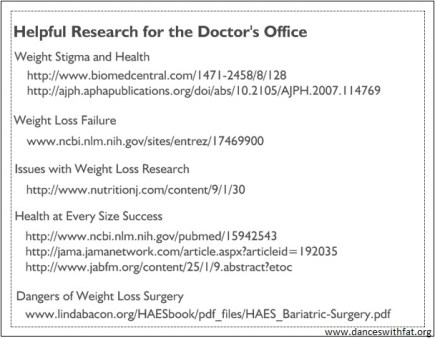
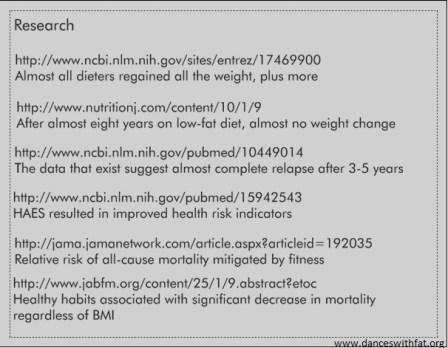
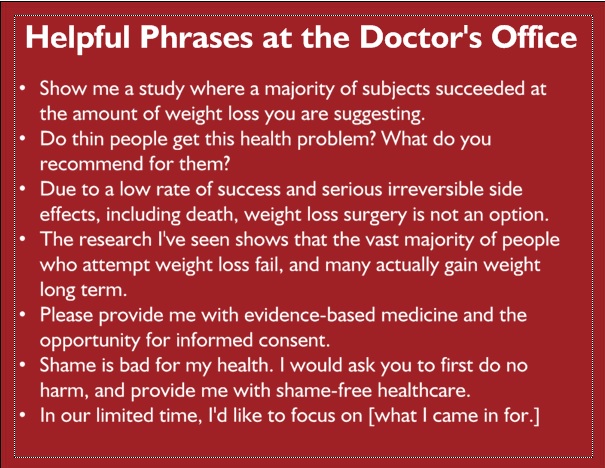
I’ve had readers request that I make cards that they can take with them.  I decided that today is the day. They are below and you can print them out to take with you.

Some notes about the cards:

Of course feel free to re-word these into phrasing the feels comfortable for you.

Use your own discretion – you’ll need to decide if you think that the situation will best be handled by you giving the card to your provider, or discussing it with them, or both.  I highly recommend calling ahead and letting a new provider know that you practice Health at Every Size and asking them if that’s something that they can respect and work with, in order to smooth the way.

The tone and timing are also things to consider.  I try to have this conversation with new practitioners before they prescribe weight loss so that I’m not starting off with conflict but with discussion. With existing providers I might say something like “I feel like I’ve been having trouble getting my healthcare values across to you, I brought in this card to help us have a dialog.” or something that means that, but that you would actually say.

I recommend practicing before trying this with the doctor/healthcare provider – you can practice in the mirror, in your car, with a friend etc.  Practice can help you stay calm and get the healthcare that you deserve.

The doctor card says “I practice Health at Every Size…” because this is what I have found to be the most effective phrasing when working with healthcare practitioners.  It is imperfect in that some people do not consider themselves Health at Every Size practitioners.  I’m absolutely open to suggestions on this.

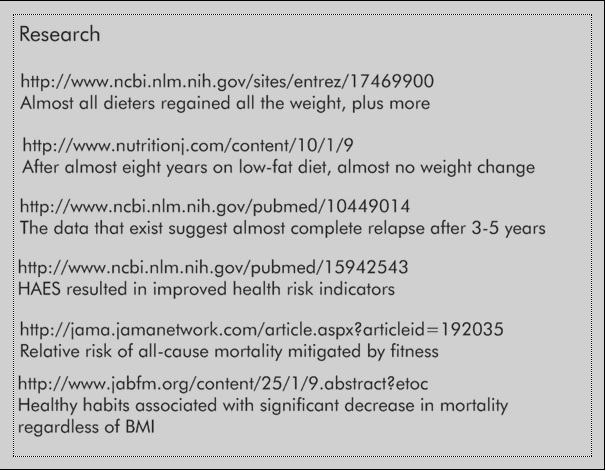
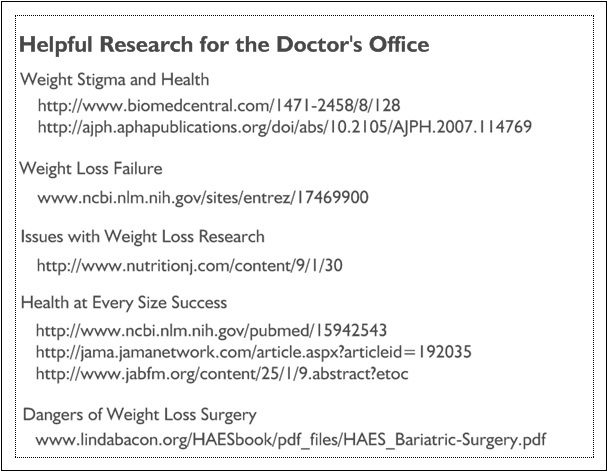
I encourage you to actually read the research that is referenced. All research has limits, this is a start for conversations.

Consider other resources you can pass along to your healthcare provider, this paper is incredible both in content and references, Linda Bacon also has a great list of other resources specifically for healthcare providers.

If you have other phrases, research, resources etc. that you’ve found helpful working with the doctor, please feel free to leave them in the comments!

Here are the cards (they are also available in Spanish, French and German here!)

Postcard - Personal Front
Personal Front
Postcard - Personal Back
Personal Back
Postcard - Doctor Front
Doctor Front
Postcard - Doctor Back
Doctor Back

Copies without my website info:
Doctor Postcard – Front

Doctor Postcard - Back
Doctor Postcard – Back
Postcard - Personal Front
Personal Postcard – Front
Postcard - Personal Back
Personal Postcard – Back

If you appreciate the work that I do, you can support my ability to do more of it with a one-time tip or by becoming a member. (Members get special deals on fat-positive stuff, a monthly e-mail keeping them up to date on the work their membership supports, and the ability to ask me questions that I answer in a members-only monthly Q&A Video!)

Like this blog?  Here’s more cool stuff:

Wellness for All Bodies ProgramA simple, step-by-step, super efficient guide to setting and reaching your health goals from a weight-neutral perspective.  This program can be used by individuals, or by groups, including as a workplace wellness program!

Price: $25.00 ($10 for DancesWithFat members – register on the member page)

Body Love Obstacle Course

This e-course that includes coaching videos, a study guide, and an ebook with the tools you need to create a rock-solid relationship with your body. Our relationships with our bodies don’t happen in a vacuum, so just learning to see our beauty isn’t going to cut it. The world throws obstacles in our way – obstacles that aren’t our fault, but become our problem. Over the course of this program, Ragen Chastain, Jeanette DePatie, and six incredible guest coaches will teach you practical, realistic, proven strategies to go above, around, and through the obstacles that the world puts in front of you when it comes to living an amazing life in the body you have now.
Price: $99.00
($79.00 for DancesWithFat members – register on the member page)

Love It! 234 Inspirations And Activities to Help You Love Your Body
This is filled with thoughtful advice from the authors Jeanette DePatie, Ragen Chastain, and Pia Sciavo-Campo as well as dozens of other notable names from the body love movement, the book is lovingly illustrated with diverse drawings from size-positive artist Toni Tails.
Price: $9.99 softcover, $7.99 Kindle, ($6.95 + free shipping for DancesWithFat Members)

Non-Members click here for all the details and to register!

Book and Dance Class Sale!  I’m on a journey to complete an IRON-distance triathlon, and I’m having a sale on all my books, DVDs, and digital downloads to help pay for it. You get books and dance classes, I get spandex clothes and bike parts. Everybody wins! If you want, you can check it out here!  (DancesWithFat Members get an even better deal, make sure to make your purchases from the Members Page!)

Book Me!  I’d love to speak to your organization. You can get more information here or just e-mail me at ragen at danceswithfat dot org!

I’m (still!) training for an Iron-distance triathlon! You can follow my journey at www.IronFat.com .

If you are uncomfortable with my offering things for sale on this site, you are invited to check out this post.