Health is not simple, and I don’t intend to make it sound like it is. However, I have had a number of requests from readers to state the case for a Health at Every Size path to health as simply as possible.
First, all the usual disclaimers apply – people get to prioritize their health however they want and they get to choose the path to get there and every choice is valid – even if it’s nothing like what you would choose. If public health is important to you then I suggest you work for access (to the foods people would choose, movement options they enjoy, and affordable evidence-based healthcare), make choices for yourself, and respect other people’s choices like you want yours respected. Ok, let’s do this:
There is not a shred of evidence that shows that weight loss works long-term for more than a tiny fraction of people, around 5% (and that tiny fraction includes people who only lost a few pounds). The evidence that fat people can become and remain thin is non-existent.
This is not just because “people go back to their old habits”, it’s because weight loss triggers the body to undergo a number of physiological and psychological changes for the express purpose of regaining weight.
Based on the evidence that exists, being surprised when people go on a diet, lose weight and then gain it back, is like being surprised when pregnant women are given thalidomide and then their babies have birth defects. In both cases the outcome is exactly what the evidence told us would happen.
Knowing what we know now, saying that anyone who tries hard enough can lose weight is roughly the same as saying that any pregnant women who tries hard enough can take thalidomide but avoid the birth defects. There is nothing in the evidence to back it up.
Even if making me thinner would make me healthier we have literally no idea how to get it done. Period.
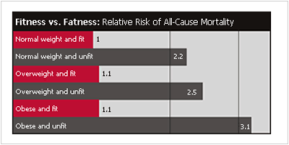
There is evidence that shows that healthy habits give us the best chance for a healthy body (like the study summarized in the graph at the top.) There is good evidence that fitness (about 30 minutes a day 5 days a week) mitigates almost all of the negative health outcomes that are associated with being overweight.
A Health at Every Size path allows me to focus on healthy habits using the advice of healthcare professionals who I choose along with my own research, and based on my own prioritization of health and my goals. Based on the existing research, that gives me the best chance of health that exists.
If am wrong about this (and I could be – if you can’t admit that you might be wrong then you are no kind of scientist or critical thinker) then based on my experience with a dieting lifestyle I choose a shorter life lived from a Health at Every Size perspective.
Epilogue:
I do not think that Health at Every Size and Size Acceptance are the same thing. HAES is a health practice and a the beginning of a paradigm shift. Size Acceptance is a civil rights issue and civil rights are not optional, and should never be put up to a vote. If someone is stepping on my foot in an elevator I do not have to obtain polling data from the rest of the people in the elevator to justify my asking them to get off my foot. Civil rights are not a request because they are not someone else’s to give – civil rights are to be demanded, fought for, and protected.
For more information I recommend Linda Bacon’s book Health at Every Size – The Surprising Truth about Your Health, as well as her community resources page where you can sign the HAES Pledge! (And no, I do not get compensated for this endorsement – I just think that Dr. Bacon, her book, and her community resource page are awesome!)
This blog is supported by its readers rather than corporate ads. If you feel that you get value out of the blog, can afford it, and want to support my work and activism, please consider a paid subscription or a one-time contribution. The regular e-mail subscription (available at the top right-hand side of this page) is still completely free. Thanks for reading! ~Ragen

 Dances With Fat
>civil rights are not optional<
Exactly!
Once again, you hit that nail right on its ugly head.
Hi Ragen,
You wrote:
If public health is important to you then I suggest you work for access (to the foods people would choose, movement options they enjoy, and affordable evidence-based healthcare), make choices for yourself, and respect other people’s choices like you want yours respected…
What would your advice be if someone chooses poor– or lack of– evidence-based healthcare. Specifically, practices such as homeopathy, detoxing, applied kinesiology allergy testing, etc. If someone wants to access this kind of healthcare, what would your advice be?
Hi Mary,
I would say that if, in your opinion, an intervention is poor or lacks an evidence-basis then you should make your choice based on your beliefs, and that it would be appropriate to share your opinion with those who’ve asked you what your opinion is. Other that than other people may have a different opinion and make a different choice and that’s between them and the people who they choose as their healthcare advisors. I believe in giving people access to as much information as possible and allowing them to make their own decisions. It’s very much the same as dietary choices, I believe in someone’s right to choose a low-carb diet for themselves, I do not believe that they should be allowed to force it on anyone else. I think that the only way to protect our own right to make health choices is to respect the choices of others, because there is always someone who feels about your choices the same way that you feel about the choices of those with whom you disagree.
~Ragen
Very well said.
Ragen, I think we have to be a more outspoken about helping to provide access to non-evidence based healthcare. As two examples, homeopathy & prayer a la Christian Scientists, as medical interventions, probably have an even lower rates of success than weight loss since their only successes have to be 1) placebic (is that a word?) or 2) keeping someone from harming themselves with another treatment because they’re only water or words.
I’m not saying people should not do what they want, but the response to people who want these paid with public funds (taxes) or even private contributions should be that resources need to go to what we are pretty sure works, not what people *want* to have work.
If I’m telling the truth about the failure of weight loss efforts, I think I have to ask others to look at the lack of evidence for the viability of “alternative” medicine on a large scale, not individual cases of “it helped me this one time.”
Thanks for the comment. First of all, in order to have this discussion we have to have more than “probably have a lower success rate”. Mostly though, I think that Western Medicine, especially when practiced for profit, has some massive issues. Let’s remember that numbers like what is considered a healthy blood pressure have been lowered because of lobbying by pharmaceutical companies that make drugs to treat these conditions. Arizona has just passed a law that a doctor can withhold information from a pregnant woman if the doctors thinks that information might lead to her choosing an abortion, and the parent(s) have no legal recourse. In some states doctors are forced to give women brochures with known misinformation because religious conservatives in legislatures have made that into law. Pharmaceutical companies and FDA leadership are a revolving door. Laws about medicine are made based on religious and not scientific grounds. There is a focus on chronic treatment rather than prevention or cure, which may likely be due to a profit motive, and often downside risk is not taken properly into account (for example diet pills with severe side effects have been approved even though in trials they provided only modest weight loss that came back when the pill stopped working.) So to believe that Western Medicine as it is currently practiced is all about evidence basis is to ignore critical truths about the situation.
Because of the profit motive, there is a tremendous incentive to keep other interventions (some of which have been practiced as primary medicines in other countries for hundreds of years) from being properly studied. Many of the studies on these medical practices are funded by companies that are competing with them for profits. There are individual observational studies, randomized placebo-controlled trials, and laboratory research that report positive effects and unique physical and chemical properties of homeopathic remedies for instance. That isn’t enough for an evidence basis but does warrant additional study. The same is true of acupuncture: there is reasonably good evidence that acupuncture is an effective treatment for chronic back pain, dental pain, pain and discomfort during gastrointestinal endoscopy, headache, nausea and vomiting after an operation, pain and discomfort during oocyte retrieval (a procedure used during IVF)m osteoarthritis of the knee. Again, the studies are not conclusive but certainly warrant additional study.
Prayer is a poor example as it is, by it’s very nature, not evidence-based. It is a matter of freedom of religion rather than healthcare.
The “my tax dollars” argument becomes a very slippery slope (some might claim that, based on the China Study we shouldn’t pay for healthcare for anyone who is not vegan for example) and I think that before we start trying to decide what medical interventions other people can choose we need to do a lot better job of doing good non-biased research, and getting lawmakers out of the doctor’s office. Until then, I think that people should be able to work with the healthcare provider of their choice.
~Ragen
Please don’t think I am hating! I love the work you do! But I have started eating whole foods and exercising ( more than 30 minutes 5 x a week, but I have found that I love it!) and I am losing weight like crazy. And kept it off for a year. Now in many circles I am still fat (210 lbs at 5’11”) I have lost nearly 50 lbs and kept it off for a year. I would say that for many folks eating whole foods and exercise will cause done weight loss. Granted, the pounds don’t come off as quickly now as they were but now I just eat well and exercise from habit. (Also I love exercise!) I understand that I will likely be a larger woman always (fine by be) but I am confused about the 5% you quote. Seems to me that continuing a clean mostly healthy diet and plenty of movement will produce some weight loss and keep it off. Right? Thanks again for your work. It has helped me so much.
Hi Jo,
I’m glad that you are finding a path to health that you love and I’m really happy that you like my work. The idea that eating a mostly healthy diet and plenty of movmetn will produce some weight loss and keep it off is actually not true based on the evidence. Most people are able to lose weight initially (almost regardless of the method that they choose) but almost everyone gains it back within 5 years whether they continue their habits or not. Those who maintain weight loss for more than 5 years are a statistical anomaly. Stay tuned, I’m going to do a post about the 95% failure thing in the next few days.
~Ragen
Great post, Ragen. You said “If public health is important to you then I suggest you work for access” – I agree, and to your list of things to advocate for, I would add housing, job security, and freedom from stigma for all. There is powerful evidence that poverty and stigma are at least as important – and probably more so – as what we think of as “health behaviors” in determining health outcomes.
Thank you for the video link in the email of this post. I think it might be the thing that actually inspires me to get moving.
Glad that you liked it! I think it’s really well done and accessible to everyone.
~Ragen
HAES gives me hope that one day I can respect my body as it is now, regardless of whether weight loss is an outcome. I choose me.
Beautifully put, Ragen. You are one heck of a writer.
Thank you so much!
~Ragen