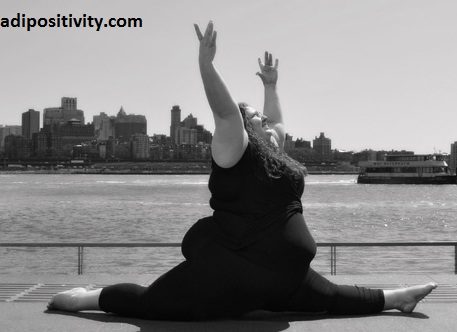
 A friend of mine alerted me to this article (trigger warning – weight loss talk, conflating weight and health etc.) The article tells two stories. The first is of a women who is using a blog to keep her “accountable’ while she loses weight. The article talks a lot about the bullying she’s undergone and how that motivates her to want to lose weight. Of course this woman is allowed to choose dieting, but as a society we need to understand that the cure for bullying is not weight loss, the cure for bullying is to stop bullying. Basically this is the typical weight loss story and obviously she’s just starting and we have no way of knowing if she is one of the 5% of dieters who actually maintain their weight loss.
The second story is about Priscilla Allen who lost weight when she stopped secretly binge eating and started exercising. It’s been 10 years and she has maintained the weight loss. Sometimes that happens, I’m glad that she is in a better place with her health, but this thing takes a pretty odd turn.
First of all the article says that she is now at “an extremely healthy weight” and I’d like to thank the article’s author for illustrating the ridiculousness of the concept of a “Healthy Weight” which in reality does not exist. I guarantee that there are people at the same weight as this woman who are extremely unhealthy. If we weren’t so quick to conflate weight and health we’d stop making this dumb mistake.
Next it talks about how she is helping people lose weight, I did some digging and it looks like she is a certified personal trainer, although it doesn’t say who qualified her (there are vast differences in various programs.)
The article says that “Allen believes weight loss for many people is 80 percent emotional.”
This entire sentence sounds like the product of a rectal pull. How many people is “many”? How did she arrive at 80%? Why does she have a precise percentage for the emotional component to weight loss but no idea how many people to whom that precise component applies? Where is her research with a statistically significant sample size and properly controlled variables that proves the validity of her method?
I see this a lot – somebody loses weight and now they are a weightloss guru.
It interests me because I am a metabolically healthy obese person – statistically about 33% of obese people are metabolically healthy and we are considered “anomalies”. Only 5% of people are able to maintain weight loss long term, but they are considered experts who can teach other people to lose weight. What the hell? Makes me think I need a bumper sticker “Stop losing weight now, ask me how!”
In order to believe that success at weight loss makes one qualified to help others lose weight, one would have to make the mistake of believing that all fat people are fat for the same reason, that this person’s ability to lose weight means that everyone is able to lose weight, and ignore the fact that we don’t even have one study showing a weight loss intervention that works for a majority of people. Her method seems to be just another take on the “eat less exercise more” that has been such a spectacular failure in research. Like so many interventions her advice would be good if it didn’t include the “…and then you lose weight” component, but because of the inclusion of the weight loss component it doesn’t meet the criteria for being an evidence based intervention.
However well intentioned they are, people who lose weight and then become “weight loss coaches” based on the idea that their experience can be everyone’s experience are gambling with other people’s health. And often they don’t even have a clue about the odds. Their followers will lose weight at first but most of them will gain it back subjecting themselves to the health risks associated with weight cycling. Typically the guru will claim that their method works but that their clients failed, even though a thorough review of the evidence tells us that weight regain in 95% of people is exactly what we should expect, and that a focus on health is much more likely to produce a healthier body than a focus on weight.
This problem wouldn’t happen so often if we, as a society, hadn’t grossly overblown the health risks associated with obesity thus creating the mistaken belief that that the danger of being fat somehow outweighs the danger gambling with fat people’s health using completely unproven interventions (like creating billboards that shame kids under the guise of helping them be healthy – just as a random example…). I vehemently disagree with this practice, hence my Behavior Centered Health lifestyle. If I were to be looking for a weight loss solution (you know, in opposite world) I would certainly want to see some real scientific proof before I would allow someone to play roulette with my health.
This blog is supported by its readers rather than corporate ads. If you feel that you get value out of the blog, can afford it, and want to support my work and activism, please consider a paid subscription or a one-time contribution. The regular e-mail subscription (available at the top right hand side of this page) is still completely free. Thanks for reading! ~Ragen

 Dances With Fat
Brilliant post! I love the “Stop losing weight now, ask me how!” slogan.
It doesn’t surprise me when I hear that one of the exceptions (that prove the rule?) has made a fulltime career out of fitness or nutrition or both. I imagine it’s more likely someone will maintain weight loss if they make it their fulltime job.
Absolutely. A lot of people have to make weight maintenance at least a part-time job, so the only way to make it sustainable long-term is to find a way to get paid for it.
(This helps me keep from being jealous of the bodies of fitness trainers and yoga teachers, whether it’s in a weight-shaming way or just a “wish I was that strong/flexible/graceful” way. Reminding myself that I’d probably be a lot stronger/more flexible/more graceful too if working out were my job helps. For that matter, I’d probably be thinner, though I doubt I’d actually be thin.)
Yeah, I’ve noticed that numerous biggest loser contestant go to new careers as weight loss coaches or motivational speakers. I wonder how many of them do it to help maintain their own weight loss.
There’s something that I keep trying to understand within the concept of HAES, and I can’t figure it out… Hope you can help me.
Right, so every body has a more or less “set point” weight that it is comfortable with maintaining, and diets, weight cycling etc mess this up, and potentially slow down your metabolism and artificially inflate this set point. That’s the main reason diets don’t work long term… Am I right so far? I would certainly seem to support that from my past experience. (Numerous diets, sensible ones, never fad diets, over the past 15 years, where I ended up weighing more at the end than I did at the start, resulting in my weight pretty much doubling from my original “comfortable area.”) I have now renounced all diets and I’m really trying to just eat what my body asks for, and trying to just increase my fitness levels (I am healthy, but very unfit so I know this could affect my health in the future.)
What my question is, is if my body had a natural “set weight” range that it was happy with, and if I have messed that up with diets, is there any way, within the philosophy of HAES, to…reset this, to some degree at least? Seeing as it was what was natural for my body in the first place? Any experience appreciated…
Unfortunately, years if dieting can bork a person’s metabolism, but its rarely beyond repair. Just eat a balanced diet – lots of fruit, veggies, wholegrains and lean protein, with some indulgences on occasion – and get at least half an hour of semi-intense physical activity five days a week. Your body will settle where it needs to be in time.
Oh, and toss out the scales and tape measure if you have ’em.
It sounds to me, from your comment, Anna, that you want your non-weight-focused, health-focused behaviors to also result in you weighing a lower weight than you currently weigh. You’re still hoping for weight loss. A Health At Every Size approach involves not having a weight goal. Your weight may or may not change over the course of your life. From Linda Bacon’s description of our current scientific understanding, in her “Health At Every Size” book, it’s the nature of our bodies to gain weight easily and defend intensely against weight loss (which generally means something dangerous and/or deadly, in body/survival logic). I wouldn’t encourage a goal of “resetting” one’s setpoint as that sounds, to me, like it has all the same problems and unlikelihood of a weight-loss goal. I also would hope you not invest a lot of effort trying to figure out why you gained weight, why you weigh what you weigh now, blaming whatever reasons you come up with…because those theories are all also based in thinking about weight in a thinner-better/fatter-worse manner. If you’re willing, forgive yourself for whatever you now wish you hadn’t done (dieting, etc.). Locate the blame (if blame is necessary) on society and on the weight prejudice that promote weight-loss goals. And have a fabulous time, now, as much as possible, whatever you happen to weigh.
Thanks to both of you for your answers. To Marilyn: Yes, I suppose you’re right in a way… I am fairly new at this. The difference to how I felt before (and I hope I can maintain this mindset, like I said I’m new at this,) is that at this point, I really don’t care how much I weigh and I wouldn’t fret if I stayed at the weight I am now -which is quite a massive difference to how I felt before! Right now I feel like I’m happy with myself the way I am. But yes, in an IDEAL world, if I would somehow “rewind” a bit, it would make my life easier in certain ways. But I wouldn’t make it my goal any more -does that make any sense? I suppose the way to explain it is that in contrast to what I did in the past, I am not going to adopt my food and exercise behaviours in the hope that I lose weight and think they’re pointless if I don’t.
Sorry I wanted to add I really hope I didn’t come across as someone who thinks thinner/better-fatter/worse, because at this point of my life, I really don’t think that, and this new way of thinking has actually made me feel quite giddy 😀 I suppose I am partly trying to understand how things work and partly still working on changing some quite deeply rooted instincts *shrug*
Marilyn’s advice is excellent as always, but I’d also like to add that you don’t need to feel bad for the wishing.
I feel exactly the same way you do, and I’m viewing it as a stepping stone. For me, holding on to the possibility of landing closer to my pre-ED weight (while accepting that it’s unlikely) has made it easier to commit to not pursue weight loss.
Some people make big leaps, but for me, body acceptance has been a series of baby steps. So I think this stage has been helpful because I didn’t have to let go of the wish and the behaviors at the same time.
And as I live with that commitment, and try to enjoy my life at my current weight, the wish *is* fading.
Big hugs!
I am of the belief that there is nothing intrinsically wrong with wanting to weigh less. The issue is what you do to get there, and how you respond if it never happens or if it doesn’t happen the way you imagine.
[Possible triggers]
To use myself as an example, I have a medical condition that caused a lot of my weight gain over the past seven years. I have always wanted to lose that weight. When I finally started getting the proper treatment, I lost weight without trying. By that I mean that I didn’t change my eating or exercise habits, I just started taking the hormones my body needed.
I have no intention of starving myself to continue the weight loss, neither would I ever consider over-medicating (which could be very dangerous) to continue losing.
I also do not wish to reach an unrealistic size. I am not a single-digit person and never will be.
But I’m not going to lie and say that I’m not happy with the loss or that I’m not hoping the loss continues and that my set point is closer to what it was 7 years ago.
But I’m also prepared to gain it all back or stop losing. Who knows, my body is still adjusting to the treatment and anything could happen.
I don’t think my attitude toward my weight is unhealthy because It’s not a make or break kind of thing. It’s like the lottery, I’m not going to spend $1,000s on tickets, obsessively watch the numbers, or tell myself I can’t do the things I want to until I win… but if a bag of money fell into my lap, I definitely wouldn’t turn it down.
A whole post.
The phenomenon you’re describing exists across the entire health spectrum. People who have dealt with any physical problem become evangelical about the cure and start setting up shop.
What’s much worse is when people who are qualified medical professionals buy into the woo woo. I watched a British TV documentary a couple of months ago about ‘the world’s fattest man’ – someone trapped by his fat and unable to move, so about to undergo gastric surgery. They interviewed his surgeon about it, and the surgeon contemptuously said “some people just can’t deal with the feeling of hunger”. That was it. His patient was trapped in that bed because of gluttony as far as he was concerned – in other words, this surgeon wasn’t aware of ANY of the research about obesity, the condition which pays his mortgage.
Based on the interviews, I speculated that the guy had some sort of obsessive-compulsive disorder that had nothing to do with hunger or gluttony. I could well be wrong. The difference between me and the surgeon is that I kept my thoughts to myself and haven’t yet set up shop as a mental therapist of any kind. Whereas he, with all his ignorance, gets to cut people up.
Great insights, Alexie! I dislike the idea of using surgery to address psychological distress and/or social prejudice. I find it gruesome and just more psychological distressing and prejudicial.
Um… Someone should tell that doctor that MOST people can’t deal with the feeling of hunger. As a matter of fact, we are designed to be unable to deal with the feeling of hunger so that we eat and STAY ALIVE.
Also, considering the state of the economy, worldwide, I think it’s safe to say that there are plenty of fat people who are very familiar with the feeling of hunger.
What an asshole. He is apparently one of those doctors who hates fat people and gets off on mutilating them.
I would buy that bumper sticker!
“statistically about 33% of obese people are metabolically healthy and we are considered “anomalies”. Only 5% of people are able to maintain weight loss long term, but they are considered experts who can teach other people to lose weight”
Oh yeah. I *love* this.
When I was anorexic (before I knew that I had an eating disorder and thought I was just a successful “lifestyle changer”) many people asked me for details about what I was doing to lose weight, and I happily shared my routine with them. Not one person suggested that I was engaging in any type of unhealthy behaviors. People, including medical professionals, had nothing but praise. Two of the nurses I worked with even asked me to write down my exact food plan so they could follow it. NURSES, people. And all I ever got was compliments on my discipline and of course my appearance. I had to read a book about eating disorders to even realize that I had one. That’s how messed up our culture is around “dieting.”
[Note: Going to discuss some restrictive eating and compulsive exercise.]
Yup. When I was eating too little and exercising too much/wrongly (i.e., with a sole focus on how many calories I could burn, how many “inches” I could lose, at the expense of what my body was feeling), I was thinner than I am now but still overweight by BMI standards. During this time, I saw maybe a half dozen health care providers, and when they asked about my diet/exercise routine — Not only did they encourage behavior that I now know was disordered, most of them instructed me to ramp it up — that is, to restrict and exercise even more. Effectively, messed up habits were deemed not only okay but necessary because I was still fat.
I think people are so accustomed to thinking of anorexics as emaciated, it doesn’t occur to them that such disordered behaviors could also occur in people who are not skeletal. In fact, I’ll bet most people would believe it’s impossible to have an eating disorder if you’re fat(unless it’s binge eating disorder), because of course if you’re fat you MUST be eating too much. Sadly, a subset of fat-haters would think that anorexic behaviors in a fat person are a good thing( ’cause thinness is more important than ANYTHING else doncha know, who cares if you get heart damage or commit suicide because ANYTHING that makes you thin is good for ya and makes you a worthy human being). Bleah. 😡
In fact, I’ll bet most people would believe it’s impossible to have an eating disorder if you’re fat..
And in fact, according to the current version of the DSM, being medically underweight is a diagnostic criteria for anorexia. Even for EDNOS, while I understand the listed examples aren’t meant to be exhaustive, it only discusses people who fit other criteria for anorexia but who are at a “normal” weight. It pretty much systemically fails to recognize that there are overweight/obese/fat people who exhibit restrictive disordered eating patterns.
[Also going to discuss some triggery stuff]
What Tori said. You literally can’t be diagnosed with anorexia unless you are under “minimally normal weight” and have stopped menstruating.
My eating disorder was identical to anorexia in behavior and mindset, but because I got help while I was still in the “normal” bmi range, it would be classified as “eating disorder – not otherwise specified”.
This makes me *furious* because:
a) Anorexia is a mental illness, but can’t be diagnosed unless a particular *physical side effect* is present. Harmful behavior and disordered mindset aren’t “enough”.
b) This leaves no publicly-understood name for our condition. Everyone knows what anorexia is. Very few people know what ED-NOS means. It was years before I identified it as an eating disorder, rather than just a “crazy diet”. Not having a “real” name makes it harder to talk about it, and makes me feel like my experience was less real and less valid.
c) As emi11n pointed out, if you’re fat and talk about an eating disorder, people assume that it’s binge-eating. I imagine that’s why Ragen always refers to hers as an “under-eating disorder”. That perpetuates the out-of-control fat person stereotype, makes it harder for us to get help, and just plain erases us.
d) As lots of you pointed out, when weight is part of the diagnostic criteria, it sends the message that restrictive, disordered behavior is only unhealthy if you’re not very thin.
That was the bedrock of my eating disorder. When I was in the-eating-disorder-cult-that-shall-not-be-named*, the leader kept saying things that I knew weren’t true, ex:
[SERIOUSLY TRIGGERY, FOLKS]
– “you can’t starve if there’s still fat on your body”
– “this is the amount gastric bypass patients eat, and their doctors are telling them to, so it can’t be unhealthy”
– “being fat is the most unhealthy thing of all”
I knew these were false and disordered, but I wanted to believe them. And the message that disordered behavior is only dangerous when you get “too thin” is what allowed me to believe that.
Okay, end rant. I had a big talk with my husband about this earlier in the month, and thought I got that all off my chest, but I guess not. 🙂
* For the record, there is nothing hyperbolic about that description. The community met all the requirements for a cult, and our behavior met the requirements of ED-NOS, and in a couple of cases, full-out anorexia.
My heart goes out to everyone in this thread.I’ve been in a similar situation being BMI obese/overweight/normal and being basically encouraged for anorexic behavior. It wasn’t until I started purging that anyone considered my behavior a problem though I felt like my sickness started years and years before that.
The reasoning I have heard others give for why anorexia must stay an underweight diagnosis is because without it it would change the mortality of the illness (as being very underweight is more physically much more dangerous). I don’t really agree with this though. People can and do die at other weights and frankly keeping the strict diagnosis gives sick people a label to strive for. Anorexia diagnosis implies that everyone who started having ED’d behavior is (and should be) normal BMI and that’s just not the way it is in reality.
If I end up going the phD route I would really be interested in studying the experience of eating disorders and treatment in people above normal weight and the associated barriers. (Without, of course, going the route of “look at these fat sick people, this will help them be healthy AND lose weight”) On the one hand, it is said anorexia can be harder than other EDs as the disease is ego-syntonic. But if you are starving yourself as a fat person, the whole world is cool with you doing this and says to not stop until you are thin, So I would think healing would be just as difficult in some ways…
I’m editing a book by someone who has struggled with her weight. In the book she mentioned that at one point she went to a diet doctor (I have no idea if this person was an actual MD/DO or what) who put her on a 700 calorie diet and prescribed LAXATIVES.
700 calories a day and laxatives… Prescribed by a fucking DOCTOR.
If I’m not mistaken, I’ve seen both of those things listed on pro-ana websites.
I almost called her to get the name of that doctor so I could hunt him down and kick his ass.
Nadira Jamal: If it’s the eating disorder cult that I think it is, I find it ridiculous that the leader of the cult wasn’t taken to court or prosecuted in any way until after it was discovered that she wasn’t the person depicted in the after photos; that she was still fat. They are prosecuting her for false claims, not because the diet is deathly unhealthy.
That implies that were she actually thin. Were she actually the person in the after photos, nobody would have said anything and she’d still be recruiting members and putting people’s health at risk.
I was recently watching a documentary called “Fat Head” which was a response to Morgan Sperlock’s “Supersize Me.” For a while the documentarian really had me; going on as he did about how fat is not just a matter of calories in/calories out, and all the reasons why BMI is bullshit. He even talked about the headless fat people on TV and the bullshit surrounding that.
Then he started on the food fear and totally lost me. He was doing the exact same thing Sperlock did except instead of vilifying meat and saturated fat, it was starch.
He followed Sperlock’s 30-day fast-food diet, but eschewed fries, sugary drinks and desserts and lost weight. Good for him. After the experiment, he took it a step further and cut out all breads and potatoes and lost some more.
I’d say good for him except he had to go and proclaim that this was the way for everyone to eat. That starches are evil because they cause insulin resistance, high blood sugar, and obesity.
Ok, let’s ignore the cultures that have been living on a mostly vegetarian grain-based diet for generations without super high rates of obesity, diabetes, or insulin resistance. Let’s also ignore the fact that the traditional American diet was meat AND potatoes (and grains and sugar) for generations, without super high rates of obesity, diabetes, or insulin resistance. We can even ignore that our bodies are designed to be highly efficient at processing starches. So efficient, in fact, that we start to break down and absorb starches the second we put them in our mouths. Meats and fats, on the other hand, have to make it to the gut and take hours to absorb.
Type 2 diabetes which is caused by insulin resistance is a hereditary disease that is autoimmune in nature. So everyone is not going to develop it just by eating starch. Diet is not the only factor that affects blood sugar, exercise and other hormones (such as cortisol and t3) also affect how the body processes sugar and stores fat. And every body is different.
But, he lost weight and his numbers were good on a meat/saturated fat-heavy diet so, according to him, everyone should eat like that.